
Market Position and Market Share
Mizuho Financial Group, Inc.(TYO: 8411 / NYSE: MFG) ranks as the third-largest financial conglomerate in Japan, forming the nation’s dominant “Three Megabanks” tier alongside Mitsubishi UFJ Financial Group(MUFG) and Sumitomo Mitsui Financial Group(SMBC).
- Total Assets & Global Ranking:Mizuho manages consolidated assets exceeding ¥260 trillion(approx. $1.8–$1.9 trillion USD), placing it consistently among the top 20 largest banking groups globally and top 10 in Asia.
- Domestic Lending & Deposit Share: In Japan’s corporate and retail banking sector, the three megabanks collectively command over 50% of the nationwide market. Within this tier, Mizuho holds an estimated 15% to 18% share of total domestic bank loans and deposits, trailing MUFG(~26–28%) and SMBC(~20–22%).
- Corporate Banking Penetration: Mizuho’s defining competitive strength is in corporate relationships inherited from the Industrial Bank of Japan(IBJ), Dai-Ichi Kangyo Bank(DKB), and Fuji Bank. Mizuho conducts business with approximately 70% of all listed companies on the Tokyo Stock Exchange and more than 80% of Japan’s large-cap enterprises. It is also the designated main fiscal agent for the Tokyo Metropolitan Government and countless municipal authorities across Japan.
- Capital Markets & Advisory: Following its acquisition of US advisory boutique Greenhill & Co., Mizuho secured a top-tier position in cross-border debt capital markets(DCM), loan syndication, and middle-market M&A advisory. In Japan, Mizuho Securities regularly ranks in the top 3 of underwriting league tables.
Supply Chain, Ecosystem & Key Suppliers
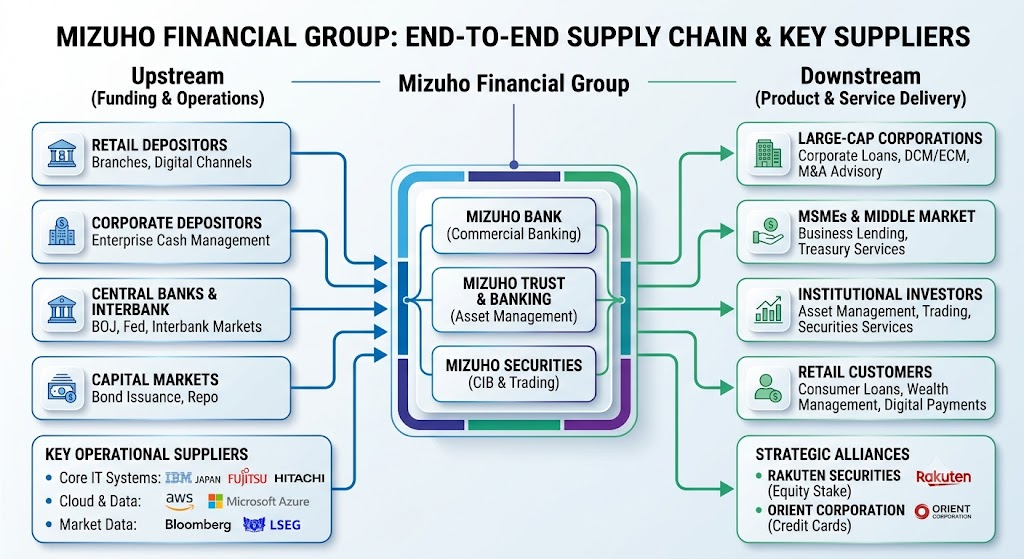
Commercial and investment banks do not operate linear manufacturing supply chains; their supply chain consists of upstream capital/IT infrastructure inputs, internal balance-sheet transformation, and downstream delivery to institutional and retail clients.
- Upstream(Funding Sources & Clearing Rail Infrastructure):
- Retail & Corporate Deposits: Over ¥150 trillion in customer deposits serve as the core raw funding material.
- Central Bank & Interbank Liquidity: Primary access to Bank of Japan(BOJ) current accounts, Federal Reserve liquidity windows(via Mizuho Americas), and global repurchase(repo) facilities.
- Clearing & Settlement Networks: Core integration into domestic Zengin System(全銀システム), BOJ-NET, and international clearing networks including SWIFT, CLS Group(continuous linked settlement for FX), and DTCC/Euroclear.
- Critical Technology & Hardware Suppliers:
- Core IT Architecture(The MINORI System):Mizuho replaced its fragmented legacy core systems with MINORI, an IT integration project costing over ¥450 billion. Key suppliers and systems integrators include:
- Cloud, Data & AI Vendors:Strategic partnerships with Microsoft Azure and Amazon Web Services(AWS) for hybrid-cloud workloads, alongside an enterprise generative AI partnership with OpenAI for internal workflow automation.
- Market Data & Execution Infrastructure: Bloomberg LP, LSEG(London Stock Exchange Group/Refinitiv), and Broadridge for securities settlement, trading connectivity, and pricing feeds.
- Downstream(Distribution Channels & End Markets):
- Wholesale & Institutional: Syndicated loans, project financing(especially global renewable energy and offshore wind), debt underwriting, and structured finance delivered to Fortune Global 500 corporations, government agencies, and sovereign wealth funds.
- Retail & Digital Distribution: Omnichannel reach via 47-prefecture branch footprint, mobile apps, and joint ventures. Key downstream alliances include a strategic equity stake in Rakuten Securities and Rakuten Card to capture Japan’s e-commerce and point-economic ecosystem.
Competitor Analysis: Technical & Financial Comparison
Mizuho primarily competes against domestic megabanks MUFG and SMBC, as well as Wall Street and European investment banks(JPMorgan Chase, Morgan Stanley, Citi) in cross-border corporate finance.
| Metric / Dimension | Mizuho Financial Group (8411.T) | Mitsubishi UFJ Financial (8306.T) | Sumitomo Mitsui Financial (8316.T) |
| Market Rank & Scale | No. 3 Megabank (Assets ~¥260T) | No. 1 Megabank (Assets ~¥400T+) | No. 2 Megabank (Assets ~¥280T+) |
| Net Profit / ROE Target | Attributable net profit >¥1.2T; ROE ~10.5%–11.4% (targeting >12% by FY28) | Net profit >¥1.6T–¥1.7T; ROE ~9.5%–10.5% | Net profit >¥1.0T–¥1.1T; ROE ~9.0%–10.0% |
| P/B Ratio (Valuation) | Approx. 0.85x–0.95x (catching up to parity) | Approx. 0.95x–1.10x | Approx. 0.90x–1.05x |
| Core IT Architecture | MINORI (Custom Multi-vendor): Highly resilient since 2022 overhaul, but historically required complex multi-vendor orchestration across Hitachi, Fujitsu, IBM, and NTT DATA. | Modular legacy modernized with deep hybrid cloud deployments and standardized core platforms. | Unified, lean core systems; aggressive in-house digital transformation (e.g., “Olive” unified consumer app). |
| Global Footprint Strategy | Focused CIB model centered on debt underwriting, syndicated loans, and Greenhill M&A advisory. | Extensive direct equity alliance with Morgan Stanley; heavy commercial banking presence in Southeast Asia. | Strategic partnership with Jefferies for US investment banking; digital retail expansion in Asia (VPBank). |
- Technical Comparison:
- System Stability & Architecture: Mizuho previously faced severe public scrutiny over core system glitches during the 2002 and 2011 merger phases and the 2021 ATM outages.However, the stabilization of its ¥450B MINORI architecture and the subsequent lifting of FSA regulatory orders have turned its infrastructure into an asset. While SMBC pioneered consumer UX with its “Olive” super-app platform and MUFG leveraged global API standardizations, Mizuho has leaned heavily into external ecosystems, embedding banking services into Rakuten’s 100M-user network and partnering across fintechs.
- Digital Assets & Stablecoins: Mizuho co-leads the “Project Pax” cross-border settlement stablecoin framework alongside MUFG and SMBC, using the Progmat platform to enable trust-backed fiat settlement across international corporate supply chains.
- Financial Performance Comparison:
- Margin Sensitivity to BOJ Rate Hikes: Mizuho holds a domestic yen loan-to-deposit ratio around 50% with short duration on its Japanese Government Bond(JGB) holdings(averaging under 1 year).As a result, every 25 bps hike by the Bank of Japan provides an outsized boost to Mizuho’s net interest margin(NIM), adding approximately 0.6 to 0.7 percentage points to its ROE.
- Capital Efficiency & Cross-Shareholdings: Historically, Mizuho carried lower Tier 1 capital ratios than MUFG. Under its latest medium-term business plan, Mizuho has systematically liquidated over ¥350 billion in legacy corporate cross-shareholdings, driving its Common Equity Tier 1(CET1) ratio to ~9.9% and expanding share buybacks and shareholder dividends to a 50%+ payout ratio.
Sources
- https://www.mizuhogroup.com/
- https://www.mizuhogroup.com/investors/financial-information/annual/cfo
- https://www.mizuhogroup.com/investors/financial-information/annual/web
- https://en.wikipedia.org/wiki/Mizuho_Financial_Group
- https://en.wikipedia.org/wiki/Mizuho_Bank
- https://the-shashi.com/en/tse/8411/
- https://hk.investing.com/equities/mizuho-financial-group,-inc.
- https://www.marketbeat.com/stocks/NYSE/MFG/sec-filings/
- https://www.jakeclaver.com/mufg-mizuho-and-smbc/
Back to Mizuho Financial Group