
Corporate History
Origins and Postwar Foundation (1673–1941)
The company traces its roots back to 1673 when Mitsui Takatoshi founded the Echigoya kimono store in Edo (now Tokyo), establishing the foundations of the Mitsui merchant house. Mitsui Real Estate Co., Ltd. was formally incorporated in 1941 through the spin-off of the real estate division of Mitsui Gomei Kaisha, the holding company of the Mitsui zaibatsu.
Postwar Reconstruction and Pioneering Developments (1950s–1970s)
Following the dissolution of the zaibatsu after World War II, the firm rapidly adapted to Japan’s economic expansion. In 1968, Mitsui Fudosan completed the Kasumigaseki Building in Tokyo, Japan’s first modern skyscraper (36 stories), which pioneered seismic structural design and revolutionized domestic high-rise architecture. During the 1970s, the company diversified into suburban residential tract development and master-planned residential communities.
Asset Diversification and Commercial Expansion (1980s–1990s)
In 1981, Mitsui Fudosan pioneered the American-style suburban retail center in Japan by opening LaLaport Tokyo-Bay in Funabashi, Chiba. It entered the hotel sector via Mitsui Garden Hotels and expanded into outlet malls in the 1990s. When the Japanese asset price bubble collapsed in the early 1990s, the company shifted away from mere speculative land ownership toward fee-based asset management, development syndication, and securitization structures.
Urban Revitalization and Global Scaling (2000s–Present)
Entering the 21st century, Mitsui Fudosan spearheaded major urban renewal projects, highlighted by the opening of Tokyo Midtown in Roppongi (2007), Tokyo Midtown Hibiya (2018), and Tokyo Midtown Yaesu (2023). It established private and public J-REITs (e.g., Nippon Building Fund, Mitsui Fudosan Logistics Park Inc.) to accelerate capital recycling. Under its long-term strategy “& INNOVATION 2030”, the firm has actively deployed capital into overseas gateway cities (New York, London, Southeast Asia) and expanded into data centers, logistics hubs, and life-science ecosystems.
Business Model and Growth Strategy
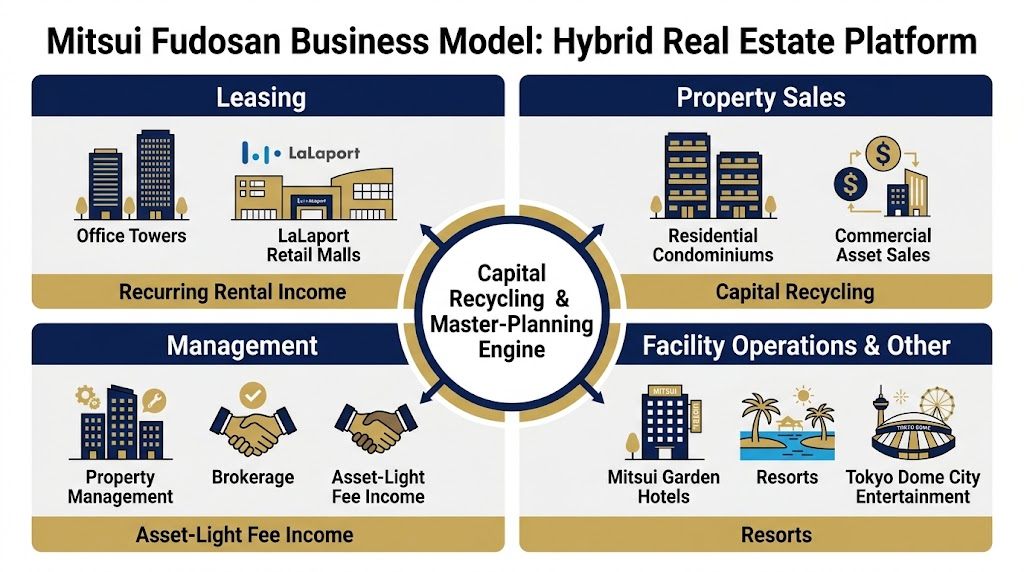
Mitsui Fudosan operates a hybrid real estate model that integrates asset-heavy property ownership with an asset-light, capital-recycling platform. Rather than depending solely on one-off development gains, the company monetizes assets across their entire lifecycle through four core segments:
- Leasing (Recurring Stable Income): The company owns and leases prime office towers, regional shopping centers (LaLaport), and urban retail destinations. In FY2025, the Leasing division generated ¥936.6 billion in operating revenue and ¥177.0 billion in business income, maintaining office vacancy rates below 2% in the Tokyo metropolitan area.
- Property Sales (Development Gains and Capital Recycling): The firm builds and sells residential condominiums (Mitsui Fudosan Residential) to individual retail buyers, while packaging stabilized commercial, logistics, and office assets for disposition to institutional investors and managed REITs. In FY2025, Property Sales achieved ¥729.3 billion in revenue and delivered the largest single share of business income at ¥193.2 billion.
- Management (Asset-Light Fee Streams): Through property management, facility operations, tenant coordination, and brokerage (Mitsui Rehouse), the company earns recurring fee revenue with low capital intensity. FY2025 operating revenue for this segment reached ¥511.5 billion with ¥80.9 billion in business income.
- Facility Operations & Other: Comprising hotel/resort operations and entertainment complexes (including Tokyo Dome City), generating ¥244.1 billion in revenue and ¥46.3 billion in business income in FY2025.
Growth Strategy (“& INNOVATION 2030”):
- Capital Velocity & Efficiency: The company focuses on expanding Return on Equity (ROE target: 10% by FY2030; 8.5% by FY2026) by trimming strategic cross-shareholdings by 50% between FY2024 and FY2026 and shifting capital into high-turnover developments.
- Industrial & Mixed-Asset Development: Diversifying beyond standard office and retail into semiconductor-related logistics, R&D/life-science parks, and hyperscale AI data centers.
- International Expansion: Scaling investments across North America, Europe, and Asia-Pacific to decouple top-line expansion from Japan’s domestic demographic plateau.
Sources for Business Model Information
- https://www.mitsuifudosan.co.jp/english/corporate/ir/finance/forecast/
- https://www.mitsuifudosan.co.jp/english/corporate/innovation2030/
- https://www.mitsuifudosan.co.jp/english/corporate/ir/presentation/pdf/&_INNOVATION_2030DE.pdf
- https://www.mitsuifudosan.co.jp/english/corporate/ir/library/integratedreport/
AI Development Strategy, Budget, and Partnerships
Under its “DX VISION 2030” framework, Mitsui Fudosan treats artificial intelligence and digital transformation as operational infrastructure, emphasizing “Real × Digital” value creation.
- Strategic Focus (“Reform Work through AI-Accompaniment”): The company applies AI to enhance front-office customer engagement and compress back-office overhead. In October 2024, Mitsui Fudosan rebuilt and deployed its proprietary enterprise generative AI platform, &Chat, directly linked to internal corporate repositories and databases. By 2025, the group deployed over 100 specialized generative AI assistants tailored to distinct business lines (e.g., automated property reporting, lease document extraction, and tenant query handling), achieving measurable administrative time savings exceeding 600,000 operational hours across verified deployments.
- Capital and Investment Scale: Under “& INNOVATION 2030”, Mitsui Fudosan established an M&A investment allocation of over ¥400 billion, alongside dedicated corporate venture capital limits for startup technology and proptech investments. Digital project criteria systematically require performance tracking, with IT/DX allocations targeting an expansion of certified internal DX business personnel to 25% of all group employees by 2030.
- Collaborations and Partnerships:
- BIPROGY Inc.: Co-developed the smart city platform “Urban OS” to integrate regional sensor, traffic, and environmental data for neighborhood operations.
- estie, Inc.: Partnered with commercial real estate data platform provider estie to integrate AI-driven rental market analysis, transaction tracking, and valuation modeling into investment decision workflows.
- Hyperscale Data Center Infrastructure: Formed development partnerships to supply physical infrastructure, high-voltage substations, and shell facilities catering to international and domestic cloud/AI compute providers.
back to Mitsui Fudosan