
Company History
Pre-War Zaibatsu Era(1876–1945)
Established in 1876 by Takashi Masuda with nominal capital and just sixteen employees, Mitsui & Co.(Mitsui Bussan) spearheaded Japan’s modernization through international commodity trading. It developed into the central trading engine of the Mitsui Zaibatsu, orchestrating global trade in rice, coal, silk, and machinery until Allied Headquarters ordered the dissolution of all zaibatsu holdings following World War II.
Post-War Reconstitution and Industrial Expansion(1947–1970s)
In 1947, former employees founded Daiichi Bussan, which merged with several spin-off trading entities in 1959 to reconstitute Mitsui & Co. During Japan’s high-growth period, the company shifted from basic import-export merchanting toward securing global resource pipelines—investing in Australian iron ore and overseas natural gas fields to fuel heavy industrialization.
Globalization and Upstream Asset Investment(1980s–2000s)
Facing compressed trading margins, Mitsui pivoted from commission-based agency intermediation to upstream asset ownership. It secured equity stakes in international energy developments, including major LNG projects in Western Australia, Qatar, and Russia, while expanding into chemical supply chains and heavy machinery distribution across North America and Southeast Asia.
Strategic Portfolio Rebalancing and Sustainability(2010s–Present)
Buffeted by the 2015 commodity downturn, Mitsui restructured its asset allocation under long-term corporate roadmaps. The company expanded non-resource pillars, notably healthcare, green ammonia, renewable energy infrastructure, and digital engineering, while maintaining capital returns supported by institutional backing, including Berkshire Hathaway’s equity investments.
Business Model and Growth Strategy
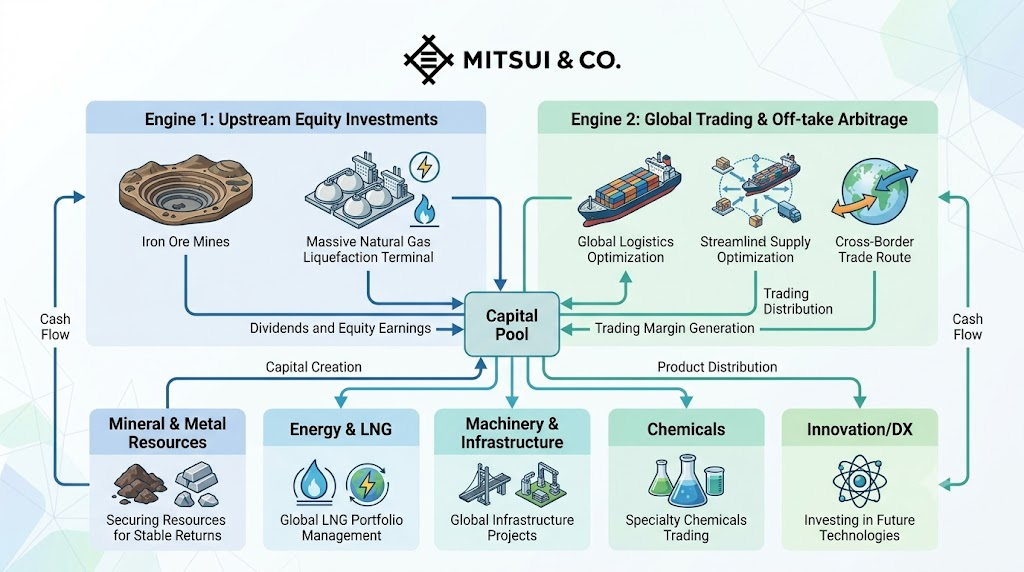
Mitsui & Co. generates revenue and cash flow primarily through a dual-engine architecture: principal investment income(dividends, equity-method earnings, and asset divestments) combined with gross trading profits from global commodity off-take agreements. The company commits capital directly into balance-sheet equity of joint ventures, resource reserves, and operational infrastructure, subsequently capturing dividends and securing exclusive long-term marketing and distribution rights.
Profit generation remains heavily anchored in two core segments:
- Mineral & Metal Resources: Contributes hundreds of billions of yen in net profit annually, driven by equity interests in low-cost, open-pit iron ore joint ventures in Australia(such as Robe River and Mt. Newman with BHP and Rio Tinto) alongside metallurgical coal and copper assets.
- Energy: Leverages equity participation in global upstream LNG liquefaction plants and exploration permits(e.g., Cameron LNG in the US, Sakhalin-2, and Mozambique LNG). Earnings flow from cash distributions and trading arbitrage across global arbitrage windows.
- Non-Resource Infrastructure and Services: Spans Machinery & Infrastructure, Chemicals, and Lifestyle sectors. These units produce recurrent revenue through commercial rolling stock leasing, ship chartering, power generation contracts(IPPs), chemical distribution, and food ingredients.
Under its Medium-Term Management Plan, Mitsui targets an annual baseline profit of over 900 billion yen. Its growth strategy centers on capital recycling—divesting mature or non-core concessions to redeploy capital into high-growth, decarbonization, and infrastructure assets(including clean ammonia, industrial gases, and specialized logistics), ensuring high return on invested capital(ROIC) while limiting non-hedged commodity risk.
Business Model Information Sources
- https://www.mitsui.com/jp/en/ir/library/online2025/pdf/en_ar2025_all_web.pdf
- https://www.mitsui.com/jp/en/ir/data/segment_information/index.html
- https://www.mitsui.com/jp/en/company/business/index.html
AI Strategy, Budget, and Partnerships
Mitsui treats artificial intelligence not merely as an internal workflow optimizer, but as an operational business vertical and asset enhancement lever. Its digital transformation roadmap combines centralized capital expenditure through its IT strategy budget with specialized tech joint ventures.
- High-Performance Infrastructure(Tokyo-1 Initiative): In collaboration with NVIDIA and subsidiary XeBRS, Mitsui spearheaded “Tokyo-1,” Japan’s first high-performance AI supercomputer designed specifically for the biopharmaceutical sector. Powered by NVIDIA DGX H100 systems, Tokyo-1 serves major pharmaceutical firms(including Astellas, Ono Pharmaceutical, and Daiichi Sankyo) by deploying molecular dynamics simulations and generative models to compress drug discovery timelines from years to months.
- Industrial AI & Supply Chain Automation: Mitsui has partnered with enterprise AI developers and digital native affiliates(such as Mitsui Knowledge Industry) to integrate predictive modeling across maritime fleet routing, liquefied gas off-take forecasting, and smart plant maintenance.
- Corporate Venture Deployment: Through its corporate venture capital arms and corporate innovation budgets—which allocate tens of billions of yen across broader DX and deep-tech initiatives—Mitsui invests directly into AI data platforms, industrial computer vision firms, and cybersecurity providers to enhance operating metrics across its global portfolio companies.
back to Mitsui