
Market Position and Market Share
Mitsubishi Estate Co., Ltd.(三菱地所株式会社, TSE:8802) ranks as Japan’s second-largest comprehensive real estate developer by revenue and market capitalization, standing alongside its historical rival Mitsui Fudosan.
- Overall Industry Standing:In the Japanese comprehensive property sector, Mitsubishi Estate ranks second in revenue, trailing Mitsui Fudosan(approximately ¥2.75 trillion) while generating consolidated operating revenue of ¥1,746.1 billion(¥1.75 trillion) for FY2025(ended March 31, 2026), with operating profit reaching ¥329.7 billion. Its market capitalization stands at approximately ¥3.8 trillion to ¥4.1 trillion($26.5 billion to $27.5 billion), competing closely with Mitsui Fudosan for the top equity valuation among pure-play property developers.
- Core Geographic Hegemony(Marunouchi/Otemachi): Mitsubishi Estate commands a near-monopoly footprint in Tokyo’s central business district(CBD). Within the 120-hectare Marunouchi, Otemachi, and Yurakucho district, the company owns or manages approximately 30 major office buildings, representing an estimated market share exceeding 30% of total prime office floor space in this core financial gateway.
- Unrealized Property Gains:Mitsubishi Estate holds the largest portfolio of unrealized gains on rental real estate among all Japanese listed corporations, estimated at over ¥5.5 trillion. This reflects historic low-cost land acquisition dating back to the Meiji era(1890).
- Segment Positions: Beyond prime CBD offices, Mitsubishi Estate ranks among Japan’s top three residential condominium developers through its “The Parkhouse” brand, holds a leading market position in premium outlet malls via its joint venture Mitsubishi Estate-Simon Co., Ltd., and manages global logistics and overseas real estate assets via platforms including Rockefeller Group(US) and Europa Capital(Europe).
Supply Chain Analysis and Key Suppliers
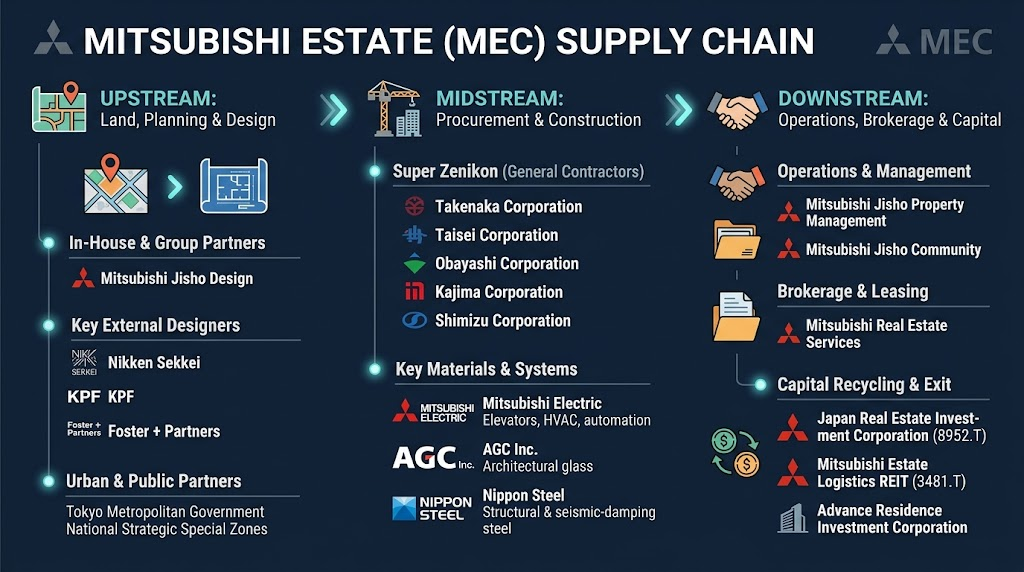
Real estate development operates through an extended project lifecycle spanning land acquisition, urban zoning, master design, procurement, general contracting, and facility management.
- Upstream:
- Land Sourcing & Planning: Sourcing involves proprietary urban redevelopment agreements with metropolitan governments, municipal land sales, and private land assemblies. Long-term zoning relies on permissions under Japan’s National Strategic Special Zones.
- Architectural Design & Engineering: Handled predominantly in-house through Mitsubishi Jisho Design Inc.(one of Asia’s largest architectural design practices), alongside external tier-1 architectural firms such as Nikken Sekkei and international designers(e.g., KPF, Foster + Partners) for landmark towers like the Torch Tower project.
- Midstream(General Contractors & Material Sourcing):
- The “Super Zenikon” Contractors: Mitsubishi Estate does not maintain direct construction operations; it commissions Japan’s five major general contractors(Super Zenikon). The primary general contractors managing Mitsubishi Estate builds include Takenaka Corporation(which also holds an equity stake of approximately 1.50% in Mitsubishi Estate), Taisei Corporation, Obayashi Corporation, Kajima Corporation, and Shimizu Corporation.
- Building Materials & Systems: Structural steel, glass, and elevators are procured through group affiliates and established industry leaders. Key system suppliers include Mitsubishi Electric Corporation(elevators, HVAC systems, building management electronics), AGC Inc.(architectural glass), and Nippon Steel Corporation(structural heavy plates and seismic-damping steel).
- Downstream(Brokerage, Facility Operations, and Capital Recycling):
- Brokerage & Leasing: Handled through Mitsubishi Real Estate Services Co., Ltd. and corporate agency networks.
- Property & Facility Management: Executed via Mitsubishi Jisho Property Management Co., Ltd. for commercial offices and Mitsubishi Jisho Community Co., Ltd. for residential complexes.
- Exit Channels & Capital Recycling: Mitsubishi Estate transfers completed and stabilized assets into sponsored J-REITs and private funds, including Japan Real Estate Investment Corporation(8952.T), Mitsubishi Estate Logistics REIT(3481.T), and Advance Residence Investment Corporation.
Competitor Analysis
Mitsubishi Estate primarily competes against three major comprehensive developers in Japan: Mitsui Fudosan(8801.T), Sumitomo Realty & Development(8830.T), and Tokyu Fudosan Holdings(3289.T).
- Financial Comparison:
- Revenue Scale:Mitsui Fudosan leads the Japanese real estate market with annual revenues around ¥2.6 trillion to ¥2.7 trillion, driven by extensive retail mall operations(LaLaport, Mitsui Outlet Parks) and residential turnover.Mitsubishi Estate ranks second with ¥1.75 trillion in revenue.
- Profitability & Margins:Mitsubishi Estate maintains higher operating margins in its leasing division due to the concentrated Marunouchi asset base, which delivers low vacancy rates and premium rents per tsubo. For FY2025, Mitsubishi Estate recorded an overall operating margin of 18.9%(operating profit ¥329.7 billion on ¥1,746.1 billion revenue), comparable to Mitsui Fudosan’s 12% to 15% range. Sumitomo Realty typically posts the highest operating margin in the sector(often exceeding 20%) by aggressively focusing on high-density Tokyo offices with lean corporate overhead.
- Leverage & Asset Quality: Mitsubishi Estate holds total assets of ¥8.57 trillion and net assets of ¥2.88 trillion, maintaining an equity ratio of 31.4% and net debt-to-equity ratio around 1.2x to 1.3x. While Mitsui Fudosan deploys a faster capital rotation model to optimize ROE, Mitsubishi Estate holds substantial unrealized asset value in Marunouchi land that provides strong collateral coverage and defensive downside protection against real estate downturns.
- Operational & Technical Comparison:
- Urban Redevelopment & Engineering Capability: Mitsubishi Estate excels in complex, multi-decade underground and subterranean connectivity, district-level smart grids, and seismic isolation systems. Its signature Tokyo Torch redevelopment(incorporating the 385-meter Torch Tower) integrates advanced seismic bracing, district cooling systems, and co-generation backup power.
- Portfolio Diversification:Mitsui Fudosan displays greater diversification across destination retail, mixed-use sports and entertainment developments(e.g., Tokyo Dome acquisition), and logistics. In contrast, Mitsubishi Estate has historically been office-centric, though it has broadened its asset base into logistics, data centers, and overseas platforms(e.g., Rockefeller Group, Europa Capital) to counter remote-work office risks.
- Execution Speed: Sumitomo Realty relies on opportunistic site acquisition and standardization, whereas Mitsubishi Estate emphasizes consortium-based consensus building with metropolitan governments and local property owners, resulting in longer gestation cycles but higher barriers to entry.
Sources
- https://www.mec.co.jp/en/ir/
- https://www.mec.co.jp/en/company/about/
- https://www.mec.co.jp/ir/library/2026/4Q/summary_2025_4_en.pdf
- https://www.mec.co.jp/en/ir/financial/
- https://companiesmarketcap.com/japan/largest-companies-in-japan-by-market-cap/
- https://companiesmarketcap.com/real-estate/largest-real-estate-companies-by-revenue/
back to Mitsubishi Estate