
Corporate History
Origins and Marunouchi Acquisition (1890–1936)
In 1890, Yanosuke Iwasaki, leader of the Mitsubishi zaibatsu, purchased the desolate Marunouchi military drill ground from the Meiji government. The firm constructed Japan’s first Western-style red-brick office district, establishing the foundation of Tokyo’s financial center.
Corporate Spin-Off and Postwar Reconstruction (1937–1969)
Mitsubishi Estate was officially established in 1937 by spinning off the real estate holdings of Mitsubishi Goshi Kaisha. Following zaibatsu dissolution after World War II, the company listed on the Tokyo and Osaka stock exchanges in 1953 and led the postwar rebuilding and modernization of the Marunouchi district.
Urban Expansion and Diversification (1970–1999)
The group diversified into residential housing, outlet malls, and regional landmarks, including the development of Yokohama Landmark Tower. During the late 1980s bubble era, it completed high-profile acquisitions overseas, notably buying a majority interest in New York’s Rockefeller Center, which later required major financial restructuring during the 1990s downturn.
Comprehensive Re-urbanization and Global Scaling (2000–Present)
In 2002, the company launched its “Marunouchi Transformation,” replacing aging structures with modern high-rises like the Marunouchi and Shin-Marunouchi Buildings. Operations expanded into capital-recycling development across Asia, the US, and Europe, culminating in flagship initiatives like Tokyo Torch (Torch Tower) and the Long-Term Management Plan 2030.
Business Model and Growth Strategy
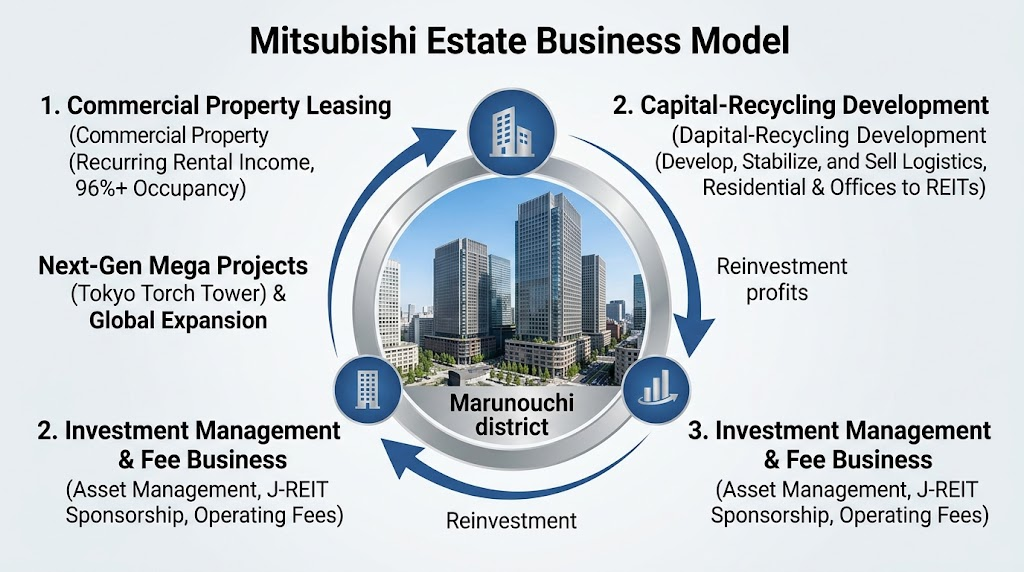
Mitsubishi Estate operates an integrated asset-monetization flywheel centered on two core profit drivers: stable long-term leasing and a dynamic capital-recycling model.
- Commercial Property Leasing Engine: The group’s domestic commercial assets generate high-margin recurring cash flows. Prime properties in Marunouchi, Otemachi, and Yurakucho command industry-leading occupancy rates above 96% and premium rents.
- Capital-Recycling Development: Rather than holding all assets indefinitely, the firm develops offices, logistics warehouses, and residential complexes, leases them to operational stability, and sells completed properties to private funds, REITs, or institutional investors. Proceeds are reinvested into higher-yielding developments.
- Investment Management and Fee Platforms: Through affiliates like Japan Real Estate Investment Corporation(JRE) and international fund management platforms, Mitsubishi Estate earns recurring asset management, property management, and transaction-related fees.
Under its Long-Term Management Plan 2030, the company targets consolidated operating profit of 400 billion yen by FY2030. Strategic capital allocation channels operational cash flow toward capital-recycling assets, overseas investments in North America, Europe, and Southeast Asia, and next-generation mixed-use hubs like the 385-meter Torch Tower.
Sources for Business Model
- https://www.mec.co.jp/en/ir/plan2030/
- https://www.mec.co.jp/assets/img/annual/integratedreport2024e_p.pdf
- https://www.mec.co.jp/en/ir/
AI Strategy, Budget, and Partnerships
Mitsubishi Estate integrates artificial intelligence across its operations through its Digital Transformation(DX) Promotion Department, addressing domestic labor shortages while creating smart city infrastructure.
- Digital Transformation and Venture Budgets: The group allocates substantial strategic capital to digital transformation and corporate venture capital, deploying 10 billion yen venture allocations alongside corporate DX programs to integrate external technologies into real estate operations.
- Facility Operations and Security AI: Mitsubishi Estate partnered with Australian visual AI company icetana and Japanese technology distributor Macnica to deploy anomaly-detection computer vision AI across high-traffic buildings, including Marunouchi and Shin-Marunouchi Buildings. The self-learning model monitors real-time CCTV streams to identify falls, escalator risks, and crowd congestion, reducing manual monitoring strain on security personnel.
- Smart City and Energy Optimization: Within the Daimaruyu(Otemachi, Marunouchi, Yurakucho) district, the firm collaborates with tech providers such as KDDI and SoftBank. These systems analyze localized mobile foot-traffic data and use machine learning algorithms to balance heating, ventilation, and air conditioning(HVAC) energy loads dynamically, contributing directly to group decarbonization targets.
- PropTech and Tenant Digitization: AI-powered property matching platforms, automated tenant service ticketing, and predictive maintenance tools are embedded into building operations to reduce operating expenditure and streamline facilities management.
back to Mitsubishi Estate