
History
- Founding and Early Decades (1921): Mitsubishi Electric was established on January 15, 1921, when it spun off from the shipbuilding department of Mitsubishi Shipbuilding Company (now Mitsubishi Heavy Industries) in Kobe, Japan, starting its independent journey as an electrical machinery producer.
- Pre-War and Wartime Expansion (1930s-1940s): The company rapidly scaled production to support Japan’s industrial growth, manufacturing heavy electrical equipment, power generators, and aviation components during World War II.
- Post-War Rebuilding and Diversification (1950s-1980s): Following post-war corporate restructuring, Mitsubishi Electric re-emerged to pioneer Japan’s consumer and industrial electronics booms, launching iconic products like air conditioners, elevators, semiconductors, and factory automation systems while expanding globally.
- Modern Restructuring and Quality Turnaround (1990s-Present): Facing fierce international competition from South Asian and Western tech giants, the company shifted focus away from low-margin consumer goods toward high-value B2B systems, industrial automation, and public infrastructure, while undergoing stringent governance overhauls following quality control lapses.
Business Model and Growth Strategy
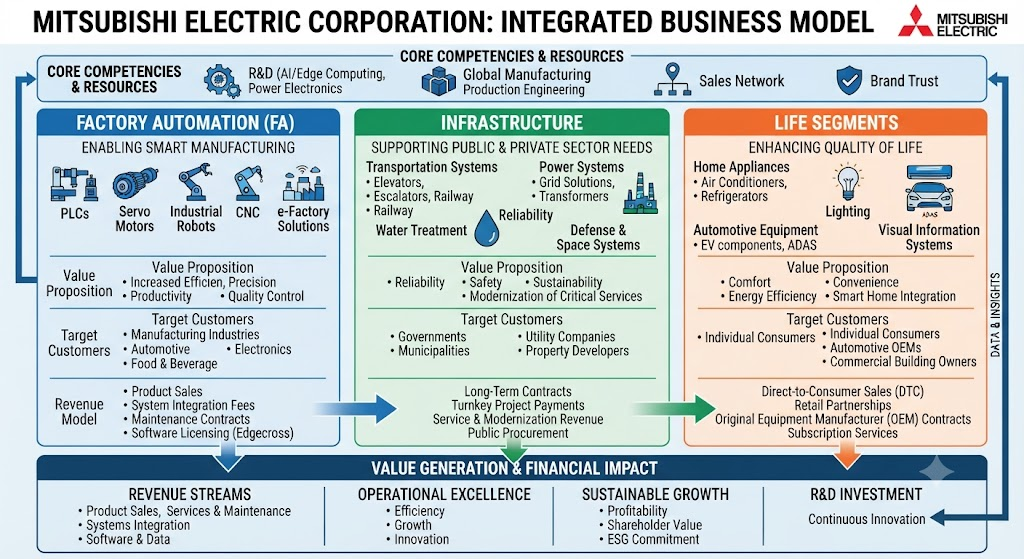
Mitsubishi Electric generates revenue through a diversified business-to-business (B2B) and business-to-consumer (B2C) model structured across core segments: Infrastructure, Industry and Mobility, Life, and Business Platform. The company makes money primarily by designing, manufacturing, selling, and servicing high-value engineered systems—such as factory automation (FA) controllers, elevators, heavy electrical power grids, rolling stock equipment, automotive electrical components, and commercial/residential air conditioning systems. Rather than relying solely on transactional hardware sales, Mitsubishi Electric secures recurring, high-margin revenue streams by combining advanced equipment delivery with long-term maintenance, software integration, lifecycle services, and system engineering contracts.
The company’s overarching growth strategy focuses on shifting capital away from commoditized hardware toward high-growth, high-margin systems essential for global decarbonization and industrial digitalization. By leveraging its core strengths in power electronics and factory automation, Mitsubishi Electric optimizes operational profitability through pricing discipline, supply chain resilience, and strategic global partnerships. For instance, in its fiscal year 2026 financial results, the company achieved record-breaking performance with consolidated revenue reaching approximately 5.89 trillion yen (an increase of 6.7% year-on-year) and operating profit rising sharply to 538.4 billion yen, driven heavily by surging global demand in industrial automation and public infrastructure projects.
Sources
- https://www.mitsubishielectric.com/en/pr/2025/pdf/1031-a1.pdf
- https://uk.investing.com/news/stock-market-news/earnings-call-transcript-mitsubishi-electric-q4-2026-beats-forecasts-ratings-93CH-4694649
- https://www.businesswire.com/news/home/20260427060797/en/Mitsubishi-Electric-Announces-Consolidated-Financial-Results-for-Fiscal-2026
Artificial Intelligence Strategy and Initiatives
Mitsubishi Electric embeds artificial intelligence deeply into its industrial automation, infrastructure management, and product engineering portfolios through its proprietary AI brand, “Maisart” (Mitsubishi Electric’s AI creates the State-of-the- ART). Rather than pursuing generalized consumer AI, the company focuses heavily on Edge AI—integrating compact, highly efficient AI processing directly into factory controllers, industrial robots, elevators, and power grids to enable real-time decision-making without relying entirely on cloud connectivity.
To accelerate its AI and digital transformation roadmaps, Mitsubishi Electric allocates substantial research and development budgets toward digital twins, automated manufacturing systems, and advanced quantum computing research. Practical examples include AI-driven predictive maintenance software embedded in its factory automation (FA) systems, which analyzes vibration and operational patterns in programmable logic controllers (PLCs) to prevent unexpected factory downtime. Furthermore, the company collaborates extensively with leading academic institutions, specialized tech startups, and global strategic partners—such as its investments in quantum hardware startups like OptQC and joint industrial platforms—to maintain technological supremacy in high-precision manufacturing and smart infrastructure markets.
back to Mitsubishi Electric