
Market Position and Market Share
Mitsubishi Corporation(TYO: 8058) ranks as the largest general trading conglomerate(sōgō shōsha) in Japan by consolidated revenues and total assets, maintaining the leading position alongside Mitsui & Co. and ITOCHU Corporation.
- Sōgō Shōsha Industry Ranking: Mitsubishi Corp consistently holds the #1 position among Japan’s major trading houses by annual consolidated revenue(exceeding ¥18–21 trillion under IFRS) and total asset base(exceeding ¥22 trillion). Among the “Big 5” trading houses(Mitsubishi, Mitsui, ITOCHU, Sumitomo, Marubeni), Mitsubishi accounts for approximately 25%–28% of the aggregate total assets and roughly 23%–26% of consolidated net earnings.
- Global Liquefied Natural Gas(LNG): Mitsubishi is an undisputed global titan in LNG equity and marketing. It controls equity offtake across major world projects(including Australia Northwest Shelf, Sakhalin-2, Donggi Senoro, and LNG Canada), handling an annual volume representing roughly 8%–10% of total Japanese LNG import allocations and ~2%–3% of global LNG trade.
- Metallurgical Coal: Through its joint venture with BHP(BHP Mitsubishi Alliance / BMA) in Queensland, Australia, Mitsubishi co-controls the world’s largest seaborne metallurgical coal supplier, commanding an estimated 25%–30% share of global high-quality coking coal exports used in blast furnace steelmaking.
- Domestic Retail & Consumer Distribution: Downstream, Mitsubishi exercises joint control of Lawson, Inc.(partnering 50/50 with KDDI), positioning it as the #3 convenience store operator in Japan with a ~20% domestic store network share(operating over 14,000 stores nationwide).
Supply Chain Architecture and Key Suppliers
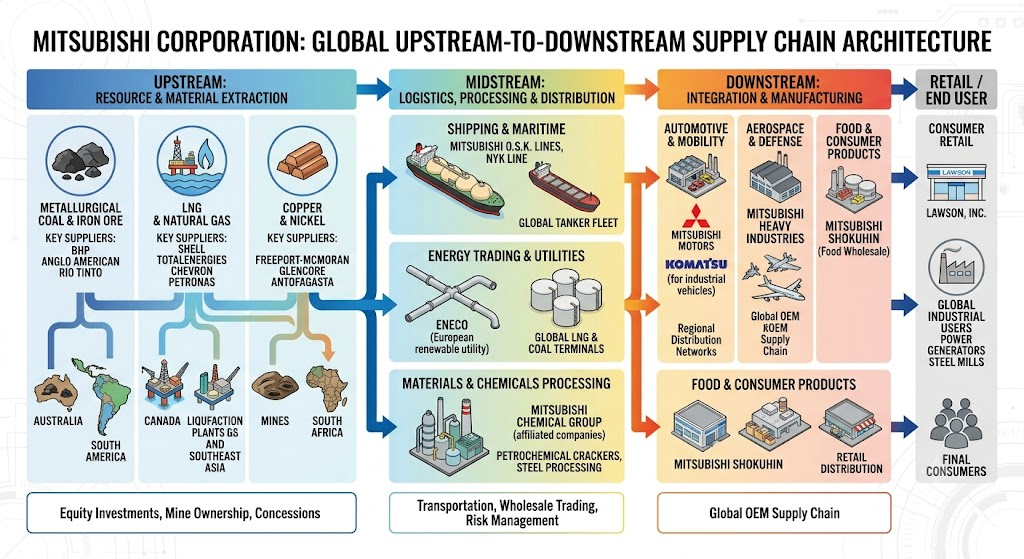
Mitsubishi Corp operates as an integrated principal investor, operator, and supply chain coordinator spanning upstream concessions, midstream distribution/infrastructure, and downstream consumer retail.
- Upstream Concessions & Extraction:
- Energy & Minerals: Upstream partners and assets include BHP Group in metallurgical coal mining(BMA assets in Australia), Shell, TotalEnergies, and Chevron in LNG upstream extraction and liquefaction facilities(e.g., LNG Canada, Sakhalin Energy, Brunei LNG), and Anglo American in copper mining(such as the Quellaveco copper project in Peru where Mitsubishi holds a 40% equity stake).
- Agri-Food & Aquaculture: Mitsubishi owns Cermaq, one of the world’s top three salmon farming operations(operating in Norway, Chile, and Canada), and sources grain through ag-commodity partnerships across the Americas and Australia.
- Midstream Infrastructure, Processing & Logistics:
- Mitsubishi coordinates specialized logistics via maritime shipping fleets, global storage terminals, and LNG carrier joint ventures(collaborating with shipping operators like Nippon Yusen Kaisha / NYK Line and Mitsui O.S.K. Lines).
- In the industrial and automotive segment, it manages distribution and assembly joint ventures for Mitsubishi Motors across Southeast Asia(particularly Thailand and Indonesia) and distributes machinery produced by Mitsubishi Heavy Industries.
- Downstream Wholesale, Power & Retail:
- Food Distribution & C-Store: Mitsubishi controls Mitsubishi Shokuhin(Japan’s leading food wholesale distributor) and Lawson, creating a closed-loop farm-to-shelf supply chain for consumer packaged goods and fresh food.
- Renewable & Traditional Power: Mitsubishi owns Eneco(a major European integrated sustainable energy provider operating offshore wind farms and retail energy in the Netherlands, Belgium, and Germany). Key equipment suppliers include industrial OEMs such as Vestas, Siemens Energy, and Mitsubishi Electric.
Competitor Analysis: Technical and Financial Comparison
Mitsubishi’s primary direct peers are Japan’s top sōgō shōsha: Mitsui & Co.(8031) and ITOCHU Corporation(8001).
- Portfolio Structure & Technical Specialization:
- Mitsubishi Corp: Historically weighted heavily toward natural resources(copper, metallurgical coal, LNG). However, its strategic shift emphasizes Energy Transformation(EX) and Digital Transformation(DX), investing heavily in European utility decarbonization(Eneco), hydrogen/ammonia supply chains, and industrial electrification.
- Mitsui & Co.: Strongest upstream direct rival, particularly in iron ore(deep partnerships with Vale and BHP in Western Australia) and natural gas. Mitsui maintains a leaner non-resource footprint and historically leans heavier on commodity extraction yield.
- ITOCHU Corporation: Pursues a non-resource-dominant strategy. ITOCHU focuses heavily on consumer goods, textile, ICT, machinery, and food retail(controlling FamilyMart). This gives ITOCHU lower commodity price volatility but lower upside during super-cycle inflationary spikes.
- Financial Profile & Operational Efficiency:
- Revenue & Asset Scale: Mitsubishi maintains the largest total asset footprint among the three(around ¥22 trillion) and highest gross revenue. Mitsui holds the second-highest resource earnings base, while ITOCHU maintains the leanest, most capital-efficient balance sheet.
- Return on Equity(ROE): Due to ITOCHU’s asset-light, consumer-centric posture, ITOCHU has frequently posted higher consolidated ROE(often 14%–16%) compared to Mitsubishi’s 11%–14%, as resource-heavy mining concessions require massive upfront capital expenditures and balance sheet gearing.
- Profit Volatility & Cash Flow: Mitsubishi generates substantial operating cash flow during raw material and LNG price spikes, which it allocates toward record share repurchases and progressive dividends. Mitsui mirrors this cyclical cash generation, whereas ITOCHU demonstrates the smoothest earnings baseline across commodity cycles.
Information Sources
- https://www.mitsubishicorp.com/jp/en/ir/library/afr/
- https://www.mitsubishicorp.com/jp/en/about/
- https://en.wikipedia.org/wiki/Sogo_shosha
- https://www.mitsubishicorp.com/jp/en/csr/
back to Mitsubishi Corporation