
The development history of Midea Group can be divided into the following four main stages:
Founding and Early Years (1968–1980)
Mr. He Xiangjian led 23 residents in Beijiao, Shunde, Guangdong, to begin manufacturing plastic bottle caps, before transitioning to metal products and electric fan components. In 1980, Midea officially entered the home appliance industry by producing its first metal electric fan, marking the company’s formal entry into consumer appliance manufacturing.
Diversification and Expansion (1981–2000)
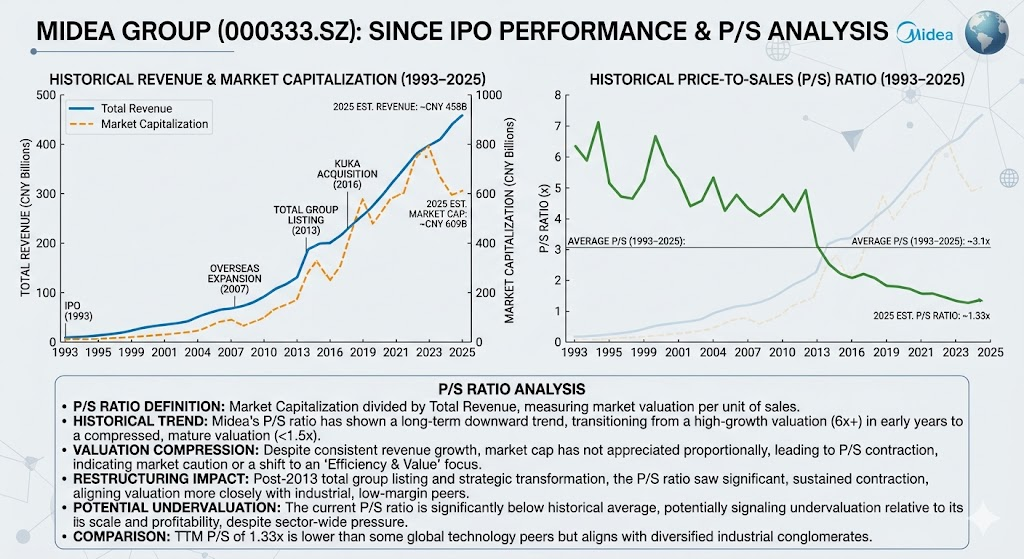
Midea began a large-scale expansion of its product lines, entering markets for air conditioners, rice cookers, and electric fans. Through acquisitions and independent R&D, the company established a comprehensive home appliance supply chain. In 1993, Midea was listed on the Shenzhen Stock Exchange, becoming the first township-owned enterprise in China to undergo restructuring and go public, leading to a rapid increase in market share.
Transformation, Upgrading, and Globalization (2001–2015)
Facing intensifying market competition, Midea initiated large-scale institutional reforms and organizational restructuring. Simultaneously, the company launched a globalization strategy to actively expand into overseas markets and achieved a total group listing in 2012. During this period, Midea increased investment in core technologies to enhance product value and solidified its position as a leader in the home appliance industry.
Technological Transformation and Ecological Layout (2016–Present)
Midea has fully transformed into a technology-driven company, establishing five main business pillars: Smart Home, Industrial Technology, Building Technology, Robotics & Automation, and Digital Innovation. By acquiring global leaders like KUKA, Midea successfully entered the high-end industrial robotics and smart manufacturing sectors, evolving from a single-product appliance manufacturer into a global technology group.
Midea Group (000333.SZ) faces intense competition across various sectors due to its diversified business strategy. Its competitive landscape can be summarized across three dimensions:
1. Home Appliance and Smart Home Market (ToC Business)
As its core traditional business, Midea adopts a dual-track strategy of “premiumization” and “ecosystem integration.”
- Key Competitors:
- Haier Smart Home: Midea’s primary rival, possessing deep expertise in premium branding (e.g., Casarte) and IoT ecosystem integration.
- Gree Electric: Maintains a strong moat in the air conditioning sector, serving as Midea’s main challenger in HVAC.
- Xiaomi: Leverages its “Human x Car x Home” full-ecosystem approach and supply chain strengths to challenge Midea in entry-level air conditioners and small home appliances through online channels.
- Global Giants (Samsung, LG, Whirlpool, Electrolux): Midea competes directly with these established global market leaders in overseas markets and high-end R&D.
2. Industrial Technology and Building Technology (ToB Business)
Midea views these as its “second growth engine,” strengthening competitiveness through technology transfer and strategic acquisitions.
- Key Competitors:
- HVAC Sector: Global enterprises with deep technical foundations such as Daikin, Carrier, and Johnson Controls.
- Robotics and Automation: Although KUKA is owned by Midea, it still faces fierce competition in the global market from traditional industrial robot giants like FANUC, Yaskawa, and ABB.
- Industrial Technology: In core components (e.g., motors, chips, thermal management systems), Midea continuously enhances its proprietary R&D to compete with specialized global component manufacturers.
3. Integrated Competitive Advantages and Challenges
- Competitive Advantages:
- Vertical Integration: Possesses the ability to control the entire industrial chain from core components to finished product manufacturing, ensuring superior cost management.
- Digitalization and R&D: Maintains a massive patent portfolio (at a global leading level) and consistently optimizes production and supply chain efficiency through “Digital Innovation.”
- Agile Transformation: In the face of new entrants like Xiaomi, Midea can swiftly leverage sub-brands (such as Hualing) for product restructuring and price defense.
- Potential Risks:
- Diversification Management: The vast span of business segments—from home appliances to robotics—places high demands on the group’s organizational integration and cross-business synergy.
- Global Compliance and Competition: During international expansion, the company must navigate geopolitical complexities, regulatory compliance, and the challenges of localized operations.
Midea’s current strategic focus is “Core Concentration,” building a moat through the three dimensions of efficiency, product innovation, and globalization. This ensures the maintenance of market share and profitability in its ToC business while accelerating its ToB transformation to overcome the cyclical fluctuations of the traditional home appliance industry.
Source:
- https://www.emic-innovation.com/en/nd.jsp?id=130
- https://www.electroluxgroup.com/en/electrolux-group-and-midea-group-form-a-highly-complementary-long-term-strategic-partnership-in-north-america-to-accelerate-profitable-growth-and-strengthen-innovation-46606/
- https://www.moomoo.com/hant/news/post/58514623/xiaomi-captures-10-of-air-conditioner-market-share-goldman-sachs
Back to Midea page