
Company History
Founding and Early Textile Expansion(1858–1948) Marubeni traces its origins to May 1858, when Chubei Itoh began traveling sales of linen cloth(Omi shonin tradition). In 1872, Itoh established a dry goods store in Osaka. Following World War II and the breakup of wartime commercial holding structures, Marubeni Co., Ltd. was formally established in December 1949 as an independent trading entity centered on textile manufacturing and wholesale distribution.
Transition to General Trading House(1950s–1980s) Throughout Japan’s post-war industrial expansion, Marubeni moved aggressively beyond textiles into heavy industry, metals, machinery, and bulk commodities. In 1955, it merged with Takashimaya-Iida to broaden overseas trade networks, subsequently adopting the name Marubeni-Iida Co., Ltd. before officially changing to Marubeni Corporation in 1972. During the 1960s and 1970s, it aligned with the Fuyo Group(centered around Fuji Bank) and rapidly expanded overseas trading offices across North America, Europe, and Asia.
The Post-Bubble Restructuring and Asian Crisis(1990s–early 2000s) The collapse of the Japanese asset price bubble, combined with the 1997 Asian Financial Crisis, inflicted substantial bad debt and non-performing asset burdens on Marubeni’s balance sheet. Under “Plan 21” and successive restructuring frameworks in the late 1990s and early 2000s, the company disposed of non-core assets, reduced interest-bearing debt, and refocused its balance sheet toward strategic core divisions.
Global Portfolio Expansion and Strategic Platform Consolidation(2010s–Present) In the 2010s, Marubeni accelerated major overseas acquisitions, including U.S. agricultural retail giant Helena Chemical Company, U.S. auto financing firm Nowlake Technology, and grain trader Gavilon(acquired in 2013, with volatile grain merchandising assets restructured and sold in 2022 to optimize capital efficiency). Under its medium-term management plans(GC2021, GC2024, and the current GC2027 running through FY2027/2028), Marubeni transformed into a value-accretive operating holding model focused on Strategic Platform Businesses across non-resource sectors while strengthening upstream copper and metallurgical coal equity cash flows.
BigGo Finance
Business Model and Growth Strategy
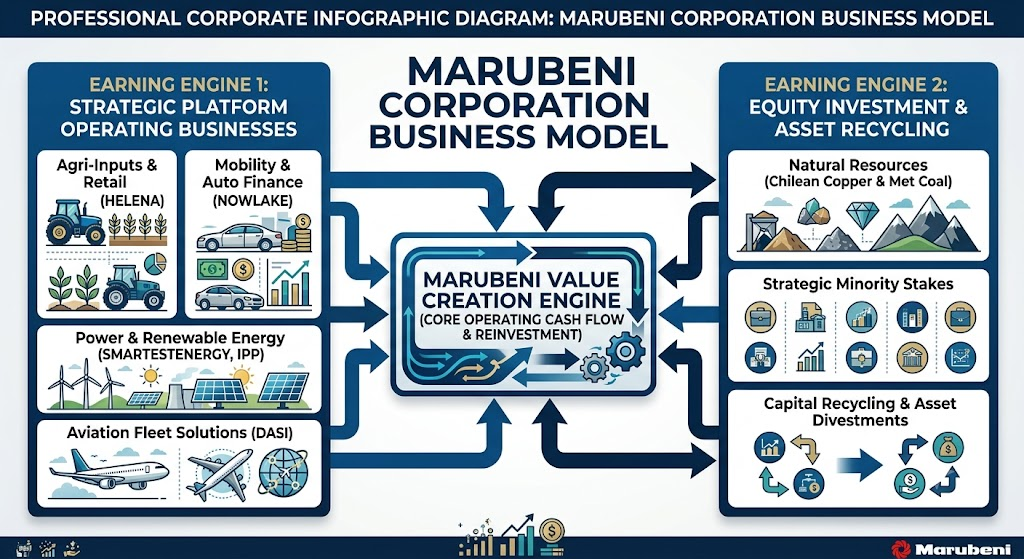
Marubeni does not function as a passive brokerage or simple intermediary; its business model generates revenue and profits through two interdependent engines: Operating Platform Businesses(principal trading, fee/interest income, and direct operational margin) and Equity Investments(equity-method earnings, dividends, and asset capital gains).
Public Technologies (PUBT)
1. Strategic Platform Operating Cash Flows(Non-Resource Engine) Marubeni owns and operates cash-generative downstream enterprises that produce recurring revenue outside commodity extraction cycles:
- Agri-Inputs and Retail Distribution: Helena Agri-Enterprises(United States) distributes crop protection products, seed treatments, and precision farming diagnostics, capturing direct retail sales and technical consulting fees rather than commodity margin spreads.
- Auto Financing and Mobility Platforms: Through Nowlake Technology in the United States, Marubeni captures high-yield auto financing, dealer management software subscription fees, and risk-adjusted consumer lending yields, powered by automated credit underwriting handling over 10 million applications annually. Marubeni Corporation
- Aviation and Fleet Asset Operations: Wholly owned subsidiaries like DASI(aircraft parts distribution) and commercial fleet leasing platforms earn recurring asset-leasing rental yields, secondary-market inventory monetization, and aftermarket service fees.
- Independent Power Producer(IPP) and Energy Trading: Marubeni manages global net generation capacity, generating long-term power purchase agreement(PPA) electricity tariffs, grid infrastructure development fees, and power wholesale trading margins through platforms like SmartestEnergy in the UK and Europe. Marubeni Corporation
2. Equity Stakes, Upstream Resources, and Divestment Recycling
- Resource Margin Capture: Marubeni holds strategic non-operating and joint-venture equity interests in tier-one assets, particularly Chilean copper mines(e.g., Centinela, Antucoya) and Australian metallurgical coal operations. In FY2025, non-resource adjusted net profit reached ¥328.0 billion, while resource earnings delivered ¥147.0 billion. Public Technologies (PUBT)
- Disciplined Capital Recycling: The group actively divests low-return or volatile assets to fund high-ROIC opportunities. For example, in FY2025, consolidated net profit reached ¥543.9 billion(with ¥480.0 billion adjusted net profit excluding one-time factors), and asset sales contributed significant capital recycling gains. Public Technologies (PUBT)+ 1
3. Growth Strategy(GC2027) Under its medium-term plan “GC2027″(covering the three fiscal years ending March 2028), Marubeni targets:
- Financial Scale: Aiming for consolidated net profit exceeding ¥620.0 billion by FYE 3/2028, backed by cumulative three-year core operating cash flows of over ¥2.0 trillion and an ROE benchmark of 15%. Public Technologies (PUBT)
- Capital Allocation Expansion: The new investment budget under GC2027 was raised to ¥1.95 trillion, directing capital into strategic platform expansions, regional healthcare distribution in Asia, green transition power assets, and U.S. domestic demand sectors. BigGo Finance
- Shareholder Value Enhancement: Progressive dividends targeting a total payout ratio around 40%, accompanied by opportunistic share repurchases(such as the ¥100 billion share buyback launched in August 2026) to expand corporate market capitalization toward ¥10 trillion by FY2031. Public Technologies (PUBT)
Sources for Business Model and Strategy
- https://www.marubeni.com/en/company/plan/
- https://docs.publicnow.com/viewDoc.aspx?filename=33636%5CEXT%5CC650656C4EE3DE47DCFC52BE8FD5A3A2EE93A71C_19E66C0BDF983A10F8B45473167E2C413551A131.PDF
- https://finance.biggo.com/news/0deda7e0-032b-45e0-b5c9-501f315e9a4b
- https://marubeni.disclosure.site/en/themes/26/
AI Strategy, Budget, and Partnerships
Marubeni’s AI and digital transformation(DX) strategy is managed directly under its Chief Digital Information Officer(CDIO) organization. Instead of speculative foundational model development, Marubeni uses an applied “Build & Run” approach focused on operational yield, logistics efficiency, credit scoring speed, and algorithmic trading margin optimization across portfolio subsidiaries.
Marubeni Corporation
Core Strategic AI Applications
- Credit Decisioning and Risk Engines(Nowlake Technology): Nowlake deploys proprietary machine learning scoring algorithms to process over 10 million subprime and near-prime auto finance applications per year, completing automated risk analysis and underwriting approvals in approximately 0.1 seconds per screening. This setup is maintained by an internal technical bench of roughly 1,400 IT and analytics specialists across the group. Marubeni Corporation+ 1
- Energy Forecasting and Position Optimization(SmartestEnergy): SmartestEnergy utilizes predictive AI models analyzing millions of real-time wholesale energy demand data points, weather telemetry, and grid capacity constraints. These machine learning systems automate power position trading, reduce imbalance exposure penalties, and optimize price hedging in deregulated power markets with over 170 in-house technical personnel. Marubeni Corporation+ 1
- Precision Agri-Diagnostics(Helena): Helena embeds machine learning diagnostics into its agronomic consulting platforms. The systems analyze soil composition records, localized weather forecasts, and historical crop yields to run automated inventory purchase models and formulate customized chemical application recipes.
- Supply Chain Tacit-to-Explicit Knowledge Systems: Across its chemical, industrial manufacturing, and logistics segments, Marubeni uses conversational AI and machine learning to digest customer purchase volumes, digitize veteran operational parameters, and automate optimal vendor routing and joint delivery truck dispatching. Marubeni Corporation
IT/AI Architecture, Dedicated Budget, and Key Partners
- Internal Execution Vehicle(Marubeni I-DIGIO Group and Dolbix Consulting): Rather than outsourcing digital transformation to external agencies, Marubeni coordinates its group-wide IT systems, enterprise infrastructure, and digital solutions through Marubeni I-DIGIO Group and its consulting arm, Dolbix Consulting. These subsidiaries construct vertical enterprise AI pipelines, speech-to-text call center summarization models, and 3D computer vision inspection systems for automotive manufacturing. Marubeni Corporation
- Strategic Ecosystem Partnerships: Marubeni partners with global hyperscalers(Microsoft Azure and Amazon Web Services) to construct enterprise data lakes connecting operational data across its global operating platforms. Additionally, Marubeni’s Next-Generation Business Development Division collaborates with venture capital ecosystems and early-stage AI startups in Silicon Valley, Israel, and Japan, testing autonomous drone inspection models for solar farms and industrial IoT sensors for offshore wind and power assets.
back to Marubeni