
Market Position and Market Share
Leonardo S.p.A.is one of the world’s leading aerospace, defense, and security (AD&S) prime contractors and the industrial pillar of Italy’s defense sector.
- Global and Regional Ranking: According to annual defense industry benchmarks such as the Defense News Top 100, Leonardo consistently ranks among the top 12 defense contractors globally and stands among the top 4 defense conglomerates in Western Europe alongside BAE Systems, Airbus, and Thales.
- Consolidated Financial Scale:Leonardo’s annual revenues stand at approximately €17.5 billion to €18.6 billion, with an order backlog exceeding €45 billion that represents roughly 2.5 to 3 years of production visibility.Defense and security activities account for approximately 75% of total corporate revenues, while commercial and civil aerospace make up the remaining 25%.
- Helicopters Division: Leonardo (formerly AgustaWestland) is a dominant global leader in multi-engine turbine helicopters. In the intermediate and medium twin-engine segment—anchored by the AW139, AW169, and AW189—Leonardo holds an estimated 40% to 45% global market share in civil, parapublic (search and rescue, emergency medical services), and offshore energy transport, competing directly against Airbus Helicopters and Bell.
- Defense Electronics and Security: Through its European electronic divisions and US subsidiary Leonardo DRS, the company ranks among the top 5 global suppliers of airborne radar, tactical communications, electro-optical/infrared (EO/IR) sensors, and naval combat management systems. Leonardo DRS alone generates over $3.6 billion in annual revenues with an order backlog of $8.7 billion.
- Aeronautics & Aerostructures: Leonardo holds a strategic 21% workshare in the Eurofighter Typhoon consortium, a 50% joint venture stake in regional turboprop manufacturer ATR with Airbus, and manufactures aerostructures (e.g., carbon-fiber fuselage sections 44 and 46 for the Boeing 787 Dreamliner). In military training, its M-346 Master holds over 30% of the newly contracted advanced jet trainer (Lead-In Fighter Trainer / LIFT) market outside the US and domestic Russian spheres.
Upstream and Downstream Supply Chain Analysis & Key Suppliers
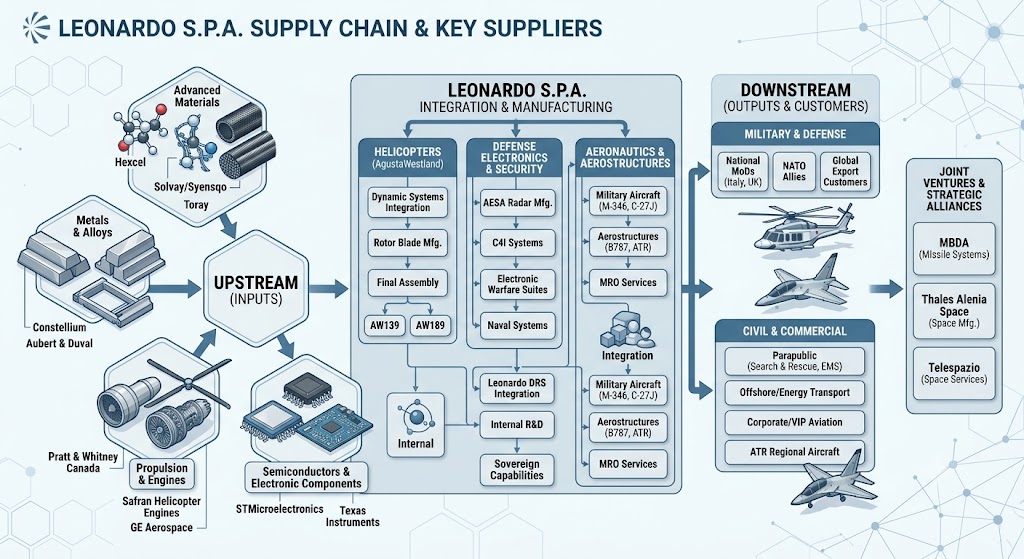
Leonardo operates an extensive, tiered aerospace and defense supply chain spanning Europe and North America, managed formally through its LEAP (Leonardo Empowering Advanced Partnerships) industrial governance program.
- Upstream Supply Chain (Raw Materials, Propulsion, and Subsystems):
- Advanced Materials & Metallurgy: Leonardo procures advanced carbon-fiber prepregs, resins, and specialized aerospace alloys. Key tier-1 suppliers include Solvay/Syensqo, Hexcel, and Toray for structural composite materials utilized in helicopter rotors and the Boeing 787 aerostructures facility in Grottaglie, Italy. High-performance aluminum and titanium forgings are sourced from suppliers like Aubert & Duval and Constellium.
- Turbine Engines & Propulsion Systems: Leonardo does not produce primary propulsion turbines internally; it relies heavily on Western engine primes. Primary helicopter propulsion suppliers include Pratt & Whitney Canada (PT6C engines for the AW139 and PW200 series for light twins), Safran Helicopter Engines (Arrano and Aneto families for AW169/AW189), and GE Aerospace (T700/CT7 engines for the AW101 and AW149). For military fixed-wing platforms, Leonardo integrates engines from the Eurojet consortium (EJ200 for Typhoon) and Rolls-Royce (AE 2100 for the C-27J Spartan).
- Semiconductors & Electronic Components: Upstream mission computers, microwave monolithic integrated circuits (MMICs) for AESA radars, and digital signal processors are sourced from major semiconductor fabricators, including STMicroelectronics, Texas Instruments, and European microelectronics foundries.
- Midstream Manufacturing, Systems Integration & JVs:
- Internal Assembly Hubs: Leonardo operates major integration hubs across Italy (Vergiate for helicopters, Venegono for jet trainers, Grottaglie for composite structures), the UK (Yeovil for rotary-wing platforms, Edinburgh and Luton for avionics, radars, and electronic warfare suites), and the US (Leonardo DRS facilities for naval electric drives, thermal imaging, and computing networks).
- Joint Venture Alliances: Leonardo delegates critical subsystems through long-standing corporate JVs: missile systems via MBDA (25% share alongside Airbus and BAE Systems) and space manufacturing and satellite operations via the Space Alliance (Thales Alenia Space 33% and Telespazio 67%).
- Downstream Supply Chain (Customers and Distribution):
- Sovereign Defense Customers: The Italian Ministry of Defence and the UK Ministry of Defence serve as foundational domestic anchor clients. The US Department of Defense is reached primarily through proxy structures via Leonardo DRS (providing equipment such as electric propulsion systems for Columbia-class ballistic submarines and ground-vehicle network computing). Export military defense forces include NATO partners (such as Poland, Germany, and Greece) and Middle Eastern governments (e.g., Qatar and Kuwait).
- Civil and Parapublic Operators: Commercial helicopter platforms are distributed worldwide to offshore energy fleet operators (such as Bristow Group and CHC Helicopter), air ambulance operators, police aviation units, and private VIP clients.
Competitor Analysis: Technical and Financial Comparison
Leonardo contends with major European and American defense primes, with primary European direct competitors being Airbus SE (particularly Airbus Defence and Space & Airbus Helicopters), BAE Systems plc, and Thales Group.
- Technical Capability Comparison:
- Rotary-Wing Platforms: Leonardo’s core technical edge against Airbus Helicopters and Bell lies in high-speed, long-range intermediate twin aircraft. The AW139 and AW189 feature superior rotor dynamics, transmission run-dry capabilities (certified to run without oil for 30 to 50+ minutes), and modern glass cockpits optimized for maritime and harsh all-weather search-and-rescue. Airbus Helicopters retains broader volume dominance in light-twin and light-single civil fleets (such as the H125 and H145) and introduced the composite-heavy H160, directly targeting the AW169.
- Combat Aviation & Trainers: In tactical aviation, Leonardo is an equal core partner with BAE Systems and Japan’s Mitsubishi Heavy Industries in the sixth-generation Global Combat Air Programme (GCAP / Tempest), rivaling the Franco-German-Spanish Future Combat Air System (FCAS / SCAF) led by Dassault and Airbus. In pilot training, Leonardo’s M-346 possesses integrated Embedded Tactical Training System (ETTS) software that emulates frontline sensor suites and tactical radar screens, giving it a technical lead in handling characteristics over the Boeing-Saab T-7A Red Hawk and KAI T-50.
- Sensors and Radars: Against Thales and Hensoldt, Leonardo’s airborne AESA radars (such as the Captor-E on the Typhoon and the Raven/Osprey surveillance families) demonstrate state-of-the-art multi-channel active electronic scanning. Thales maintains a broader installed base in naval sonar systems and global civilian air traffic management (ATM), while Leonardo maintains higher technical depth in naval gun fire-control (OTO Melara heritage) and automated turret systems.
- Financial Metrics Comparison:
- Revenue & Operating Scale: BAE Systems leads the European cohort with revenue exceeding £28 billion (~$36 billion), while Airbus generates total group revenues surpassing €70 billion (with roughly €11 billion to €12 billion in Defense and Space). Leonardo operates at a consolidated revenue level of ~€17.5 billion to €18.6 billion, matching Thales (~€18 billion to €19 billion) in direct defense and security throughput.
- Operating Profitability (EBITA / EBITDA): Leonardo delivers an adjusted EBITA margin of roughly 9.0% to 9.5% (S&P-adjusted EBITDA margin of ~10.5% to 11.5%). This is broadly in line with BAE Systems (~10.5% to 11.0% underlying EBIT) and slightly below Thales (~11.6% EBIT margin). Leonardo historically underperformed European peers in profitability due to drag in its commercial Aerostructures division (Boeing 787 rate fluctuations), but has closed this gap through operational turnaround initiatives and strong pricing in defense electronics and helicopters.
- Balance Sheet & Financial Leverage: Leonardo has aggressively executed a deleveraging program, reducing its Group Net Debt from historical levels above €3.5 billion down to approximately €1.1 billion to €1.6 billion, bringing debt-to-EBITDA below 1.5x. While BAE Systems maintains very stable, defense-backed cash generation and investment-grade headroom, Leonardo’s cash conversion (FOCF surpassing €800 million to €950 million annually) has rebounded to historical highs, supporting expanded R&D investments.
Sources
- https://www.leonardo.com/en/press-release-detail/-/detail/30-07-2025-leonardo-1h2025-financial-results
- https://www.leonardo.com/en/suppliers
- https://electronics.leonardo.com/en/suppliers
- https://www.leonardodrs.com/news/press-releases/leonardo-drs-announces-financial-results-for-second-quarter-2025/
- https://www.leonardodrs.com/news/press-releases/leonardo-drs-announces-financial-results-for-fourth-quarter-and-full-year-2025/
- https://www.spglobal.com/ratings/es/regulatory/article/-/view/sourceId/13214961
- https://freemalta.com/markets/company-stories/compare/leonardo-vs-bae-systems
- https://www.alphaspread.com/comparison/mil/ldo/vs/par/air
- https://www.theguardian.com/business/2025/oct/23/airbus-leonardo-thales-european-rival-elon-musk-spacex
Back to Leonardo