
Corporate History
Origins and Industrial Agglomeration (1948–1980s)
Founded in 1948 as Finmeccanica (Società Finanziaria Meccanica), the enterprise operated for decades as a state-owned industrial holding company under Italy’s IRI (Istituto per la Ricostruzione Industriale). Its early portfolio was broadly diversified across mechanical engineering, automotive manufacturing, energy equipment, and transport. During the 1960s and 1970s, Finmeccanica steadily concentrated its capital on aerospace and defense, acquiring domestic manufacturing pillars such as Aeritalia and Selenia to establish sovereign Italian industrial defense capabilities.
Privatization and International Expansion (1990s–2013)
In the 1990s, Finmeccanica initiated privatization and restructured into an international defense contractor. The early 2000s marked substantial cross-border M&A and joint-venture activity: Finmeccanica acquired the remaining shares of AgustaWestland to command vertical-lift aviation, secured U.S. defense electronics firm DRS Technologies in 2008 for approximately $5.2 billion, and formed the Space Alliance joint ventures with Thales (Thales Alenia Space and Telespazio). However, this debt-financed expansion coincided with governance challenges and international bribery allegations involving foreign contracts in the early 2010s.
The “One Company” Transformation and Rebranding (2014–2022)
Under CEO Mauro Moretti in 2016, Finmeccanica dissolved its complex web of independent subsidiaries (AgustaWestland, Alenia Aermacchi, Selex ES) and absorbed them into a unified, divisional corporate operating structure known as the “One Company” model. The group rebranded as Leonardo-Finmeccanica in 2016 and formally took the name Leonardo S.p.A. in 2017. During this era, the company stabilized its balance sheet, exited rail manufacturing via the divestment of AnsaldoBreda and Ansaldo STS to Hitachi, and resolved legacy compliance disputes.
Strategic Realignment and Multi-Domain Focus (2023–Present)
Led by CEO Roberto Cingolani, Leonardo launched its 2024–2028 Industrial Plan, targeting €95 billion in cumulative revenues and €105 billion in cumulative order intake. The strategy prioritizes cyber solutions, space, and international alliances—including core participation in the Global Combat Air Programme (GCAP) alongside the UK and Japan, and a major armored vehicle joint venture with Rheinmetall—while divesting legacy assets like underwater armaments to strengthen the core balance sheet.
Business Model and Strategy
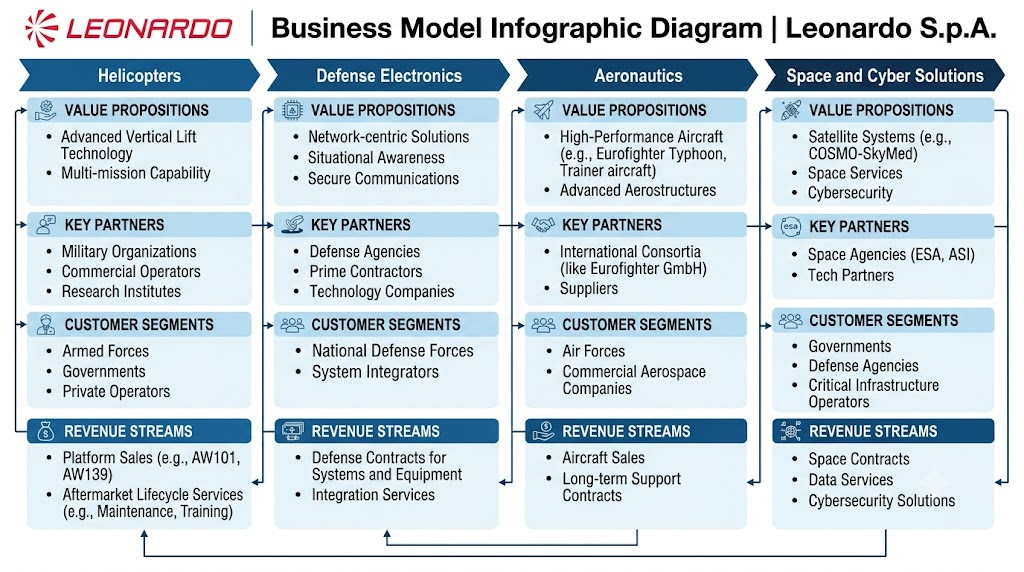
Leonardo generates revenue through the design, manufacturing, systems integration, and full lifecycle sustainment of high-technology defense and dual-use aerospace platforms.
- Revenue Streams and Segment Dynamics: The company monetizes capital equipment sales and long-term service agreements across five core reporting segments:
- Helicopters: Generates roughly 28–30% of group revenue through proprietary platforms (e.g., AW139, AW169, AW101) sold to military and civil parapublic operators, yielding stable 7.5–8.0% return on sales (ROS).
- Defense Electronics & Security: The primary profit engine, delivering over 40% of group revenue and boasting ROS exceeding 11.5%, driven by airborne radars (such as the Captor-E AESA for the Eurofighter), naval combat management systems, electro-optics, and Leonardo DRS U.S. defense programs.
- Aeronautics: Monetizes military trainer aircraft (M-346, M-345), tactical airlifters (C-27J), consortium manufacturing (Eurofighter Typhoon, F-35 center fuselage subassemblies), and aerostructures supply contracts for commercial OEMs like Boeing (787 fuselage sections) and Airbus.
- Cyber & Security Solutions: Provides command-and-control, sovereign cloud infrastructure, and national cybersecurity operations centers.
- Space: Operates through equity alliances (67% of Telespazio, 33% of Thales Alenia Space) monetizing satellite communications, Earth observation data, and orbital exploration payloads.
- Service and Lifecycle Monetization: Leonardo derives a growing share of recurring, higher-margin revenue from long-term fleet management, performance-based logistics (PBL), flight simulators, and pilot training (including the International Flight Training School with the Italian Air Force), which de-risks cash flow from lumpy equipment procurement cycles.
- Financial Strategy and Targets: Under the 2024–2028 Plan, Leonardo targets a compound annual growth rate (CAGR) of 6% in revenues and an increase in group-wide ROS to 10% in 2026 and 11.5% by 2028. The group emphasizes cash generation, targeting annual Free Operating Cash Flow (FOCF) exceeding €1.3 billion by 2028 to cut gross debt and fund targeted technological acquisitions.
Sources for Business Model Information
- https://www.leonardo.com/en/press-release-detail/-/detail/12-03-24-industrial-plan
- https://www.leonardo.com/documents/15646808/30043445/Results+at+30+09+25.pdf/e93b06d8-69c7-3ae6-398f-1dc9b67603fd
- https://www.spglobal.com/ratings/es/regulatory/article/-/view/sourceId/13214961
AI Strategy, Budget, and Partnerships
Leonardo positions artificial intelligence as a foundational horizontal layer embedded across its multi-domain defense platforms rather than an isolated software product. The strategy centers on digital twins, autonomous systems, sensor fusion, predictive logistics, and battlefield cognitive decision-support systems.
- Infrastructure and Core Assets (davinci-1): The operational core of Leonardo’s AI computation is the davinci-1 supercomputer located at the Torre Fiumara data center in Genoa. Ranked among the premier high-performance computing (HPC) installations in the aerospace and defense sector, davinci-1 delivers over 5 PFLOPS of computing power across 200 server nodes and 20 petabytes of enterprise memory, powered by NVIDIA GPU accelerators. The facility acts as the computational engine for training proprietary defense neural networks, running fluid dynamics simulations, and executing real-time digital twins of active aircraft fleets.
- R&D Allocation and Investment Commitments: Leonardo channels a significant portion of its corporate R&D budget—which totaled approximately €2.5 billion in 2024—into advanced digitalization, high-performance computing, and autonomous software development. Under the 2024–2028 Industrial Plan, targeted gross efficiency savings of €1.8 billion are being redirected into advanced engineering tools, digital factories (the NEMESI model), and AI-enabled product lines.
- Strategic Partnerships and Program Integration:
- Global Combat Air Programme (GCAP): Partnering with BAE Systems, Mitsubishi Heavy Industries, and sensor consortium partners, Leonardo is integrating AI into the 6th-generation fighter’s ISANKE & ICS (Integrated Sensing and Non-Kinetic Effects & Integrated Communications System) to process multi-spectral sensor data and govern autonomous loyal-wingman uncrewed systems.
- Defense Tech Alliances: Through Leonardo DRS in the United States, the company collaborates with the U.S. Department of Defense and AI mission software developers to deploy computer vision and threat-classification algorithms onto mast-mounted reconnaissance platforms and tactical vehicle radar suites.
- Academic and Research Ecosystem: Leonardo operates a network of Leonardo Innovation Labs located near leading European universities (including Politecnico di Milano, Politecnico di Torino, and the Italian Institute of Technology), funding specialized post-doctoral researchers dedicated to neuromorphic computing, generative modeling for radar signal analysis, and autonomous swarm robotics.
Back to Leonardo