
Market Position and Market Share
Legrand is the world’s leading pure-play specialist in electrical and digital building infrastructures. It holds a dominant global position, particularly in switches and sockets (wiring devices) and cable management solutions.
- Global Ranking:#1 pure-play specialist worldwide for low-voltage electrical and digital building infrastructure products.
- Global Market Share in Switches & Sockets: Holds approximately 19% to 20% of the global market for wiring devices, making it the clear worldwide leader.
- Global Market Share in Cable Management: Holds roughly 15% of the global market share, leading the category globally.
- Revenue Leadership: Generates nearly two-thirds of its total revenue from product lines where it holds either the #1 or #2 market position locally or globally.
- Target Addressable Market: Operates in an estimated €150 billion addressable global market across residential (~33% of sales), data centers (~26%), non-residential offices/healthcare (~40%), and industrial segments.
Supply Chain Analysis and Key Suppliers
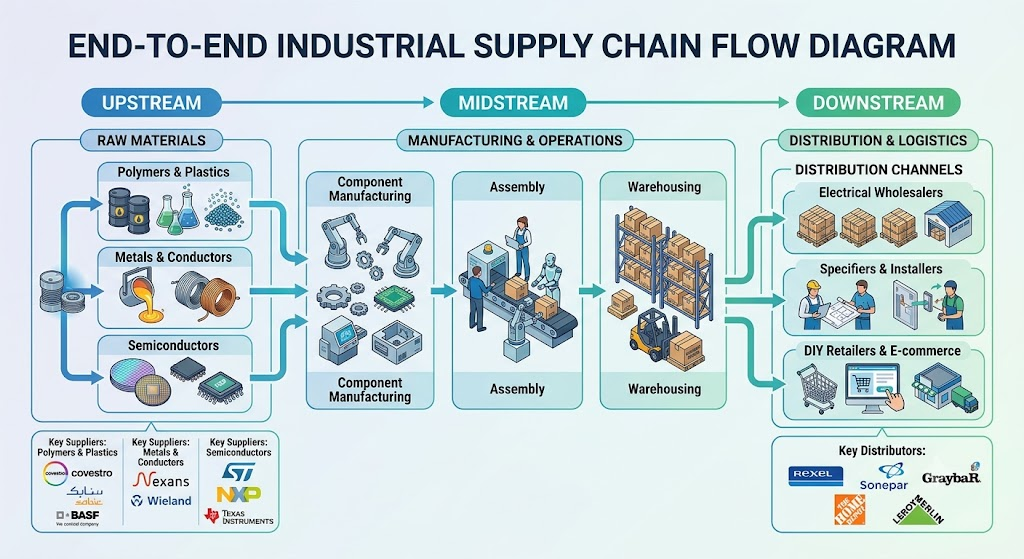
Legrand’s operational model is highly decentralized, relying on an extensive regional assembly network to comply with distinct localized electrical standards across over 90 countries.
Upstream Supply Chain (Raw Materials & Critical Components)
- Polymers & Plastics: Polycarbonate, ABS, and PVC form the foundation for switch plates, socket enclosures, and plastic trunking. Suppliers include major chemical groups such as Covestro, SABIC, and BASF.
- Metals & Conductors: High-grade copper, brass, steel, and aluminum are sourced for internal contact points, busbars, and heavy-duty metallic cable trays. Key suppliers include international metal processors and commodity distributors (e.g., Nexans or Wieland for copper alloys).
- Semiconductors & Electronic Components: For smart home systems (IoT), microcontrollers, Wi-Fi/Zigbee chips, and power electronics are supplied by semiconductor manufacturers such as STMicroelectronics, NXP Semiconductors, and Texas Instruments.
- OEM Sub-assembly Partners: Legrand utilizes contract manufacturers for specialized electronic sub-assemblies while maintaining direct control over critical assembly process lines.
Downstream Supply Chain (Distribution & Channel Ecosystem)
- Electrical Wholesalers & Distributors: Over 70% of Legrand’s products reach end-users through major international wholesale networks like Rexel, Sonepar, and Graybar, which act as primary gatekeepers.
- Specifiers & Installers: Electricians, system integrators, and building engineering consultants drive specifications during project design phases.
- Retailers & E-commerce: DIY chains (e.g., Home Depot, Leroy Merlin) and online platforms distribute consumer-facing smart devices and basic hardware directly to end-users.
Competitor Analysis
Legrand competes against major global electrical equipment conglomerates, but its pure-play strategy on building infrastructure sets it apart.
Direct Competitors
- Schneider Electric: The primary global competitor in low-voltage electrical distribution, building automation, and data center physical infrastructure.
- ABB: Competes strongly in low-voltage protection equipment, smart home automation, and commercial building systems.
- Eaton: Focuses heavily on power distribution, circuit protection, and data center power quality, competing directly with Legrand’s UPS offerings.
- Leviton & Lutron: Key regional competitors in North America for wiring devices, lighting controls, and smart home ecosystems.
Technical Comparison
- Architecture Strategy:Competitors like Schneider Electric (EcoStruxure) and ABB (ABB Ability) focus heavily on enterprise-scale, end-to-end IoT software and automation platforms. Legrand focuses on modular, installer-friendly, open-protocol hardware integrations (e.g., “with Netatmo” series supporting Matter, Apple Home, Google Home, and Zigbee).
- Product Specialization: Legrand’s technical depth lies in ergonomic physical designs, rapid-install cable management systems (such as Cablofil), and compact data center rack units/PDUs. Competitors generally possess stronger technical depth in high-voltage and medium-voltage industrial utility systems, whereas Legrand focuses entirely on low-voltage and digital building applications.
Financial Comparison
- Operating Margins: Legrand consistently maintains industry-leading profitability, with adjusted operating margins ranging from 20% to 21%. This surpasses ABB and matches or slightly exceeds Schneider Electric’s medium-voltage/low-voltage segments due to Legrand’s low capital intensity and pricing power in specification-driven markets.
- Free Cash Flow & Capital Efficiency: Legrand targets free cash flow conversion of over 100% of net income annually. It executes a disciplined bolt-on M&A strategy, spending 3% to 5% of sales per year on small-to-medium acquisitions rather than large, high-risk mega-mergers.
- Revenue Scale: Legrand’s revenue sits at approximately €8.6 billion to €9.0 billion. Schneider Electric (~€36+ billion) and ABB (~€30+ billion) have significantly higher total revenues, but a substantial portion of their revenue comes from heavy industrial automation and medium-to-high voltage power grids, segments where Legrand does not compete.
Sources
- https://www.legrand.com/en/group/a-world-leader
- https://pestel-analysis.com/blogs/competitors/legrandgroup
- https://www.legrand.com/datacenter/au-en/news/integrated-electrical-ecosystems-for-safe-and-reliable-power-distribution
- https://www.comparably.com/companies/legrand/competitors
- https://www.craft.co/legrand/competitors
- https://www.distillintelligence.com/competitors/legrand
Back to Legrand