
Company History
Foundation and Industrialization (1814–1890)
Founded on March 20, 1814, as Kongsberg Våpenfabrikk (KV), the company was established to build national self-reliance in arms manufacturing and generate employment following the decline of local silver mines. It initially supplied rifles to the Norwegian Armed Forces.
International Breakthrough and Expansion (1890–1986)
The company gained global prominence with the Krag–Jørgensen rifle in the late 19th century, which was adopted by both the Danish and U.S. militaries. Post-WWII, KV diversified into civil markets, manufacturing automotive parts for Volvo, maritime dynamic positioning systems, and advanced defense products like the Penguin missile.
Restructuring and Public Listing (1987–2010s)
Following severe financial distress in 1986, KV was restructured in 1987. Defense assets were transferred to Norsk Forsvarsteknologi (NFT), which listed on the Oslo Stock Exchange in 1993 and was renamed Kongsberg Gruppen in 1995. The company built out its civil maritime footprint by acquiring Norcontrol and Rolls-Royce Commercial Marine.
Modern Era and Structural Transformation (2020s–Present)
Reorganized across defense, maritime, discovery, and digital domains, Kongsberg capitalized on unprecedented geopolitical demand. In early 2026, the company executed a major corporate demerger, separating its maritime commercial business to focus core operations on defense, aerospace, and ocean sensing technology under a unified structure.
Business Model and Strategy
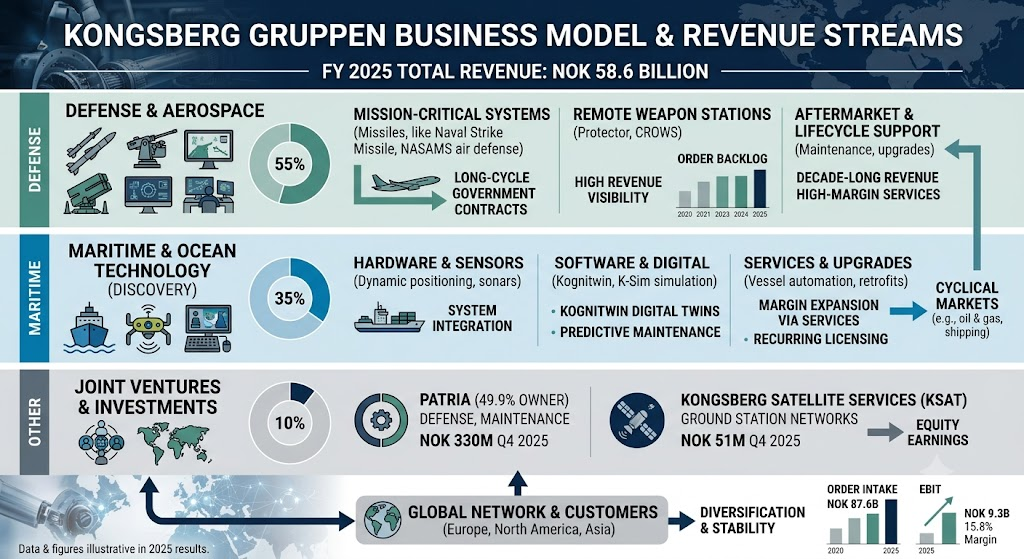
Kongsberg generates revenue by selling highly engineered, certified, mission-critical systems and capturing recurring aftermarket lifecycle support. In fiscal year 2025, total group operating revenues reached NOK 58.6 billion, driven by record order intakes of NOK 87.6 billion and an EBIT of NOK 9.3 billion (15.8% margin).
The group operates across core cash-generating divisions:
- Defense & Aerospace: Monetizes via long-cycle government procurement contracts for missile systems (Naval Strike Missile/JSM), Remote Weapon Stations (Protector/CROWS), and NASAMS air defense platforms. Defense operations provide long-term revenue visibility, accounting for over 55% of the long-term order backlog extending beyond 2028.
- Maritime & Ocean Technology (Discovery): Earns revenue through hardware sales (sensors, sonars, subsea robotics), software licensing (Kognitwin, K-Sim simulation), and maintenance services. Margin expansion is driven by vessel automation retrofits and high-margin lifecycle service agreements.
- Joint Ventures & Equity Investments: Receives financial contributions from partial ownership stakes, including Patria (49.9% ownership, contributing NOK 330 million in Q4 2025) and Kongsberg Satellite Services (KSAT, contributing NOK 51 million in Q4 2025).
The strategic priority centers on differentiation through high switching costs and regulatory barriers rather than cost leadership. Kongsberg converts long-cycle defense sales into decades of high-margin maintenance, upgrades, and software services across installed bases.
Business Model Sources
- https://www.kongsberg.com/
- https://www.investing.com/news/company-news/kongsberg-q4-2025-presentation-17-revenue-growth-amid-strategic-demerger-plans-93CH-4489474
- https://umbrex.com/resources/company-profiles/kongsberg-gruppen/
AI Development Strategy and Partnerships
Kongsberg embeds Artificial Intelligence directly into operational hardware and software architectures across maritime autonomy, defense platform targeting, and industrial digital twins.
- Embedded Autonomy & Defense AI: AI is utilized for real-time sensor fusion, automated target recognition, and autonomous navigation. Kongsberg incorporates machine learning algorithms into uncrewed surface vessels (USVs) and remote weapon systems, enabling automated threat detection without relying on continuous satellite communications.
- Digital Twins and Cloud Infrastructure: Through its digital division, Kongsberg develops “Kognitwin,” an AI-driven digital twin platform for heavy industrial and energy assets. It leverages predictive ML models to optimize energy usage, forecast maintenance needs, and simulate operational scenarios.
- R&D Allocations & Ecosystem Partnerships: Kongsberg allocates significant annual capital toward digital innovation, software engineering, and subsea robotics. Key strategic initiatives include collaboration with academic institutes like the Norwegian University of Science and Technology (NTNU) on autonomous surface vessel projects (such as the milliAmpere2 autonomous ferry testbed) and partnerships with defense prime contractors (e.g., Raytheon for NASAMS integration and Thales for remote weapons platforms).
Back to Kongsberg Gruppen