
Market Position and Market Share
Komatsu Ltd. is the second-largest manufacturer of construction and mining equipment globally, trailing only Caterpillar Inc. According to International Construction’s Yellow Table ranking, Komatsu holds the No. 2 position worldwide with a global market share of approximately 10.4%, while Caterpillar leads at 16.8%.
For the fiscal year ended March 31, 2026(FY2025), Komatsu posted record consolidated net sales of JPY 4,132.8 billion(approximately USD 26.4 billion to USD 27.5 billion depending on conversion rates), up 0.7% YoY.Operating profit reached JPY 567.3 billion, yielding an operating margin of 13.7%. By business division, Construction, Mining, and Utility Equipment accounts for over 90% of total revenue(JPY 3,806.0 billion in FY2025), with the remainder generated by Industrial Machinery(such as automotive press machines and semiconductor excimer lasers via Gigaphoton) and Retail Finance.
Geographically, Komatsu generates roughly 90% of its construction and mining equipment sales outside Japan. Its largest geographic revenue contributors are North America(representing approximately 27% to 28% of sales), Latin America, Europe, Asia, and Oceania. Komatsu holds a commanding market share in hydraulic excavators, large mining dump trucks, and super-large mining bulldozers, while maintaining a top-tier duopoly alongside Caterpillar in autonomous haulage systems(AHS) for large open-pit mining operations.
Supply Chain Analysis and Key Suppliers
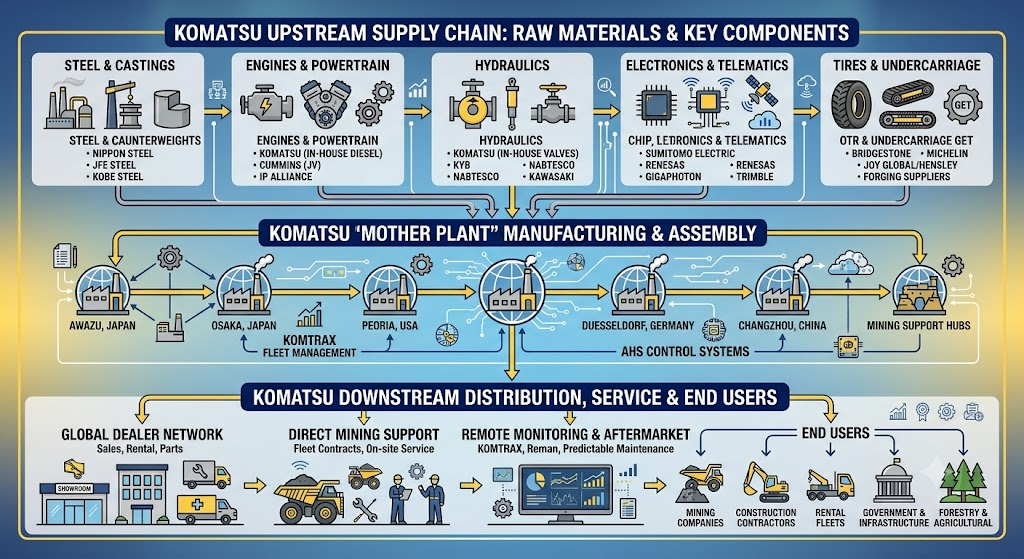
Komatsu operates an integrated “Mother Plant” system that links design, production engineering, and regional manufacturing hubs worldwide to manage cyclical capital goods demand.
Upstream Supply Chain
- Raw Materials and Casting/Forging: Upstream procurement centers on high-grade plate steel, specialized alloy steels, cast steel components, and heavy counterweights. Komatsu relies heavily on major Japanese and regional steelmakers, including Nippon Steel, JFE Steel, and Kobe Steel, alongside localized foundries for structural weldments and chassis fabrication.
- Powertrains and Engine Components: Komatsu is largely vertically integrated for mid-to-large diesel engines, designing and building its own core industrial diesel powertrains(such as the SAA6D series). For select product tiers, specialized emissions systems, and global joint ventures, it partners with engine manufacturers including Cummins(through long-standing joint ventures such as Komatsu Cummins Engine Co. in Oyama and Industrial Power Alliance). Key fuel injection and common rail systems are supplied by Denso and Bosch.
- Hydraulic and Drivetrain Systems: Precision hydraulic pumps, control valves, swing motors, and final drives form the operational core of excavators. While Komatsu internally designs and manufactures critical proprietary high-pressure valves and pumps through its internal hydraulics division, it also procures hydraulic components and systems from tier-1 suppliers such as KYB Corporation, Nabtesco, and Kawasaki Heavy Industries Precision Machinery. Transmission components and heavy-duty drivetrain gears rely on specialized gearing specialists and bearing leaders like NSK, NTN, and JTEKT.
- Electronics, Telematics, and Sensors: Komatsu’s KOMTRAX telematic architecture and Autonomous Haulage System(AHS) require automotive-grade microcontrollers, LiDAR, radar, GPS/GNSS receivers, and harsh-environment wiring harnesses. Critical electronic components are sourced from Sumitomo Electric, Renesas Electronics, Trimble(for machine guidance and grade control integration), and Tokyo Electron Device.
- Tires and Undercarriage: Large off-the-road(OTR) giant radial tires for 200+ ton mining trucks are procured from Bridgestone and Michelin, representing a critical supply bottleneck during mining upcycles. Undercarriage track assemblies and ground engaging tools(GET) are handled both in-house(such as via Komatsu’s Joy Global/Hensley acquisitions) and through specialized forgings suppliers.
Downstream Supply Chain
- Global Assembly and Mother Plant Coordination: Core components(transmissions, hydraulic valves, and advanced diesel engines) are manufactured at centralized Mother Plants in Japan(e.g., Awazu, Osaka, Ibaraki, and Oyama) and shipped as modular subassemblies to regional final-assembly plants across North America(Peoria, Chattanooga), Europe(Germany, UK), China(Changzhou), and Latin America(Brazil).
- Dealer and Distribution Architecture: Komatsu delivers equipment primarily through a dual structure of independent authorized dealerships and direct regional distribution subsidiaries. In North America and Europe, independent dealer networks provide sales, rental fleets, and field support. In major mining territories(such as Western Australia, Chile, and parts of Africa), Komatsu often maintains wholly-owned or direct regional support hubs to service multi-million-dollar fleet maintenance contracts on-site.
- Aftermarket Remanufacturing and Telematics-Driven Service: Downstream profitability relies heavily on recurring parts sales, maintenance, and remanufacturing(“Reman”). Through KOMTRAX and smart construction platforms, Komatsu monitors machine hours, fuel usage, fault codes, and component wear in real time, shifting maintenance from reactive repairs to predictive part-replacement schedules before unplanned site downtime occurs.
Competitor Analysis: Technical and Financial Comparison
Komatsu competes against global full-line heavy equipment giants, specialized European manufacturers, and aggressive Chinese capital goods producers. Its primary competitors include:
- Caterpillar Inc.(USA): The global market leader with broader scale across construction, resource industries, and energy/transportation.
- Hitachi Construction Machinery(Japan): A close Japanese rival, particularly strong in hydraulic excavators and open-cast mining excavators.
- Volvo Construction Equipment(Sweden): Highly competitive in articulated dump trucks, wheel loaders, and compact electric construction equipment.
- Sany Heavy Industry and XCMG(China): Price-competitive players dominating the Chinese domestic market and aggressively expanding exports into Southeast Asia, Africa, Europe, and Latin America.
- Deere & Company(USA): Strong presence in North American earthmoving and forestry equipment, directly competing in construction post-Hitachi joint-venture unwinding.
Technical Comparison
- Automation and Autonomous Haulage Systems(AHS): Komatsu pioneered commercial autonomous haulage in 2008(FrontRunner AHS) and remains in a tight duopoly with Caterpillar(Cat MineStar Command). Komatsu’s AHS deployment exceeds hundreds of autonomous trucks operating across Australia and South America. While Caterpillar holds a slightly larger total deployed fleet and has expanded into retrofitting third-party trucks, Komatsu differentiates through deep integration between dispatch software, vehicle drive systems, and quarry/mine site mapping.
- Telematics and Connected Fleets: Komatsu was an early mover with KOMTRAX, making satellite-linked machine monitoring standard across even mid-sized excavators. Caterpillar countered with Cat Product Link and VisionLink. Both now provide predictive maintenance, yet Komatsu’s “Smart Construction” ecosystem extends beyond the single machine into full job-site digital twins, drone aerial surveying, and 3D terrain modeling for civil engineering projects.
- Electrification and Alternative Powertrains: European competitors like Volvo CE moved faster in commercializing compact, battery-electric excavators and loaders in urban settings where noise and emission restrictions are strictest. However, Komatsu and Caterpillar focus heavily on mega-tier decarbonization: Komatsu formed the “Komatsu Greenhouse Gas(GHG) Alliance” with major mining customers(including Rio Tinto and BHP) to co-develop zero-emission battery-electric and hydrogen fuel-cell haul trucks with modular trolley-assist capabilities. Chinese competitors(Sany, XCMG) lead in low-cost electrification for short-range domestic excavators and small mining trucks, though their battery duty cycles under extreme temperature environments remain less proven than Komatsu’s heavy-duty engineering.
- Hydraulic Efficiency and Machine Control: Komatsu maintains industry-leading electronic closed-center load-sensing hydraulic systems(CLSS), delivering precise operator feedback, lower hydraulic pump loss, and superior fuel economy in medium-to-large excavators relative to Chinese and American peers.
Financial Comparison
| Metric / Dimension | Komatsu Ltd.(Japan) | Caterpillar Inc.(USA) | Sany Heavy Industry(China) |
| Revenue Scale(FY2024–FY2025/2025) | ~JPY 4.13T(~$26B–$27B) | ~$67B–$75B | ~RMB 74B–$10.5B |
| Operating Profit Margin | ~13.7%–16.0% | ~19.0%–21.0% | ~6.0%–9.0% |
| Gross Margin | ~31%–33% | ~37%–39% | ~25%–27% |
| Return on Equity(ROE) | 11.3%–14.2% | ~50%+ (leveraged capital structure) | ~6%–9% |
| Geographic Diversity | High(~90% non-Japan; balanced Americas, Europe, Asia) | High(balanced, largest weight North America) | Emerging global, still concentrated in China/developing markets |
| Balance Sheet Leverage | Conservative(Net D/E ~0.24–0.26) | Moderate(active share buybacks & financial services debt) | Moderate to high working capital intensity |
- Profitability and Pricing Power:Caterpillar achieves significantly higher operating margins(roughly 19%–21% vs. Komatsu’s 13.7%–16.0%), driven by its immense scale, premium machine pricing in North America, and high-margin aftermarket parts division(Financial Products and Cat Reman). Komatsu maintains solid margins exceeding Japanese industrial averages, but its margins are more susceptible to regional mix shifts, US tariff burdens, and currency swings(JPY/USD, JPY/EUR, and JPY/AUD).
- Balance Sheet Resilience: Komatsu maintains a conservative, low-leverage balance sheet with a Net Debt-to-Equity ratio of 0.24 to 0.26, prioritizing long-term R&D continuity and steady dividend payouts(targeting roughly 40%–46% payout ratios). Caterpillar carries higher structural debt and aggressively returns cash to shareholders via repurchases.
- Cost Structure vs. Chinese Rivals: Sany and XCMG operate with lower labor and capital expenditure costs per unit, enabling them to undercut Komatsu and Caterpillar pricing by 15% to 30% in commoditized product segments(e.g., standard mini and 20-ton excavators). However, Komatsu offsets this through superior total cost of ownership(TCO), higher residual fleet resale value, significantly better fuel efficiency, and established parts supply logistics that prevent costly downtime on critical job sites.
Sources
- https://www.komatsu.jp/en/ir/library/results/2025/en_fy254qpresentation.pdf
- https://www.komatsu.jp/en/ir/library/interview-movie/executive-insight-script_en_20260701
- https://www.komatsu.com/en-za/suppliers
- https://www.rayattachments.com/China-s-Construction-Machinery-Industry-in-the-2024-Global-Ranking-Performance-and-Development-Trends-id48542436.html
- https://portfolioslab.com/tools/stock-comparison/KMTUY/CAT
- https://finance.biggo.com/news/JP_6301.T_2026-04-28
back to Komatsu