
Market Position and Market Share
Kioxia Holdings Corporation (formerly Toshiba Memory) is the pioneer of NAND flash memory, having invented NAND flash in 1987. It ranks as the world’s second or third largest NAND flash manufacturer by revenue, alternating positions with the combined SK Group (SK Hynix and Solidigm) and trailing market leader Samsung Electronics.
- Global Revenue Market Share: As of recent industry tracking, Kioxia holds an individual NAND revenue market share typically between 14.5% and 16.0%, with Samsung holding approximately 33% to 35%, and SK Group capturing around 18% to 20%.
- Manufacturing Capacity Share: Kioxia operates a decades-long 50/50 joint venture with Western Digital (SanDisk). On a combined production capacity basis, the Kioxia-Western Digital alliance accounts for roughly 30.1% of global NAND flash bit production, making the joint alliance on par with or occasionally surpassing Samsung’s total manufacturing wafer output.
- Core Product Dominance: Kioxia maintains top-tier market share in eMMC and UFS mobile embedded storage (particularly across tier-1 smartphone OEMs) and has been scaling aggressively in enterprise SSDs (eSSDs) designed for AI infrastructure and hyperscale cloud service providers.
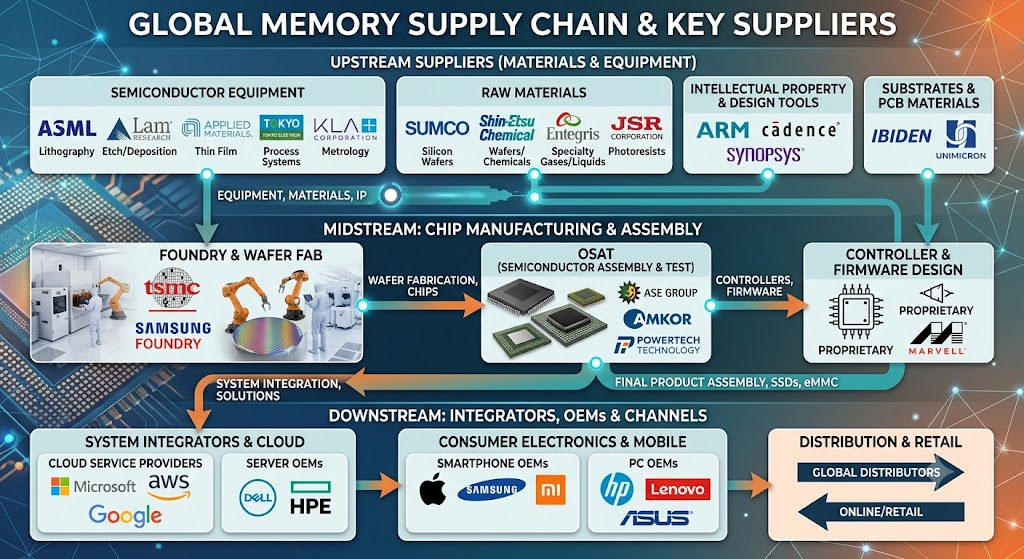
Supply Chain Upstream and Downstream Analysis & Key Suppliers
Kioxia operates predominantly as an Integrated Device Manufacturer (IDM), running major wafer fabrication complexes in Yokkaichi (Mie Prefecture) and Kitakami (Iwate Prefecture).
Upstream Ecosystem and Key Suppliers
- Silicon Wafers: Kioxia relies heavily on Japanese domestic wafer giants Shin-Etsu Chemical and SUMCO for prime 300mm polished and epitaxial silicon wafers.
- Deposition, Etching, and Lithography Equipment:
- Etch and Deposition: High-aspect-ratio hole (HARH) etching and multi-layer chemical vapor deposition (CVD/ALD) are critical for 3D NAND stacking. Lam Research and Tokyo Electron (TEL) provide core plasma etching and deposition systems, alongside Applied Materials for thin-film deposition and planarization.
- Lithography: ASML provides DUV (ArF immersion) lithography systems. Canon also supplies specialized nanoimprint lithography (NIL) systems tested at Kioxia facilities to bypass optical complexity for fine patterning.
- Process Control & Inspection: KLA Corporation is the primary supplier for defect detection and wafer metrology.
- Specialty Chemicals and Materials:
- Photoresists & Litho Materials: Tokyo Ohka Kogyo (TOK) and JSR Corporation supply advanced deep-ultraviolet (DUV) photoresists.
- CMP Slurries and Clean Chemicals: Resonac Holdings (formerly Showa Denko/Hitachi Chemical) and Entegris provide Chemical Mechanical Planarization (CMP) slurries, critical cleaning chemicals, and high-purity electronic gases.
- Strategic Co-Investment Partner: Western Digital (SanDisk) shares capex and R&D for cleanrooms and wafer processing tools at the Yokkaichi and Kitakami joint venture fabs, allowing both companies to achieve substantial scale economies.
Downstream Ecosystem and Integration
- In-House Controller Development & Assembly: Kioxia designs proprietary NAND controllers, firmware, and error-correction (ECC) engines for its enterprise and client SSDs. Advanced controller silicon is outsourced to pure-play foundries (primarily TSMC).
- Outsourced Semiconductor Assembly and Test (OSAT): While primary testing and high-end enterprise packaging are handled in-house and through domestic affiliates, Kioxia also leverages leading OSAT providers (such as ASE Group and Powertech Technology) for commodity packaging and ball grid array (BGA) assembly.
- End Customers and Channels:
- Hyperscalers and Enterprise Servers: Microsoft Azure, AWS, Google Cloud, Meta, Dell Technologies, and Hewlett Packard Enterprise (HPE) purchase enterprise PCIe NVMe SSDs for cloud data centers.
- Mobile and PC OEM: Apple, Xiaomi, OPPO, vivo, Lenovo, HP, and ASUS integrate Kioxia’s BiCS FLASH NAND and SSDs into laptops, desktops, and mobile devices.
Competitor Analysis
Kioxia competes against three primary diversified memory giants: Samsung Electronics, SK Hynix (including Solidigm), and Micron Technology.
Technology Comparison
- Architectural Stacking Strategy (BiCS vs. Competitors):
- Kioxia (BiCS FLASH): Employs BiCS (Bit Cost Scaling) technology developed with Western Digital. The current node, BiCS8 (218 layers), utilizes CMOS directly Bonded to Array (CBA) architecture, separating peripheral logic and memory cell arrays onto two separate wafers before bonding them. Kioxia is transitioning to 332-layer BiCS10, achieving an industry-leading areal density exceeding 29 Gb/mm² with 4.8 GT/s I/O speeds.
- Samsung: Employs V-NAND (currently V8 at ~236 layers and V9 at ~290 layers, targeting 400+ layers with V10) using extreme dual-stack etching. While historically the process leader, Samsung’s aggressive layer scaling has encountered yield complexity.
- SK Hynix / Solidigm: Employs 4D NAND (Periphery Under Cell – PUC) at 238 to 321 layers, and holds a distinct advantage in ultra-high-capacity QLC enterprise drives (61.44TB and 122TB eSSDs) via Solidigm’s specialized floating-gate architecture.
- Micron: Utilizes replacement-gate (RG) architecture and CMOS-under-Array (CuA) at 232 layers and 276 layers, prioritizing high interface I/O speeds.
- Strategic Focus Divergence: Samsung, SK Hynix, and Micron allocate substantial capex to High Bandwidth Memory (HBM3e/HBM4) for AI accelerators. Because Kioxia does not manufacture DRAM, it is 100% focused on NAND scaling, allowing it to bring 332-layer BiCS10 to volume while competitors temper NAND expansion to prioritize HBM.
Financial Comparison
- Revenue and Operating Profitability:
- Kioxia:In FY2024 (ended March 2025), Kioxia posted net sales of 1,706.5 billion JPY with an operating profit of 453.0 billion JPY (27% operating margin).In FY2025 (ended March 2026), revenue expanded to 2,337.6 billion JPY with operating profit reaching 876.2 billion JPY (~37% non-GAAP margin).
- Competitors:Samsung and SK Hynix benefit from blended portfolio hedges (DRAM plus NAND). DRAM and HBM command gross margins upwards of 55% to 65%, generating superior corporate cash flows. Kioxia’s financial results show wider cyclical swings because pure-play NAND margins are historically more volatile than DRAM.
- Capital Structure and Capex Flexibility:
- Samsung, Micron, and SK Hynix maintain stronger corporate balance sheets with lower net leverage ratios.
- Kioxia’s capital expenditures are buffered by its 50/50 joint venture structure with Western Digital, allowing it to deploy advanced cleanroom capacity with half the per-fab equipment capex burden of an independent fab operator.
Information Sources
- https://www.kioxia-holdings.com/en-jp/ir/earnings/highlights.html
- https://www.kioxia-holdings.com/en-jp/sustainability/social/supply-chain.html
- https://www.trendforce.com/news/2025/06/06/news-kioxia-plans-to-double-output-in-five-years-ramping-up-nand-flash-for-ai-data-centers/
- https://www.tomshardware.com/pc-components/ssds/kioxia-and-sandisk-sample-worlds-densest-3d-nand-new-332-layer-beats-samsungs-400-layer-nand
- https://www.bccresearch.com/company-index/profile/kioxia-holdings-corp/financial-statements
- https://en.eeworld.com.cn/news/manufacture/eic717137.html
Back to Kioxia