
Market Position and Market Share
Kingspan Group plc is the global market leader in advanced insulation and high-performance building envelope solutions. The company operates across five core divisions: Insulated Panels, Insulation, Light & Air, Water & Energy, and Roofing & Waterproofing.
- Insulated Sandwich Panels: Kingspan is ranked #1 worldwide. It holds an estimated 30% to 35% market share in Western Europe and upwards of 20% to 25% in North America’s commercial and industrial building envelope sector. Globally, Kingspan accounts for an estimated 15% to 18% share of the overall insulated metal panel (IMP) market.
- Rigid Insulation Boards: Kingspan holds the #1 position in Europe for rigid phenolic and polyisocyanurate (PIR) insulation boards through its Kooltherm and Therma ranges, and ranks among the top three global players in rigid foam insulation alongside Saint-Gobain and Owens Corning.
- Revenue Base: For FY2023, Kingspan reported revenues of €8.09 billion, maintaining a trading profit of €871 million, underpinned by its dominant footprint across Europe (accounting for ~55% of revenue), the Americas (~25%), and Australasia/Rest of World (~20%).
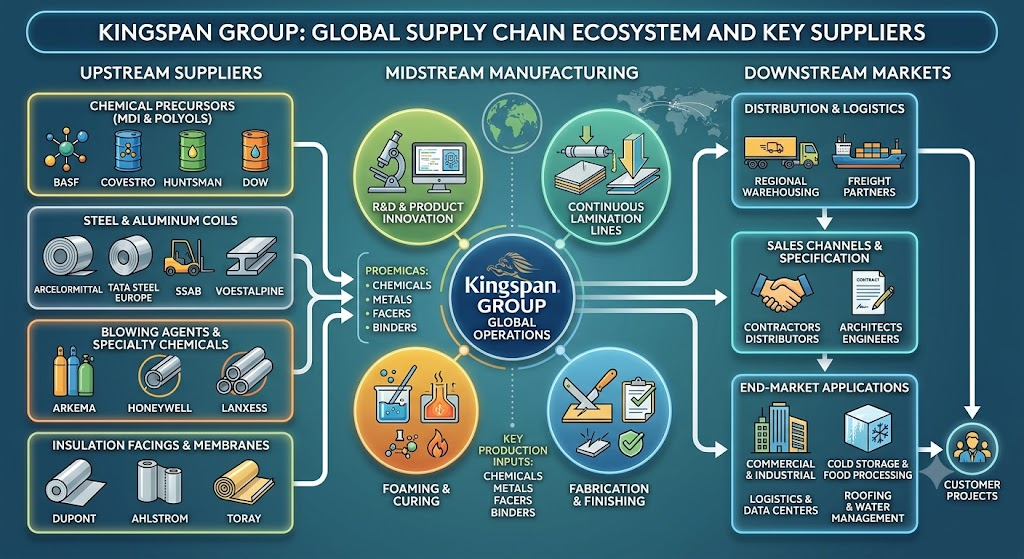
Supply Chain: Upstream, Downstream, and Key Suppliers
Upstream Dynamics and Raw Material Inputs
Kingspan’s cost structure is heavily exposed to upstream chemical precursors and metal substrates:
- MDI (Methylene Diphenyl Diisocyanate) and Polyols: Core components required to synthesize polyisocyanurate (PIR) foam and Kingspan’s proprietary QuadCore matrix. Pricing volatility in crude oil, benzene, and natural gas directly impacts input costs.
- Coil-Coated Steel and Aluminium: Used for the exterior and interior facings of insulated panels. Kingspan consumes substantial volumes of pre-painted galvanized steel coils.
- Blowing Agents and Catalysts: Specialty blowing agents (such as pentane blends and hydrofluoroolefins/HFOs) and proprietary fire-retardant chemistries.
Key Upstream Suppliers
- Chemical Precursors: Covestro, BASF, Huntsman Corporation, and Dow Inc. provide bulk supplies of polymeric MDI, polyether/polyester polyols, and specialty catalysts.
- Steel and Metal Facings: ArcelorMittal, Tata Steel Europe, SSAB, and voestalpine provide hot-dip galvanized and coil-coated structural steel coils.
Manufacturing and Midstream Processing
Kingspan operates continuous lamination production lines across more than 200 manufacturing facilities globally. The manufacturing process entails high-speed chemical foaming between continuous unwinding metal or flexible facings, requiring tight temperature controls, proprietary metering pumps, and automated curing tunnels.
Downstream Distribution and End Markets
Kingspan operates primarily through a B2B project-driven model:
- Customer Channels: Building envelope contractors, specialized cladding installers, general commercial contractors, and system distributors (such as SIG plc and Travis Perkins in Europe).
- Architectural Specification: A critical sales driver is getting proprietary specifications (such as QuadCore envelope systems) written directly into project tenders by architects, structural engineers, and LEED/BREEAM energy consultants.
- End-Market Exposure: Highly weighted toward commercial, logistics, cold-storage warehousing, data centers, modern industrial facilities, and public infrastructure, with lower exposure to private new-build residential housing.
Competitor Analysis: Technological and Financial Comparison
Key Competitors
- Rockwool A/S: Global leader in stone wool (mineral fiber) insulation.
- Compagnie de Saint-Gobain S.A.: Diversified multinational producing glass wool (Isover), plasterboard (Gyproc), and composite materials.
- Owens Corning: Major US producer of fiberglass insulation, extruded polystyrene (XPS), and roofing shingles.
- Tata Steel Building Systems / ArcelorMittal Construction: Direct integrated competitors in insulated sandwich panels and profile sheeting.
Technological Comparison
- Core Chemistry vs. Fibrous Materials: Kingspan emphasizes closed-cell, thin-profile thermoset foams. Its proprietary QuadCore technology delivers an ultra-low thermal conductivity ($\lambda$-value) of 0.018 W/mK, significantly superior to standard mineral wool (~0.034 to 0.038 W/mK) and standard EPS/XPS (~0.032 to 0.036 W/mK). This enables developers to achieve high thermal resistance ($R$-value) with up to 50% thinner walls, maximizing internal floor space.
- Fire Performance: Mineral wool manufacturers like Rockwool hold an inherent non-combustibility advantage (Euroclass A1/A2 ratings). Kingspan has historically faced stringent fire-safety scrutiny; it countered this by engineering QuadCore to achieve FM 4882 approvals for smoke-sensitive environments and high LPCB (Loss Prevention Certification Board) fire ratings, narrowing the regulatory gap with non-combustible stone wool.
- Embodied Carbon and Circularity: Mineral wool and stone wool production are energy-intensive (requiring high-temperature cupola furnaces). Kingspan has integrated circular feedstock (e.g., bio-based polyols and recycled PET bottles converted into polyester polyols via its Planet Passionate initiatives) to reduce upfront embodied carbon in its rigid foam cores.
Financial Comparison
- Trading Margins and Profitability: Kingspan consistently achieves trading margins between 10.0% and 11.5%, outpacing diversified peers like Saint-Gobain (~8.0% to 11.0% operating margin across broad building materials). Rockwool achieves comparable operating margins (~10.0% to 14.0%) due to premium positioning in fire-safe applications.
- Capital Efficiency: Kingspan typically generates a Return on Capital Employed (ROCE) exceeding 15% to 16%, driven by disciplined, aggressive bolt-on M&A and vertical integration into roofing membranes (Derbigum, Ondura) and skylights/ventilation.
- Revenue Scale and Cyclicality: While Saint-Gobain (€47+ billion revenue) operates as a mega-cap conglomerate with lower organic growth, Kingspan (€8+ billion revenue) functions as a pure-play building envelope and thermal efficiency specialist. Kingspan maintains a more resilient backlog than residential-heavy players like Owens Corning, due to heavy commercial demand from automated cold-storage facilities, high-tech manufacturing plants, and cloud computing data centers.
Information Sources
- https://www.kingspan.com/group/investors/reports-and-results
- https://www.kingspan.com/group/who-we-are/our-history-and-strategy
- https://www.rockwool.com/group/about-us/investors/
- https://www.saint-gobain.com/en/finance/financial-results
- https://www.owenscorning.com/en-us/corporate/investors
Back to Kingspan