
Market Position and Market Share
Keyence Corporation ranks among the most valuable industrial automation and sensing technology companies globally, consistently holding the top market capitalization position within Japan’s electronics and precision instruments sector and standing among the top five most valuable public companies in Japan.
Keyence dominates the factory automation(FA)sensing and optical inspection landscape through its ultra-high-margin, direct-sales model:
- Machine Vision Systems: In industrial 2D and 3D machine vision systems, Keyence holds the number one or two global position alongside Cognex Corporation. Estimates place Keyence’s global market share in vision sensors and general machine vision systems at approximately 30% to 35%, leading in Asia and holding strong double-digit share in North America and Europe.
- Photoelectric, Proximity, and Fiber-Optic Sensors: Keyence holds a top-three global market position with approximately 15% to 20% global market share in discrete automation sensors, competing primarily with Omron and Sick AG. In Japan, its domestic market share in high-precision detection sensors exceeds 40%.
- Laser Markers and Measurement Systems: Keyence is the clear global market leader in high-precision digital microscopes(such as the VHX Series)and non-contact 3D profilometers, controlling an estimated 50%+ share of the digital optical inspection microscope niche. In industrial laser marking systems, it holds roughly 20% to 25% of the worldwide market.
- Financial Scale: Keyence generates over 950 billion to 1 trillion JPY in annual revenue while sustaining an industry-leading operating profit margin consistently between 50% and 55%, a metric unmatched by any hardware-oriented industrial peer globally.
Supply Chain Analysis and Key Suppliers
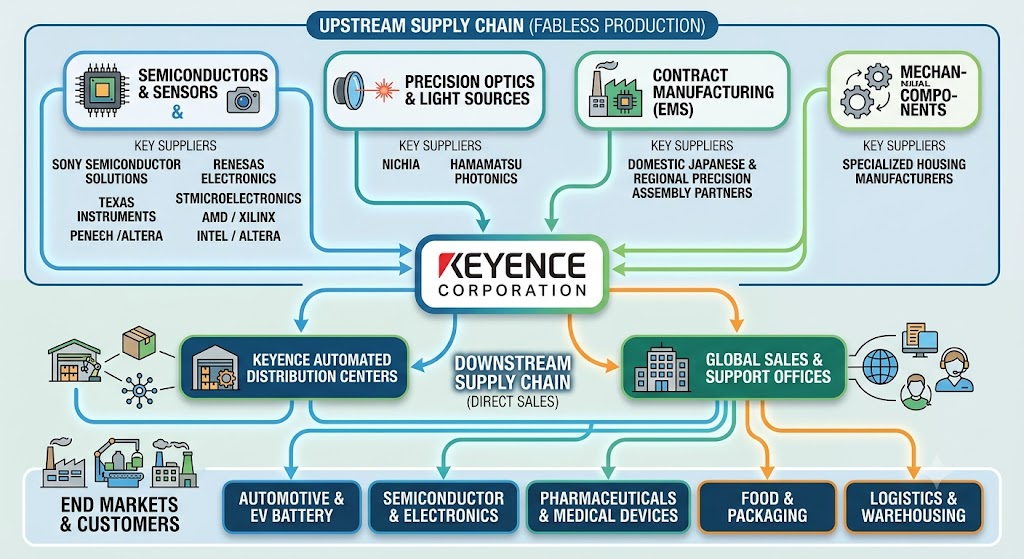
Keyence operates an asset-light, 100% fabless manufacturing architecture paired with an entirely direct-to-customer distribution model. This creates a distinct upstream and downstream profile:
- Upstream Supply Chain(Fabless Production Model):
- Contract Manufacturers(EMS and Precision Assembly): Keyence does not own physical production plants. Manufacturing is outsourced to domestic Japanese and regional precision contract manufacturing partners. Keyence retains all intellectual property, core optical designs, proprietary ASIC schematics, and firm-level firmware, while suppliers handle printed circuit board assembly(PCBA), surface mount technology(SMT), and mechanical enclosure assembly under strict quality audits.
- Semiconductor and Sensor Components: Keyence relies on top-tier global semiconductor foundries and component vendors for custom vision processing units, Field Programmable Gate Arrays(FPGAs, predominantly from AMD/Xilinx and Intel/Altera), image sensors(CMOS image sensors sourced primarily from Sony Semiconductor Solutions), and microcontrollers/DSP units(sourced from vendors such as Renesas Electronics, Texas Instruments, and STMicroelectronics).
- Optical Elements and Laser Diodes: High-grade optical glass, precision molded lenses, and laser diodes are sourced from specialized optical component manufacturers in Japan and Germany(such as Nichia, Hamamatsu Photonics, and specialized lens molders). Keyence engineers design the optical paths and lens groupings internally to guarantee telecentricity and high dynamic range before outsourcing physical element fabrication.
- Downstream Supply Chain(Pure Direct Sales and Rapid Logistics):
- Bypassing Distributors: Unlike competitors(e.g., Omron, Rockwell Automation, or Banner Engineering)who rely heavily on third-party distribution networks, Keyence sells 100% directly to end-user manufacturers and system integrators.
- Same-Day Shipping Infrastructure: Keyence maintains centralized automated distribution centers across Japan, the United States, Europe, and mainland China. Over 90% of standard catalog orders ship the same day they are received, removing downstream retail inventory friction.
- Customer Segments: End-market demand is broadly diversified across automotive and EV battery assembly(~25-30%), semiconductors and consumer electronics(~25%), pharmaceuticals and medical devices(~15%), food and packaging(~15%), and general logistics/warehousing(~15%).
Competitor Analysis: Technical and Financial Comparison
Keyence’s competitive environment spans focused machine vision specialists and broad industrial automation conglomerates.
- Primary Competitors:
- Cognex Corporation(USA): Direct rival in 2D/3D vision systems, barcode readers, and AI-driven deep learning inspection.
- Omron Corporation(Japan): Broad factory automation competitor across sensors, PLCs, safety controllers, and industrial robotics.
- Sick AG(Germany): Major European rival in industrial optical sensors, LiDAR, safety light curtains, and logistics identification.
- Banner Engineering(USA): Competitor in optoelectronic sensors, measurement systems, and industrial wireless monitoring.
- Technical Comparison:
- Integration and Usability vs. Cognex: Cognex relies on advanced, highly customizable software algorithms(such as VisionPro and In-Sight Explorer)that offer exceptional flexibility for complex algorithmic customization but often require certified vision integrators. In contrast, Keyence emphasizes built-in, pre-calibrated algorithms, auto-focus optical modules, and all-in-one vision systems that can be commissioned in hours by plant engineers without software coding expertise.
- Hardware Innovation and Form Factor vs. Omron and Sick: Keyence prioritizes edge intelligence inside the sensor head or compact controller, eliminating separate PC architectures on the factory floor. While Omron and Sick provide standard catalogue sensors designed to integrate into open fieldbus architectures(e.g., EtherCAT, IO-Link, PROFINET), Keyence delivers higher sampling rates(e.g., ultra-high-speed laser displacement sensors sampling at up to 392 kHz)and proprietary noise-rejection optics designed to operate in severe industrial environments.
- Breadth vs. Specialization: Omron and Siemens offer full-stack factory automation solutions(including PLCs, servo motors, and CNC controls). Keyence purposefully avoids low-margin commoditized hardware(like standard contactors or generic AC drives), focusing solely on high-value data acquisition nodes: detection, measurement, vision, and microscopic analysis.
- Financial Comparison:
- Operating Margins: Keyence maintains an operating margin of 50% to 54%. In comparison, Cognex typically posts operating margins of 15% to 25%(varying with consumer electronics and logistics CapEx cycles), Omron operates at 5% to 10%, and broader automation peers(such as Rockwell Automation)operate around 18% to 22%.
- Capital Expenditures and Return on Capital: Keyence incurs minimal capital expenditures(CapEx/Sales ratio under 2% to 3%)due to its fully outsourced production model, generating Free Cash Flow(FCF)conversion rates above 80% of net income. Competitors with dedicated internal fabrication facilities(such as Omron or Fanuc)sustain higher fixed overhead, depreciating assets, and lower return on invested capital(ROIC).
- Sales Efficiency and R&D Allocation: Keyence reinvests approximately 3% to 4% of revenue into R&D, but its research yields disproportionately high returns because products are designed directly around unresolved client operational issues identified by its consultative sales force. Cognex invests roughly 12% to 15% of sales into software and vision R&D, reflecting a heavier software-engineering emphasis over direct field consulting.
Sources
- https://www.keyence.com
- https://www.keyence.co.jp/company/investor/
- https://www.cognex.com/investor-relations
- https://www.omron.com/global/en/ir/
- https://www.sick.com/ag/en/about-sick/company/financial-reports/s/annual-report
back to Keyence