
Corporate History
1974–1985: Foundation and Core Sensor Innovation Founded by Takemitsu Takizaki in 1974 as Lead Electric Co., Ltd., the company initially developed automatic wire-cutting machinery before pivoting toward specialized industrial sensors. It adopted the name Keyence(a portmanteau of “Key of Science”)in 1986, establishing its foundational principle of creating high-margin products that resolve unmet factory-floor bottlenecks.
1986–2000: Fabless Transition and Public Listings During this phase, Keyence refined its 100% direct sales model and abandoned in-house fabrication, converting fully to a fabless operating structure. It listed on the Osaka Securities Exchange in 1987 and the Tokyo Stock Exchange(Prime Market: 6861)in 1989. The company systematically expanded from standard proximity and photoelectric sensors into high-resolution digital microscopes and machine vision systems.
2001–2015: Global Footprint and Margin Expansion Keyence aggressively expanded operations across North America, Europe, and Asia, duplicating its direct consultative sales model internationally. By focusing on rapid delivery(same-day shipping for standard items)and high-utility products where customized solutions commanded premium pricing, Keyence sustained gross margins above 80% and entered major automotive, medical device, and consumer electronics supply chains.
2016–Present: Factory Automation Platform and Software Integration Keyence broadened its hardware scope to include 3D measuring systems, handheld computers, and laser markers, while integrating edge software into its portfolio. It grew into one of Japan’s most valuable enterprises by market capitalization, capitalizing on worldwide manufacturing reshoring, labor shortages, and smart-factory modernization programs.
Business Model and Strategic Monetization
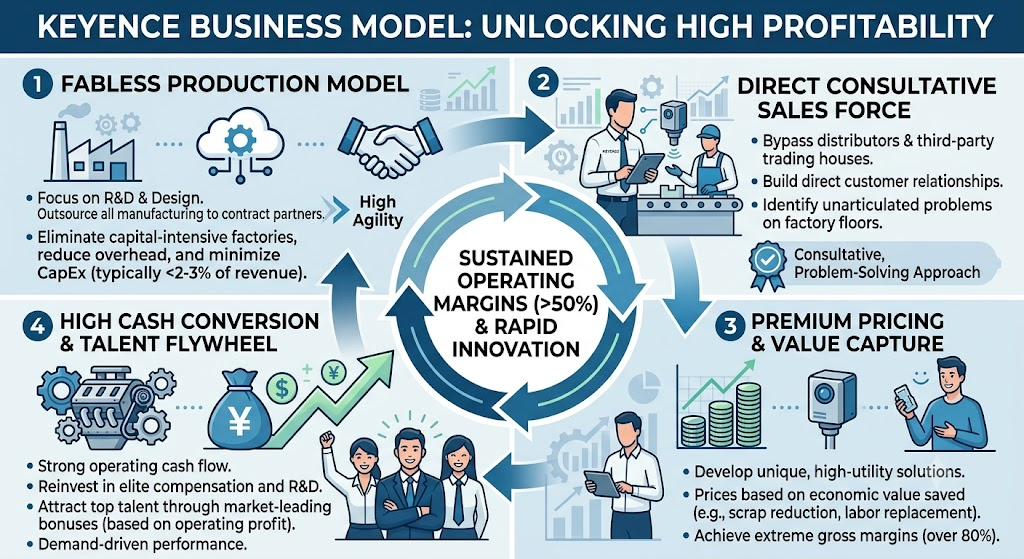
Keyence generates revenue by identifying unarticulated production inefficiencies, designing proprietary hardware/software solutions to solve them, and selling those solutions directly to end users at premium price points.
- Fabless Capital Efficiency: Keyence does not own production facilities. It outsources 100% of fabrication to contract manufacturing partners. This eliminates capital-intensive depreciation costs and factory maintenance CapEx, allowing CapEx to remain minimal(typically under 2% to 3% of revenue).
- Direct Consultative Sales Force: The company completely bypasses third-party distributors and trading houses. Sales engineers visit client facilities daily to diagnose throughput bottlenecks directly. Because Keyence owns the customer relationship end-to-end, it captures the entire distribution margin that third-party distributors usually absorb.
- Pricing Power and Premium Margins: Approximately 70% of Keyence’s newly released products are designed to be “industry firsts” or “world firsts.” By addressing complex inspection or measurement tasks that standard components cannot perform, Keyence prices its products based on the economic value saved(e.g., scrap reduction, labor replacement)rather than cost-plus formulas. This structural pricing power enables gross margins regularly between 80% and 82% and operating profit margins consistently hovering in the 50% to 54% range.
- High Cash Conversion and Compensation Flywheel: With high operating cash flows, Keyence funds an elite performance-driven bonus pool. Up to several percentage points of operating profits are distributed directly back to employees, yielding average annual employee compensation figures that frequently rank Keyence among the top two highest-paying listed firms in Japan(often exceeding ¥20 million per employee). This sustains hyper-demanding productivity quotas and rapid sales execution.
Sources
- https://www.keyence.com/about-us/corporate/financials/
- https://www.keyence.com/about-us/corporate/profile/
- https://www.bloomberg.com/quote/6861:JP
- https://asia.nikkei.com/Companies/Keyence-Corp
AI Strategy, Implementations, and Partnerships
Keyence approaches artificial intelligence not as an abstract cloud service, but as an embedded, deterministic edge-computing tool tailored for real-time factory line decisions.
- Embedded Edge-AI Hardware(Vision and Sensors): Keyence integrates onboard AI algorithms directly into its machine vision platforms, such as the IV-G/IV2/IV3 and VS Series smart camera systems. These devices use edge-based deep learning inference engines to handle automated optical inspection(AOI), detecting surface flaws, scratch patterns, and assembly alignment errors without requiring the complex manual rule configuration of classic pixel-thresholding systems.
- Data Science Platforms(KI Engine): Beyond physical sensors, Keyence commercialized KI(Keyence Intelligence), an internal no-code machine learning analytics platform originally built for internal operations and now sold to enterprise customers. KI allows non-technical business operators to ingest structured corporate or manufacturing data to predict equipment failure, forecast component demand, and pinpoint yield anomalies without dedicated data science teams.
- R&D Allocation and Internal Spend: Keyence allocates approximately 3% to 4% of total revenue annually to research and development(consistently representing hundreds of millions of USD equivalent annually). A growing portion of this budget is dedicated to neural network model training for machine vision edge silicon, automated classification logic, and proprietary sensor DSPs.
- Technology Partnerships and Ecosystem Model: Keyence maintains strict proprietary control over its software stack and algorithmic IP. Rather than forming public, branded joint ventures or relying on third-party cloud AI vendors(such as AWS or Microsoft Azure)for industrial control operations, Keyence relies on closed-ecosystem firmware co-developed with high-performance silicon vendors, FPGA suppliers, and specialized image sensor fabrication partners. This closed-loop design ensures deterministic, sub-millisecond inspection latency on production lines without external network dependency.
back to Keyence