
Market Position and Market Share
KBC Group N.V. is a major European financial institution and one of the dominant universal bank-insurers in Central and Eastern Europe (CEE) as well as its home market of Belgium. Operating primarily under an integrated “bancassurance” model, KBC provides retail, private banking, SME, and corporate banking alongside insurance products.
- Belgium:KBC is one of the “Big Four” domestic banks (alongside BNP Paribas Fortis, ING Belgium, and Belfius). In the Flemish region, KBC holds a market-leading position with market shares typically estimated between 20% and 25% across mortgage lending, retail deposits, and SME commercial banking.
- Czech Republic (ČSOB): Through its subsidiary Československá obchodní banka (ČSOB), KBC is the #1 or #2 financial group in the country, commanding over 20% market share in total deposits, loans, and mutual fund management.
- Central & Eastern Europe (Slovakia, Hungary, Bulgaria): KBC maintains top-tier market rankings (top 3 in most core product segments) across its key CEE markets, including ČSOB Slovakia, K&H Bank in Hungary, and UBB (United Bulgarian Bank) in Bulgaria.
Supply Chain Analysis and Key Vendors
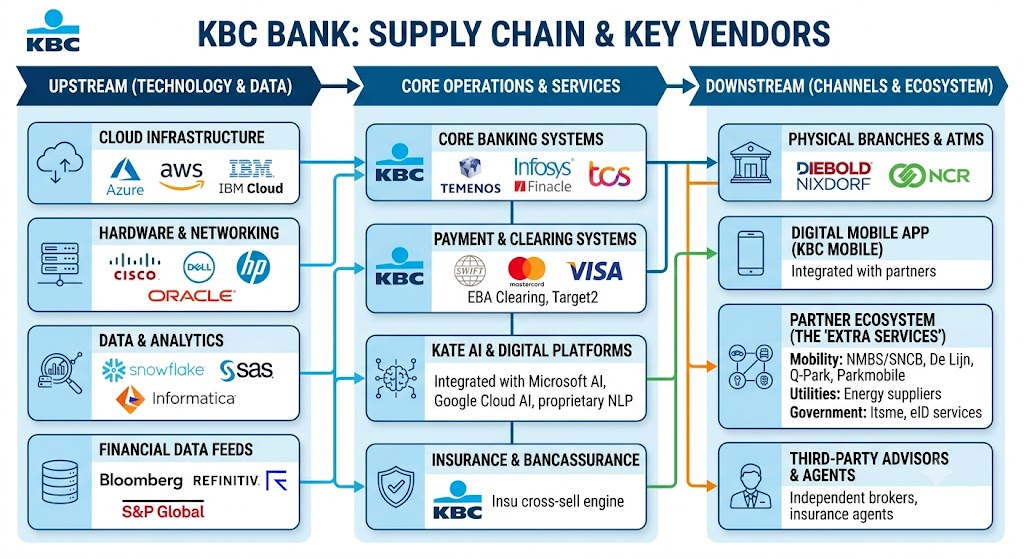
As a financial services group, KBC’s supply chain consists of upstream technology/infrastructure providers, financial market infrastructure, and downstream distribution ecosystems rather than raw physical materials.
- Upstream Infrastructure & Core Banking Tech:
- IT & Cloud Infrastructure: KBC relies heavily on strategic partnerships with major technology vendors such as IBM, Microsoft (Azure), and AWS for hybrid cloud computing, core banking modernization, and enterprise data architecture.
- Payment Systems & Clearing: Integrated with global payment clearing networks including SWIFT, Mastercard, Visa, and European TARGET2/EBA Clearing frameworks.
- AI & Digital Assistant Engine:KBC’s proprietary AI assistant, Kate, relies on deep integration with specialized natural language processing (NLP) platforms, real-time data streaming layers, and localized IT infrastructure.
- Downstream Distribution & Ecosystem Integration:
- Direct & Omnichannel Network:Operates through thousands of physical bank branches and insurance agency networks integrated directly into a digital-first mobile architecture.
- Bancassurance Cross-Selling:Front-end and back-end integration allows insurance products (KBC Insurance) to be distributed directly via banking application channels and vice versa.
- Third-Party Ecosystem Partnerships: Integrates non-banking service providers into its mobile app (e.g., public transport ticketing, parking services, and utility payment providers) to expand consumer touchpoints.
Competitor Analysis
KBC competes against major pan-European banking groups and domestic players across its primary operating regions.
- Main Competitors:BNP Paribas Fortis, ING Group, Belfius Bank, and Erste Group.
- Technological Comparison:
- Digital-First & AI Integration:KBC is widely recognized as a regional frontrunner in digital banking due to its proprietary AI assistant, Kate, which handles millions of customer interactions autonomously.Compared to BNP Paribas Fortis or Belfius, KBC has achieved a higher degree of end-to-end process automation and digital product adoption through its mobile ecosystem.
- Bancassurance Architecture: Unlike purely digital challenger banks or conventional lenders like ING (which primarily focuses on pure-play digital banking scalability), KBC’s software architecture seamlessly binds banking ledger systems with insurance policy engine data under a single digital front end.
- Financial Comparison:
- Profitability & ROE:KBC consistently outperforms many European peer banks in profitability, regularly generating a Return on Equity (ROE) around 13%–15%, compared to the European sector average often hovering between 8% and 11%.
- Cost-to-Income Ratio:Thanks to its high-density market penetration in Belgium and CEE along with digital automation, KBC maintains an efficient Cost-to-Income ratio (excl. bank taxes) around 41%–43%, outperforming traditional competitors like BNP Paribas and Deutsche Bank.
- Capital & Solvency: KBC holds a strong CET1 (Common Equity Tier 1) capital ratio around 14.9%–15.0%, providing a solid buffer well above regulatory requirements and supporting steady dividend payouts.
Sources
- https://en.wikipedia.org/wiki/KBC_Group
- https://www.kbc.com/en.html
- https://www.kbc.com/en/about-us/our-financial-performance.html
- https://strategy.transforml.co/kbc-strategy-cascade-analysis
- https://www.zoominfo.com/competitors/kbc-group-nv/102810731
Back to KBC