
History of KBC Group
Foundation and Early Roots (1889–1997)
The origins of KBC trace back to the establishment of Volksbank van Leuven in 1889 and the creation of Kredietbank in 1935. Over several decades, Kredietbank grew into one of Belgium’s premier financial institutions, closely linked with agricultural and regional cooperative networks, notably ABB Insurance and CERA Bank.
The Mega-Merger and Expansion (1998–2007)
In 1998, Kredietbank, CERA Bank, and ABB Insurance merged to form KBC Bank Insurance Holding. The unified entity pursued an aggressive expansion strategy into Central and Eastern Europe (CEE), acquiring dominant local institutions in the Czech Republic (ČSOB), Hungary (K&H), Slovakia, and Bulgaria.
Financial Crisis and Restructuring (2008–2013)
Hit hard by the 2008 global financial crisis due to exposure to structured credit products, KBC received a €7 billion bailout from the Belgian federal and Flemish regional governments. Under European Commission state-aid mandates, KBC underwent a massive divestment program, selling off international assets (such as KBL European Private Banking and its Asian operations) to repay the state aid with interest by 2015.
Digital Transformation and Consolidation (2014–Present)
Post-bailout, KBC refocused exclusively on its core markets in Western and Central Europe. It exited non-core markets, including a complete exit from Ireland in 2023. Simultaneously, the group launched an aggressive digital-first strategy, positioning itself as an AI-driven bank-insurer.
Business Model and Growth Strategy
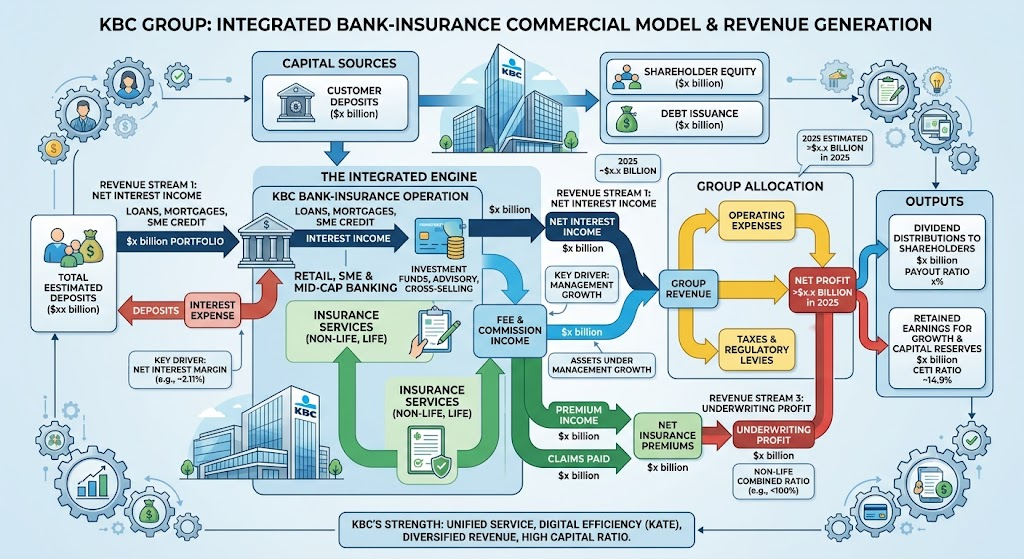
KBC generates income primarily through a dual-engine structure: net interest income from retail/commercial banking and fee/commission income from asset management and insurance underwriting.
- Net Interest Margin (Banking Engine): KBC gathers customer deposits and issues loans (mortgages, SME loans, corporate credit). In FY2025, total income reached €12.2 billion, supported by loan portfolio growth of 7% year-on-year to €208.6 billion. Net interest income remains its largest earnings driver, benefiting from a net interest margin around 2.11%.
- Integrated Bank-Insurance Synergies: Rather than treating banking and insurance as separate silos, KBC distributes both through unified channels. Non-life insurance combined ratios remain healthy at ~87% (where lower than 100% indicates underwriting profit).
- Fee and Commission Generation: Wealth management, investment funds, and payment processing generate steady recurring fee revenue. Assets under management reached elevated levels in 2025, driving fee income gains to offset interest rate fluctuations.
- Geographic Revenue Distribution: Belgium accounts for the vast majority of net profit (~€2.15 billion in FY2025), followed by the Czech Republic (~€922 million), and International Markets (~€814 million).
Sources for Business Model Information
- https://www.kbc.com/en/about-us/our-financial-performance.html
- https://umbrex.com/resources/company-profiles/kbc-groep/
- https://ml-eu.globenewswire.com/Resource/Download/b26f8bb5-f185-4510-9abc-b765dc0b375e
AI Strategy, Budget, and Key Partnerships
KBC’s digital strategy revolves around its “Digital-First” vision, centered on its proprietary AI virtual assistant, “Kate”.
- Core AI Product (“Kate”): Launched in 2020, Kate serves as an autonomous conversational assistant integrated directly into KBC’s mobile apps. It handles routine retail tasks (e.g., transfers, loan queries, insurance claims) without human intervention. Millions of customer queries are processed fully autonomously by Kate, significantly reducing front-line service desk expenses and improving the group’s cost-to-income ratio (down to ~41% in 2025 excluding banking taxes).
- Generative AI & Enterprise Integration: KBC utilizes Generative AI to assist back-office employees, summarizing client interactions, drafting routine advisory documents, and enhancing internal compliance checks.
- Investment & Budgetary Commitment: KBC consistently allocates hundreds of millions of euros annually to IT and digital transformation, with digital investments incorporated into its multi-year capital deployment strategy.
- Partnerships & Ecosystem Infrastructure: KBC partners with major technology enterprise providers to run its data architectures and cloud operations. Furthermore, KBC extends Kate’s functionalities beyond standard banking by connecting with external third-party services—allowing users to purchase public transport tickets, pay for parking, or access energy deals directly inside the application.
Back to KBC