
Company History
Foundation and Commercial Roots(1792-1988)
Jerónimo Martins founded the company in 1792 with a modest grocery store in Chiado, Lisbon. The business earned prestigious supplier status to the Portuguese Royal Household in the 19th century. In 1921, the dos Santos family took control of the enterprise, modernizing operations into wholesale distribution and establishing the structural foundation that would eventually lead to the group’s public listing on the Euronext Lisbon stock exchange in 1989.
Domestic Modernization and Strategic Alliances(1989-1994)
During the late 1980s and early 1990s, the company spearheaded modern grocery retail formats in Portugal. It launched the Pingo Doce supermarket chain in partnership with Dutch retailer Delhaize and expanded cash-and-carry operations under the Recheio brand. The group also formed a long-standing manufacturing joint venture with Unilever(FIMA/Unilever Jerónimo Martins) to manufacture and distribute consumer packaged goods in Portugal.
Polish Breakthrough with Biedronka(1995-2010)
The defining pivot occurred in 1995 when Jerónimo Martins entered Poland through the acquisition of the fledgling Biedronka discount chain. Recognizing Poland’s post-communist economic transition and massive unorganized retail sector, the group rolled out a high-volume, low-cost hard-discount model. Biedronka scaled from a regional network to Poland’s undisputed retail grocery leader, permanently shifting the group’s primary revenue engine from Iberia to Central and Eastern Europe.
International Diversification and Digital Transformation(2011-Present)
In 2013, the group entered Latin America by launching Ara, a discount food chain in Colombia designed to replicate Biedronka’s value proposition in an emerging market. In Portugal, Pingo Doce transformed into a hybrid supermarket-foodservice model featuring extensive ready-to-eat meal solutions. Today, the group focuses on omni-channel logistics, digital loyalty programs, automated supply chain forecasting, and selective European expansion, including entry into the Slovakian market.
Business Model and Growth Strategy
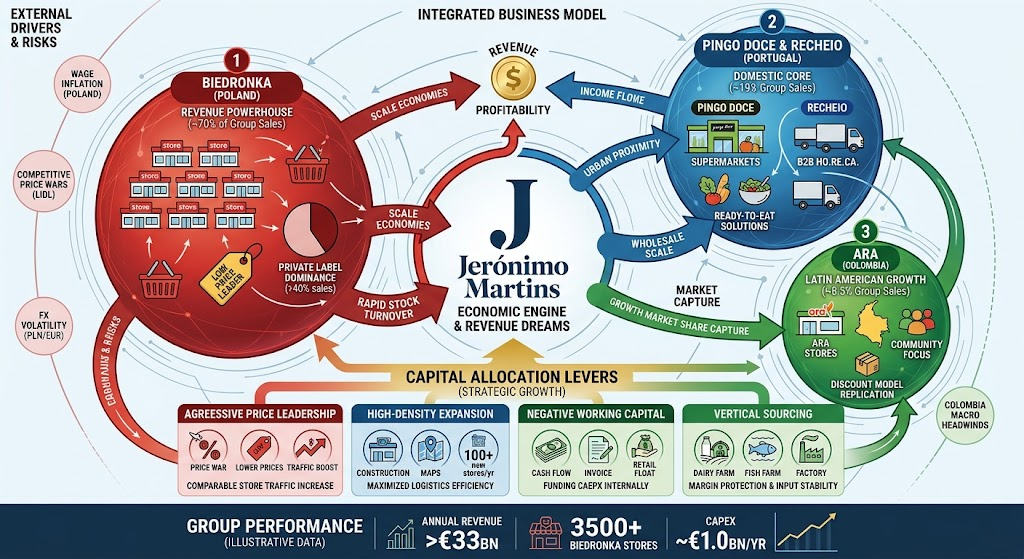
Jerónimo Martins generates revenue primarily through retail grocery sales, operating high-volume, low-margin food retail banners anchored by private-label penetration and scale economies. The group monetizes its footprint through three primary business units:
- Biedronka(Poland): The economic cornerstone, generating approximately 70% of total group turnover(delivering over €23.5 billion annually). The banner operates over 3,500 stores using an efficient proximity-discount format. Monetization relies on rapid stock turnover, a focused assortment dominated by private labels(over 40% of retail sales), and massive localized procurement volumes that squeeze supplier pricing while undercutting traditional supermarkets.
- Pingo Doce and Recheio(Portugal): Contributing roughly 19% of consolidated revenue, Pingo Doce(over €5 billion in sales) functions as an urban supermarket leader focused on fresh produce and proprietary central-kitchen meal solutions, securing higher retail gross margins than pure discount formats. Recheio generates over €1.3 billion through B2B cash-and-carry wholesaling, capturing cash flows from the HoReCa(Hotels, Restaurants, and Cafés) sector.
- Ara(Colombia): Accounting for approximately 8.5% of revenue(over €2.85 billion), Ara operates over 1,300 proximity discount stores. The monetization thesis targets long-term market share aggregation in Latin America by replacing fragmented, informal corner stores with low-priced neighborhood grocery chains.
The corporate development strategy focuses on four capital allocation levers:
- Aggressive Price Leadership: Sacrificing marginal gross margin to maintain a measurable price gap against competitors, driving comparable store customer traffic and basket size.
- High-Density Network Expansion: Opening 100-200 net new stores annually across Poland and Colombia, maximizing regional distribution center efficiency.
- Negative Working Capital Exploitation: High inventory turn velocity paired with standard retail vendor payment terms generates positive structural float, funding internal capital expenditures without excessive debt reliance.
- Vertical Sourcing Integration: Investments in proprietary agribusiness(dairy, aquaculture, and fresh produce) through Jerónimo Martins Agro-Alimentar protect key product margins and mitigate input price shocks.
Business Model Information Sources
- https://reports.jeronimomartins.com/annual-report/2024/_assets/downloads/mgr-management-report-jeronimomartins-ar24.pdf
- https://reports.jeronimomartins.com/annual-report/2024/_assets/downloads/ovw-overview-jeronimomartins-ar24.pdf
- https://reports.jeronimomartins.com/annual-report/2025/
- https://www.jeronimomartins.com/en/about-us/who-we-are/our-approach-to-business/
AI Development Strategy, Budget, and Partnerships
Jerónimo Martins approaches Artificial Intelligence pragmatically, prioritizing operational efficiency, inventory shrink reduction, dynamic replenishment, and personalized customer engagement over speculative foundation model development.
- Strategic Focus Areas:
- Demand Forecasting and Replenishment: Machine learning algorithms analyze historical checkout data, localized weather forecasts, foot traffic, and promotion elasticity across thousands of stores to optimize daily perishable inventory ordering and decrease food waste.
- Computer Vision and Autonomous Retail: In collaboration with enterprise software platforms such as OutSystems, the group developed its “Store of the Future” laboratory store, deploying ceiling and shelf-mounted computer vision cameras and sensor fusion to automate stock tracking, trigger real-time restocking alerts, and run unattended 24/7 self-service formats.
- Personalized Retail Media and Loyalty Systems: AI engines power customer basket analysis within the Moja Biedronka loyalty program(covering over 10 million active users in Poland), automatically generating tailored dynamic promotions and app-based discounting.
- Technology Partnerships:
- Enterprise Core and AI Deployment: The group partners with SAP for core ERP and predictive logistics, Microsoft Azure for cloud-based machine learning data pipelines, and OutSystems for low-code/rapid AI microservice deployments.
- Logistics and Delivery Platforms: In Poland, Biedronka partners with Glovo for algorithmically dispatched on-demand delivery, leveraging route optimization and predictive order assembly algorithms.
- Budget and Investment Allocation:
- The group embeds AI and digital engineering within its broader operational Capex program(which historically ranges between €1.0 billion and €1.2 billion annually). Digital, IT modernization, and supply chain automation represent an estimated 5% to 8% of this total annual capital expenditure(approximately €50 million to €100 million per year dedicated to enterprise digital systems, data governance, and automated logistics infrastructure).
Back to Jeronimo Martins