
Market Position and Market Share
Japan Post Holdings Co., Ltd. (TYO: 6178) operates as a massive state-linked conglomerate managing postal logistics, banking, and life insurance services through its primary operating subsidiaries: Japan Post Co., Japan Post Bank (TYO: 7182), and Japan Post Insurance (TYO: 7181). The Japanese government legally retains an anchor equity stake of over one-third in the holding company.
- Domestic Mail and Parcel Logistics (Japan Post Co.): Holds a near-total monopoly (approx. 99% market share) in traditional addressed letter mail and postcards under universal service obligations. In the competitive domestic parcel delivery segment (Takkyubin/express parcels), Japan Post ranks #3 with its Yu-Pack service, commanding roughly 11% to 12% market share, trailing Yamato Transport (approx. 47%) and Sagawa Express (approx. 27%). In the flat-rate lightweight mail-parcel segment (Yu-Packet/Letter Pack), Japan Post maintains a larger share (over 25%).
- Banking and Retail Deposits (Japan Post Bank): Operates the largest retail deposit base in Japan. With approximately ¥190 trillion to ¥195 trillion in deposits across over 23,000 nationwide post office branches, it ranks #1 in Japan by retail deposit volume, outpacing megabanks such as Mitsubishi UFJ Financial Group (MUFG), Sumitomo Mitsui Financial Group (SMFG), and Mizuho Financial Group in pure domestic retail retail deposit count.
- Life Insurance (Japan Post Insurance / Kampo): Ranks among the top life insurers in Japan by total assets (exceeding ¥60 trillion), generally placing in the top 3 to top 4 alongside Nippon Life (Nissay), Dai-ichi Life, and Meiji Yasuda Life. Its market share in individual insurance policies in force sits at approximately 12% to 14%.
Supply Chain and Key Suppliers Analysis
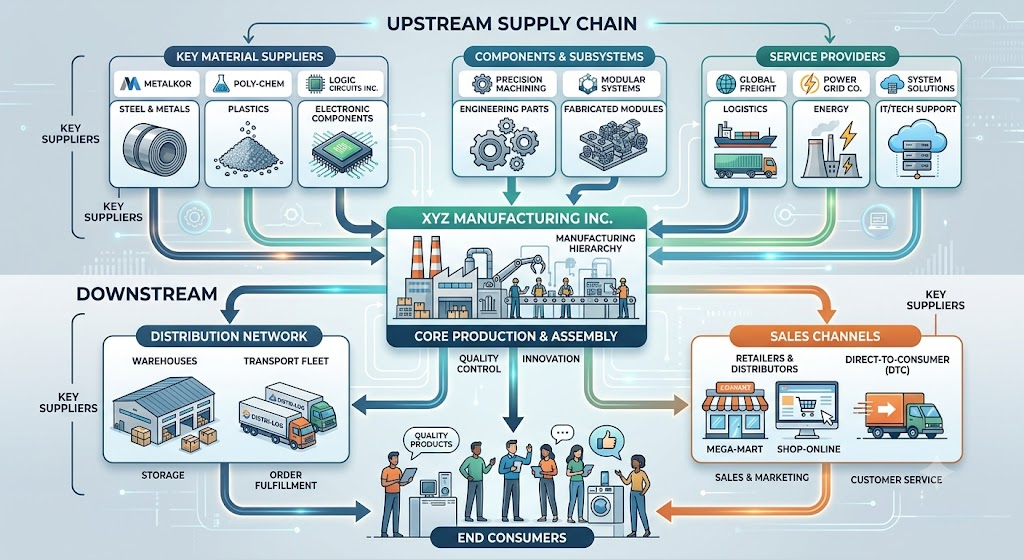
Japan Post Holdings operates a hybrid infrastructure model spanning logistics and financial intermediary services.
Upstream (Procurement and Key Vendors)
- Fleet and Mobility Providers: Procures and maintains an extensive fleet of light commercial vans, trucks, and two-wheeled delivery vehicles. Key vehicle suppliers include Honda Motor Co. (electric delivery scooters like the Benly e:), Suzuki Motor, and Toyota Motor / Daihatsu (kei-class commercial vans). Japan Post has partnered with commercial EV venture startups and OEMs to transition its urban delivery fleet toward battery electric platforms.
- Sorting Equipment and Automation Technology: Core mail and parcel sorting machines are supplied by specialized Japanese heavy technology conglomerates, predominantly Toshiba Corporation and NEC Corporation, which engineer high-speed optical character recognition (OCR) mail-sorting and automated parcel handling systems.
- IT Infrastructure, Mainframes, and Core Banking Platforms: Japan Post Bank and Japan Post Insurance rely heavily on legacy and modern enterprise system integration providers. Key technology vendors include NTT DATA (primary system integrator and network infrastructure provider), Hitachi, and Fujitsu, alongside enterprise software providers such as Salesforce and Oracle for customer relationship and cloud data modernization.
- Aviation and Rail Freight Transportation: For long-haul domestic line-haul transport, Japan Post procures cargo capacity from Japan Freight Railway Company (JR Freight) and domestic airlines, including Japan Airlines (JAL) and All Nippon Airways (ANA), as well as dedicated joint freighter operations.
Downstream (Distribution and Delivery Network)
- Retail Counter Network: A proprietary network of over 23,000 post offices nationwide acting as universal distribution nodes for logistics drop-offs, banking counters, and insurance consultations.
- Corporate and E-Commerce Clients: Primary B2B clients include major e-commerce platforms such as Rakuten Group (which entered a capital and business alliance with Japan Post), Amazon Japan, and Mercari, who utilize Yu-Pack and Yu-Packet fulfillment networks.
- Last-Mile Independent Contractors: Relies on a hybrid workforce comprising direct postal employees and thousands of outsourced regional logistics contractors (subcontracted transport companies and owner-operators) to absorb peak delivery volumes.
Competitor Analysis: Technical and Financial Comparison
Because Japan Post Holdings operates as a conglomerate, its competitive landscape is divided between logistics and commercial financial institutions.
Logistics Segment: Japan Post Co. vs. Yamato Holdings and SG Holdings (Sagawa)
- Technical Infrastructure Comparison: Yamato Holdings and SG Holdings operate far superior digitized sortation routing and dynamic scheduling architectures. Yamato’s “NEKO System” and SG’s automated fulfillment hubs (such as X Frontier) feature advanced automated guided vehicles (AGVs) and machine learning dispatch algorithms. Japan Post’s sorting infrastructure has historically leaned on centralized legacy OCR systems for flat mail; however, it has increasingly deployed automated package sortation and locker networks (PUDO partnership with Packcity Japan) to narrow the efficiency gap.
- Financial and Operational Profile:
- Margins: Yamato and SG Holdings maintain higher logistics operating margins (typically 3% to 6%) compared to Japan Post’s postal and logistics arm, which consistently runs near breakeven or at an operating loss due to the high fixed cost of mandated nationwide daily mail delivery amidst secular volume declines.
- Pricing Power: Yamato and Sagawa possess greater corporate contractual pricing leverage to pass on fuel surcharges and labor inflation compared to Japan Post, whose standard postage adjustments face heavier regulatory oversight.
Financial Segments: Japan Post Bank and Insurance vs. Megabanks and Private Insurers
- Financial Institutions Comparison (Japan Post Bank vs. MUFG / SMFG):
- Asset Allocation and Yield: Japan Post Bank is subject to strict regulatory constraints under the Postal Privatization Act. Unlike MUFG or SMFG, which generate robust net interest margins (NIM) through extensive corporate syndicated lending, overseas expansion, and investment banking, Japan Post Bank has historically deployed its balance sheet heavily into Japanese Government Bonds (JGBs), foreign securities, and alternative investment funds with limited direct corporate lending. This results in structurally lower return on assets (ROA) and return on equity (ROE) (typically 3% to 4% ROE vs. 7% to 9% for private megabanks).
- Digital Banking: Private megabanks lead in digital-native retail apps, cross-border corporate treasury, and wealth management, whereas Japan Post Bank retains superior physical branch penetration in aging, rural Japanese municipalities.
- Insurance Comparison (Japan Post Insurance vs. Nippon Life / Dai-ichi Life):
- Distribution and Solvency: Japan Post Insurance maintains an exceptionally high Solvency Margin Ratio (typically exceeding 900% to 1,000%), reflecting deep capital conservation. However, Nippon Life and Dai-ichi Life possess stronger product development capabilities in foreign-currency-denominated annuities, whole-life medical riders, and global asset management acquisitions, while Japan Post Insurance focuses on standardized endowment and whole-life policies distributed via post office windows.
Sources
- https://www.japanpost.jp/en/
- https://www.jp-bank.japanpost.jp/en/
- https://www.jp-life.japanpost.jp/en/
- https://www.post.japanpost.jp/index_en.html
- https://www.forbes.com/companies/japan-post-holdings/
- https://en.wikipedia.org/wiki/Japan_Post_Holdings
back to Japan Post Holdings