
Company History
- Founding and Pre-War Expansion (1875-1945): The postal savings system was founded in 1875 by Maejima Hisoka, who modeled it after the postal savings framework of the United Kingdom. During the Meiji era and the lead-up to World War II, the system mobilized household savings to fund national modernization and wartime production through government bond purchases.
- Post-War Reconstruction (1945-1970s): Following the disarray and severe inflation of World War II, which destroyed records for millions of accounts, the postal savings system gradually rebuilt public trust. It became a primary engine for gathering household capital to fuel Japan’s post-war economic miracle and industrial financing via the Fiscal Investment and Loan Program (FILP).
- Privatization and Corporate Formation (2006-2015): In response to long-standing political drives to reform public sector entities, legislation was passed to privatize the postal services. Japan Post Bank was officially incorporated on September 1, 2006, began standalone operations in October 2007, and subsequently completed its initial public offering on the Tokyo Stock Exchange in November 2015.
- Modern Portfolio Diversification (2016-Present): Facing protracted negative and ultra-low interest rate policies by the Bank of Japan, the bank transitioned away from heavy reliance on traditional Japanese government bonds. It expanded significantly into risk assets, alternative investments like private equity and real estate funds, and foreign securities to secure higher yields.
Business Model and Growth Strategy
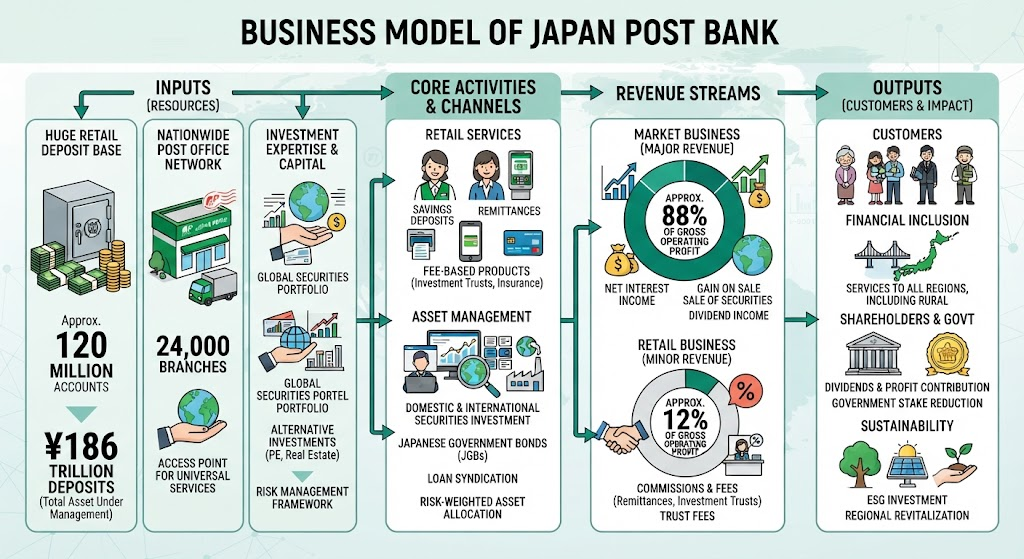
Japan Post Bank operates on a distinct financial model that combines characteristics of a massive retail deposit-taker with those of a giant institutional asset manager. The bank generates revenue primarily through two channels: its Retail Business and its Market Business.
The Retail Business focuses on routine banking services, including savings deposits, domestic and international remittances, settlement services, and fee-based asset management products like investment trusts and government bonds. However, retail fees and commissions account for only about 12% of gross operating profit.
The vast majority of revenue—approximately 88%—is derived from its Market Business. This segment involves investing the bank’s massive pool of retail deposits (totaling roughly ¥186 trillion across approximately 120 million accounts) into domestic and foreign securities, Japanese government bonds, and alternative asset classes such as private equity funds and real estate equity. Under its current medium-term management plan, the bank aims to drive non-linear growth through disciplined risk-asset allocation, targeting a net income of ¥1 trillion or higher and an ROE of around 10%.
AI Development Strategy and Digital Transformation
Japan Post Bank is actively pursuing digital transformation to streamline its extensive operational footprint and enhance customer engagement. The bank’s technology strategy centers on upgrading its legacy core banking systems, expanding digital touchpoints through applications like the Japan Post Bank Passbook App, and automating back-office administrative workflows.
To improve efficiency and combat rising labor shortages in regional areas, the bank integrates robotic process automation and data analytics into customer service operations and risk management frameworks. While specific multi-billion-dollar standalone artificial intelligence budgets are not isolated from broader IT capital expenditure, collaborative initiatives involve partnering with major technology vendors and fintech solution providers to deploy secure cloud infrastructure, digital identity verification systems, and automated fraud detection models. These digital investments aim to optimize cost structures across its expansive nationwide post office network while transitioning traditional savers toward digital self-service channels.
back to Japan Post Bank