
Market Position and Market Share
ITOCHU Corporation(8001.T)is one of Japan’s “Big Five” general trading companies(sogo shosha),alongside Mitsubishi Corporation,Mitsui & Co.,Sumitomo Corporation,and Marubeni Corporation.Within this cohort,ITOCHU ranks #2 to #3 in market capitalization and net profit(frequently competing with Mitsui & Co.for the second position behind Mitsubishi Corporation,while periodically capturing the #1 spot in net profit during commodity downcycles due to its asset mix).
Unlike traditional peers whose revenues are heavily anchored in upstream mining,oil,and LNG,ITOCHU’s core differentiation lies in its dominance in consumer-facing,non-resource sectors:
- Earnings Composition: Over 75-80% of ITOCHU’s net profit originates from non-resource businesses(consumer goods,food,textiles,machinery,ICT,and general products),representing the highest non-resource earnings ratio among the Big Five.
- Convenience Retail Market Share: Through its consolidated subsidiary FamilyMart Co.,Ltd.,ITOCHU holds approximately 25-27% of the Japanese convenience store market by store count(operating over 16,300 domestic locations),firmly establishing itself as the #2 convenience store chain in Japan behind Seven & i Holdings(7-Eleven,~31%)and ahead of Lawson(~21%).
- Food Distribution & Textile Wholesale: ITOCHU commands the #1 wholesale trading position in Japan for textiles and apparel brand management(holding exclusive distribution/licensing for brands such as Converse Japan,Descente,and LeSportsac).Through its subsidiary Nippon Access,Inc.,it controls roughly 18-20% of Japan’s processed food wholesale market,ranking as a co-market leader alongside Mitsubishi’s Mitsubishi Shokuhin.
- Global Pulp & Resources: Through its investment in Brazil’s Cenibra(Celulose Nipo-Brasileira)and related entities,ITOCHU accounts for over 15% of Japan’s bleached eucalyptus kraft pulp imports.
Supply Chain Upstream/Downstream and Key Suppliers
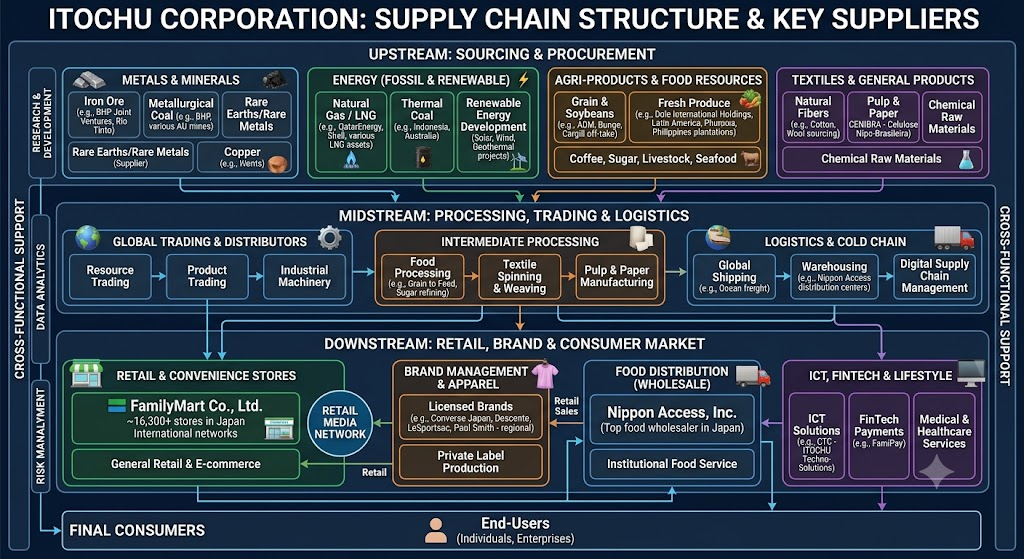
ITOCHU operates an end-to-end “downstream-to-upstream” supply chain model,distinguished from traditional resource trading firms by starting with consumer demand and pulling goods through logistics and upstream procurement.
- Upstream(Sourcing & Concessions):
- Agricultural & Soft Commodities: ITOCHU secures raw grains,soybeans,sugar,and coffee via long-term off-take agreements and equity stakes in grain elevators across North America,Latin America,and Australia.Through its historical stake in Dole International Holdings,it sources fresh fruit directly from plantations in the Philippines and South America.
- Metals,Minerals & Energy: While underweight relative to peers,upstream positions include stakes in Australian iron ore and metallurgical coal mines(such as investments alongside BHP in Western Australia),North American renewable energy developments,and equity-method investments in Indonesian thermal coal and LNG liquefaction facilities.
- Key Upstream Suppliers/Partners:BHP Group(iron ore/metallurgical coal joint ventures),CITIC Limited(broad strategic partnership in China across trade and industrial finance),and global agricultural originators across the Americas.
- Midstream(Processing,Trading & Logistics):
- Intermediate Processing: Food processing plants convert raw grain and animal feed into food components.Its chemical and plastics division handles the import and processing of synthetic resins,organic chemicals,and basic petrochemicals.
- Wholesale & Cold Chain Infrastructure:Nippon Access operates temperature-controlled distribution centers across Japan,providing daily just-in-time delivery logistics.
- Machinery & Industrial Infrastructure: ITOCHU distributes heavy equipment,automotive systems,and industrial plant machinery,integrating automation equipment into consumer manufacturing lines.
- Downstream(Retail,Brand Operations & Direct Consumers):
- Retail Distribution:FamilyMart serves as the primary consumer touchpoint,processing transactions for millions of daily retail customers and generating consumer behavioral datasets.
- Brand & Licensing Operations: ITOCHU controls regional master licensing,product manufacturing rights,and brand management for apparel,footwear,and lifestyle retail across East Asia.
- Digital/Fintech Integration: Digital ad networks(via FamilyMart’s in-store digital signage and retail media networks)and payment settlement systems(FamiPay)connect the physical retail network back to consumer analytics.
Competitor Analysis: Technical and Financial Comparison
ITOCHU’s primary competitors are the other four Japanese sogo shosha: Mitsubishi Corporation(8058.T),Mitsui & Co.(8031.T),Sumitomo Corporation(8053.T),and Marubeni Corporation(8002.T).
Financial Profile & Efficiency Comparison
| Financial Metric | ITOCHU Corporation | Mitsubishi Corporation | Mitsui & Co. | Sumitomo Corporation | Marubeni Corporation |
| Primary Profit Driver | Non-resource(Consumer,Food,ICT) | Mixed(Metals,Natural Gas,Automotive) | Upstream Resources(LNG,Iron Ore) | Mixed(Tubular goods,Infrastructure,Media) | Non-resource & Food/Agri(Gavilon legacy,power) |
| ROE Profile(Cycle Average) | 14% – 17%(Consistently highest) | 11% – 14% | 12% – 15% | 8% – 11% | 11% – 13% |
| Gross Margin Structure | High(15% – 17% via consumer/retail) | Moderate(8% – 10%) | Lower(Commodity volume/equity-heavy) | Moderate(8% – 11%) | Moderate(7% – 9%) |
| Earnings Volatility | Low(Defensive cash flow profile) | High(Tied to coking coal,copper,LNG) | Very High(Tied to oil,LNG,iron ore) | Moderate to High | Moderate |
| Net Debt-to-Equity Ratio | ~0.5x – 0.6x | ~0.6x – 0.7x | ~0.5x – 0.6x | ~0.7x – 0.8x | ~0.7x – 0.8x |
- Profitability & ROE: ITOCHU consistently achieves the highest Return on Equity(ROE) and Return on Invested Capital(ROIC) among the Big Five.Because consumer businesses require less massive,lumpy capital expenditure than offshore LNG or deep-sea copper exploration,ITOCHU generates higher asset turns and superior margin stability.
- Downside Defense: During global commodity recessions,ITOCHU’s net profit often overtakes Mitsubishi and Mitsui,whose bottom lines compress severely when oil,coking coal,and iron ore prices collapse.Conversely,during hyper-inflationary resource supercycles,Mitsubishi and Mitsui generate higher peak net income surges.
Strategic and Technical Capabilities
- Downstream Data & Retail Media Architecture: Unlike Mitsubishi(which partially divested operational control of Lawson to a joint structure with KDDI)or Mitsui,ITOCHU fully consolidated FamilyMart,turning its 16,000+ stores into a localized data-collection and digital advertising platform.ITOCHU leads in retail media infrastructure,monetizing customer traffic via targeted in-store digital screens and retail data alliances with data platforms.
- Supply Chain Digitalization & Traceability: ITOCHU leads peers in supply chain traceability for consumer products,implementing blockchain-based tracking for sustainable cotton,textiles,and deforestation-free pulp/palm oil to satisfy strict EU and US ESG procurement rules.
- Capital Allocation Discipline: ITOCHU operates with strict hurdle rates on M&A,prioritizing bolt-on downstream acquisitions with immediate cash flows over speculative mega-concessions.Competitors like Mitsubishi and Mitsui maintain superior technical engineering capabilities in mega-project management(e.g.,hydrogen/ammonia export terminals,deepwater offshore drilling,and carbon capture and storage/CCS technologies),where ITOCHU remains primarily an off-taker or minority co-investor rather than a technical operator.
Information Sources
- https://www.itochu.co.jp/en/ir/finance/highlights/index.html
- https://www.itochu.co.jp/en/ir/financial_statements/index.html
- https://www.itochu.co.jp/en/ir/library/annual_report/index.html
- https://www.mitsubishicorp.com/jp/en/ir/
- https://www.mitsui.com/jp/en/ir/
- https://www.bloomberg.com/quote/8001:JP
Back to Itochu