
Corporate History
Founding and Textile Roots (1858–1940s)
The company traces its origin to 1858, when founder Chubei Itoh began traveling merchant operations selling linen in the Kansai region. Operating under the Ohmi merchant philosophy of “Sampo-yoshi” (good for the seller, buyer, and society), the business incorporated in 1918. Through the pre-war era, it established dominance in domestic and regional textile trade, building the commercial base that supported its modern expansion.
Post-War Reconstruction and Conglomerate Expansion (1950s–1980s)
Following post-war dissolution and restructuring, ITOCHU transformed from a specialized textile trader into an integrated general trading house. It diversified rapidly into machinery, petroleum, metals, and chemicals. During this era, ITOCHU financed Japanese heavy industrial exports, established overseas offices across North America and Southeast Asia, and laid the foundations for its long-term distribution networks.
Balance Sheet Overhaul and Non-Resource Pivot (1990s–2000s)
The collapse of Japan’s bubble economy saddled the firm with substantial real estate and non-performing asset write-downs. Under leadership that prioritized return on equity (ROE) and capital discipline, ITOCHU executed aggressive asset cleanups. It strategically reallocated capital away from cyclical, upstream mining projects toward steady cash-flow businesses in food distribution, brand licensing, and retail, setting the stage for its acquisition of FamilyMart.
Consolidation, Privatizations, and Berkshire Investment (2010s–Present)
In 2015, ITOCHU partnered with Thailand’s CP Group to invest over $10 billion into China’s CITIC Limited. In 2020, ITOCHU took convenience store chain FamilyMart private in a roughly ¥580 billion transaction to control customer data and store-level operations directly. That same year, Berkshire Hathaway acquired an initial 5% stake in ITOCHU (subsequently increased across the top trading houses). In late 2023, ITOCHU completed a take-private transaction for its listed systems integrator subsidiary, ITOCHU Techno-Solutions (CTC), for approximately ¥386 billion to accelerate enterprise digital transformation.
Business Model and Growth Strategy
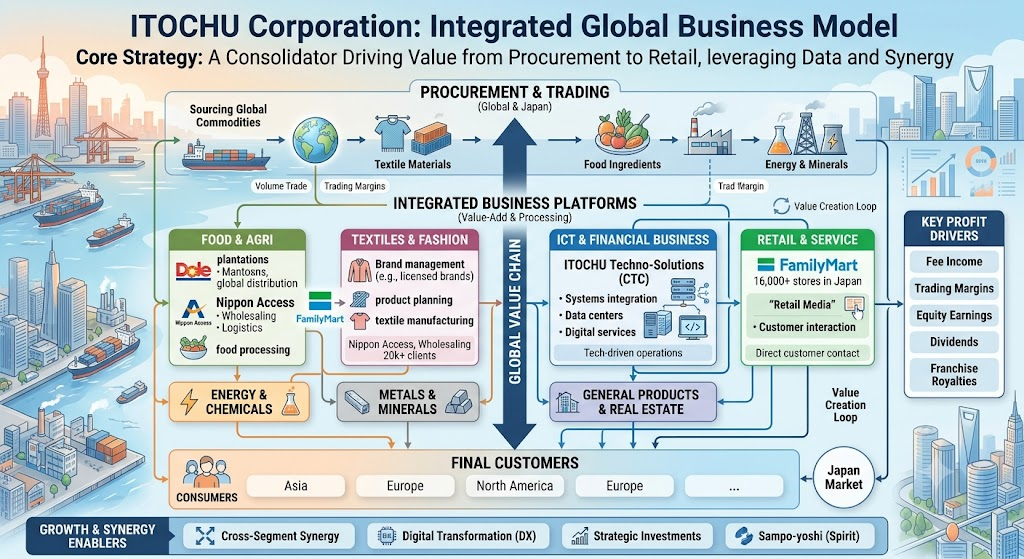
ITOCHU’s core profit engine centers on acquiring majority stakes or significant operating control in customer-facing and midstream enterprises, generating recurring earnings via fee streams, trading margins, franchise royalties, and dividend yields rather than passive minority holdings. The group targets consolidated net profit exceeding ¥800 billion to ¥900 billion annually, maintaining return on equity (ROE) targets consistently above 15%.
The operational cash flow model functions through distinct profit pillars:
- The Downstream Retail and Food Value Chain: Through FamilyMart (operating over 16,000 stores across Japan), Nippon Access (one of Japan’s largest food wholesalers), and global agribusinesses like Dole, ITOCHU captures value at every transaction point. It earns merchant margin on commodity procurement, distribution fees via logistics hubs, and franchise fee percentages on retail sales.
- Non-Resource Industrial Franchises: Its Machinery and ICT divisions leverage controlling operational assets to extract high-margin service revenue. Subsidiaries such as ITOCHU Techno-Solutions (CTC) generate recurring systems integration, enterprise software deployment, and maintenance fees from financial institutions, telecom carriers, and manufacturers.
- Capital Allocation and Cash Conversion: ITOCHU deploys free cash flow into asset optimization, targeting bolt-on acquisitions that immediately add earnings per share, maintaining a minimum dividend payout ratio of around 30% to 40% with continuous share buybacks. Its growth strategy prioritizes capital-light expansions in renewable energy, circular economy value chains, and supply-chain digitization over deep-water oil fields or greenfield mines.
Sources for Business Model Information
- https://www.itochu.co.jp/en/ir/doc/annual_report/online2019/segment.html
- https://www.itochu.co.jp/en/ir/financial_statements/2024/__icsFiles/afieldfile/2024/06/06/24_ended_02_e.pdf
- https://www.itochu.co.jp/en/files/ar2025E.pdf
- https://umbrex.com/resources/company-profiles/itochu-corp/
AI Strategy, Budget, and Partnerships
ITOCHU approaches artificial intelligence not merely as an internal efficiency tool, but as a commercial offering deployed across its network of operating subsidiaries and client infrastructure.
Enterprise Digitization through CTC
The strategic foundation of ITOCHU’s AI roadmap is ITOCHU Techno-Solutions (CTC). By privatizing CTC in late 2023 in an equity transaction valued at approximately ¥386 billion, ITOCHU removed subsidiary minority interests to freely cross-deploy CTC’s roughly 9,000 engineers and data architects across its retail and supply chain operations. CTC operates enterprise-scale AI testing environments, deploying NVIDIA AI infrastructure (including DGX systems) and hybrid multi-cloud integration architectures for corporate clients across Japan.
Consortiums and Dedicated AI Entities
ITOCHU formed a dedicated Generative AI Research Lab in collaboration with data science provider BrainPad, SIGMAXYZ, and CTC. This partnership focuses on deploying proprietary enterprise large language model (LLM) workflows, automating business analysis, trade documentation, and operational reporting across all corporate divisions. In May 2025, ITOCHU further formalized this capability by establishing a new technological venturing and digital integration company to coordinate investments across its portfolio of over 100 venture capital fund partnerships and 200 direct tech startup investments.
Store-Level Edge AI and Retail Media Deployment
At the operational retail level, FamilyMart represents ITOCHU’s primary testbed for physical AI integration:
- Autonomous Checkout and Inventory Vision: In partnership with Japanese startup Touch To Go (TTG), FamilyMart deployed unstaffed, computer-vision checkout stores that eliminate scanning through overhead ceiling sensors and real-time shelf weight tracking.
- Robotics Integration: FamilyMart partnered with Telexistence to roll out AI-driven robotic shelf-stocking systems (“T-E-X”) across selected high-volume stores, utilizing ceiling-mounted cameras and visual recognition algorithms to monitor beverage replenishment cycles.
- Retail Media Network (FamilyMartVision): By deploying large-format digital signage across more than 10,000 FamilyMart stores, ITOCHU monetizes physical foot traffic via data-driven advertising engines. The ad platform optimizes dynamic screen content based on demographic foot-traffic estimates, store location data, and direct point-of-sale receipt patterns.
Back to Itochu