
Market Position and Market Share
Ipsen S.A. is a French mid-cap global specialty biopharmaceutical company with FY 2025 total sales of €3,675.9m (an 8.1% reported growth and 10.9% at constant exchange rates) and a core operating margin of 35.2%.The company concentrates on three therapeutic franchises: Oncology (representing approximately 67% to 70% of total sales), Neuroscience (approximately 20% to 22%), and Rare Disease (approximately 8% to 10%, growing over 100% year-over-year).
- Oncology (Lanreotide / Somatuline): Ipsen ranks second globally behind Novartis (Sandostatin/octreotide) in the somatostatin analogue (SSA) market for neuroendocrine tumors (NETs) and acromegaly, holding an estimated global volume share of 38% to 42% (estimated based on market tracking). Somatuline generated over €1.15b in sales in 2025, maintaining resilient pricing and market share due to technical manufacturing bottlenecks faced by generic entrants. Cabometyx (ex-US rights licensed from Exelixis) maintains a leading position in second-line renal cell carcinoma (RCC) and second-line hepatocellular carcinoma (HCC) across Europe, holding an estimated 25% to 30% second-line RCC market share in major EU markets.
- Neuroscience (Dysport / AbobotulinumtoxinA):Ipsen holds the second-largest global volume position in the neurotoxin market behind AbbVie (Botox), holding an estimated 18% to 22% global market share in therapeutics (spasticity, cervical dystonia) and facial aesthetics (partnered with Galderma).
- Rare Disease (Bylvay and Iqirvo):Bylvay (odevixibat) holds a pioneering position in progressive familial intrahepatic cholestasis (PFIC) and Alagille syndrome.Iqirvo (elafibranor), approved for second-line primary biliary cholangitis (PBC), competes directly as a first-in-class PPAR agonist against Gilead’s Livdelzi (seladelpar) and Intercept’s Ocaliva, capturing an estimated 15% to 20% share in newly treated second-line PBC patients in launched territories.
Supply Chain Upstream, Downstream, and Key Suppliers
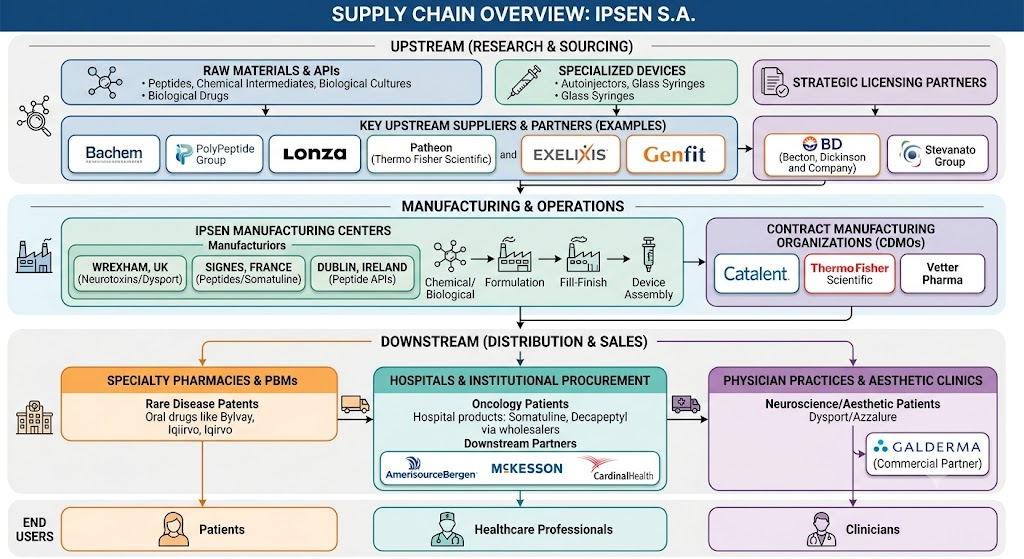
Ipsen operates a hybrid manufacturing and externalized sourcing model, balancing internal proprietary manufacturing with strategic active pharmaceutical ingredient (API) sourcing and contract development and manufacturing organizations (CDMOs).
- Upstream Supply Chain and Raw Materials:
- Peptides and Complex Biologics Synthesis: The production of Somatuline (a cyclic octapeptide) relies on solid-phase peptide synthesis and complex sustained-release gelling technology. Intermediate chemical reagents, amino acid derivatives, and specialized polymer carriers are sourced from specialized European chemical suppliers (including Bachem and PolyPeptide Group).
- Biological Fermentation: Dysport is derived from Clostridium botulinum cultures. Fermentation, protein purification, and formulation require specialized media and stringent bio-safety Level 3 containment standards at Ipsen’s dedicated manufacturing center in Wrexham, UK.
- Active Pharmaceutical Ingredients (APIs): For licensed small molecules like cabozantinib (Cabometyx), upstream chemical synthesis of the bulk drug substance is tied to Exelixis’ validated primary chemical suppliers (e.g., Lonza, Patheon/Thermo Fisher Scientific).
- Specialized Device and Primary Packaging: Somatuline’s pre-filled, needle-shielded autoinjector system relies on precision medical device component suppliers, such as BD (Becton, Dickinson and Company) and Stevanato Group for glass syringes, plunger stoppers, and automated safety injection casings.
- Internal Manufacturing Footprint:
- Wrexham (UK): Global hub for neurotoxin production, fill-finish, and formulation of Dysport.
- Signes (France): Center of excellence for peptide formulation, sterilization, and automated assembly of Somatuline autoinjector devices.
- Dublin (Ireland): Chemical synthesis and peptide active ingredient production.
- Key Suppliers and Strategic Licensing Partners:
- Exelixis: Licensor and primary upstream synthesis coordinator for Cabometyx (cabozantinib) for ex-US commercialization.
- Galderma: Downstream co-development, aesthetic distributor, and commercial partner handling Dysport/Azzalure aesthetic sales worldwide.
- Genfit: Licensor for Iqirvo (elafibranor) supplying drug technology and development support.
- Catalent / Thermo Fisher Scientific / Vetter Pharma: Secondary fill-finish, clinical trial packaging, and backup commercial production CDMOs for injectable formulations.
- Downstream Distribution Channels:
- Hospital and Institutional Procurement: Oncology and hospital specialty products (Somatuline, Decapeptyl, Onivyde) move via national healthcare tenders, central hospital purchasing bodies (e.g., NHS in the UK, UniHA in France), and pharmaceutical wholesalers (AmerisourceBergen/Cencora, McKesson, and Cardinal Health in North America).
- Specialty Pharmacies: Used for rare disease oral therapies (Bylvay, Iqirvo) requiring cold-chain distribution, patient support programs, and payer prior-authorization verification.
- Physician Practice and Aesthetic Clinics: Downstream aesthetic botulinum toxin reaches medical aesthetic practices through Galderma’s commercial supply chain.
Competitor Analysis: Technical and Financial Comparison
Ipsen competes against major multinational pharmaceutical players and focused biotechs across its three core franchises.
- Neuroscience / Medical Aesthetics (Competitors: AbbVie, Merz Therapeutics, Revance Therapeutics):
- Technical Comparison: AbbVie’s Botox (onabotulinumtoxinA) dominates with broad FDA approvals and standard dosing familiarity. Ipsen’s Dysport (abobotulinumtoxinA) demonstrates faster onset of action (2 to 4 days vs. 3 to 7 days for Botox) and a wider field of muscular diffusion, which confers clinical advantages in large-muscle spasticity, though requiring precise localized dosing in facial aesthetics. Revance’s Daxxify utilizes a peptide exchange technology providing longer median duration (up to 6 months), but Dysport remains favored in therapeutic neurology due to decades of real-world safety data.
- Financial Comparison: AbbVie’s neurotoxin portfolio generates over $5.5b annually. Ipsen’s Dysport generates approximately €750m to €800m annually, growing at 9% to 10% CER.Dysport generates lower gross margins than Botox due to revenue-sharing structures with Galderma, yet it delivers consistent high-single-digit volume gains.
- Oncology / Neuroendocrine & Solid Tumors (Competitors: Novartis, Pfizer, Bristol Myers Squibb):
- Technical Comparison: In NETs, Novartis’s Sandostatin LAR requires reconstitution of microspheres prior to intramuscular gluteal injection, risking syringe clogging. Ipsen’s Somatuline Autogel/Depot is supplied as a ready-to-use, deep subcutaneous pre-filled syringe that patients or caregivers can administer at home, representing a major drug delivery convenience advantage. Novartis leads in radioligand therapy (Lutathera), positioning Sandostatin LAR as a companion agent. In renal cell carcinoma, Ipsen’s Cabometyx targets VEGFR, MET, and AXL receptors, preventing secondary resistance better than older multi-kinase inhibitors like Pfizer’s Sutent (sunitinib) or Inlyta (axitinib).
- Financial Comparison: Novartis dominates neuroendocrine therapies with billions in combined SSA and radioligand revenues. Ipsen achieves a consolidated core operating margin of 35.2%, outperforming several mid-sized EU pharma peers by running a lean R&D model (R&D spend at ~18% to 20% of sales) focused on in-licensing late-stage assets rather than sustaining large early-discovery infrastructure.
- Rare Disease / Cholestatic Liver Disease (Competitors: Gilead Sciences, Mirum Pharmaceuticals):
- Technical Comparison: In primary biliary cholangitis (PBC), Gilead’s Livdelzi (seladelpar, acquired via CymaBay) is a potent, selective PPAR-delta agonist with robust pruritus relief data. Ipsen’s Iqirvo (elafibranor) is a dual PPAR-alpha/delta agonist, which provides systemic metabolic benefits alongside alkaline phosphatase reduction, but faces close technical competition on pruritus management efficacy. In PFIC, Mirum’s Livmarli (maralixibat) competes directly with Ipsen’s Bylvay (odevixibat); Bylvay features once-daily oral capsule dosing (which can be opened and sprinkled onto food) without the systemic diarrhea side effects occasionally noted in competitors.
- Financial Comparison: Mirum generates approximately $300m to $400m in rare disease revenue with heavy commercial spend. Ipsen’s rare disease segment surpassed €300m in 2025 (growing >100% year-over-year), funded entirely by the robust free cash flow (>€1,000m in FY 2025) of its oncology and neuroscience cash cows.
Information Sources
- https://www.ipsen.com/investors/financial-results/
- https://firstwordpharma.com/story/7102256
- https://ml-eu.globenewswire.com/Resource/Download/cb3c09c8-f23d-4075-9958-dae7b56991f4
- https://ml-eu.globenewswire.com/Resource/Download/1031e2b7-7eea-46e8-8e1e-74cc00499e14
- https://www.ipsen.com/sustainability/governance/sustainable-procurement/
- https://www.ipsen.com/wp-content/uploads/2025/10/Ipsen-Sustainable-Procurement-Ambition-Final-Oct-2025-update.pdf
Back to Ipsen