
Corporate History
Predecessor Roots and Early Foundations (1563–1990s)
The group traces its lineage back to 1563 with the establishment of Istituto Bancario San Paolo di Torino. Over centuries, it evolved from a charitable pledge organization into one of Northern Italy’s dominant financial institutions. In parallel, Cassa di Risparmio delle Provincie Lombarde (Carplo) and Banco Ambrosiano Veneto laid the groundwork for commercial banking across Lombardy and Veneto.
Italian Banking Consolidation (1990s–2006)
Following the deregulation of Italian banking in the 1990s, major mergers occurred. In 1998, Sanpaolo merged with Istituto Mobiliare Italiano (IMI) to create Sanpaolo IMI. Simultaneously, Banco Ambrosiano Veneto, Cariplo, and Banca Commerciale Italiana merged to form Banca Intesa.
The Merger and Creation of Intesa Sanpaolo (2007)
On January 1, 2007, Banca Intesa S.p.A. and Sanpaolo IMI S.p.A. officially combined to form Intesa Sanpaolo. The merger created Italy’s dominant bank, headquartered in Turin with major operations in Milan.
Post-Crisis De-risking and UBI Banca Acquisition (2008–2020)
Intesa Sanpaolo navigated the European sovereign debt crisis by shedding bad loans and restructuring its balance sheet. In August 2020, the group executed a takeover of UBI Banca (Unione di Banche Italiane) for roughly €4.1 billion, cementing its market position in northern Italy.
Tech Transformation and Digital Pivot (2021–Present)
Under CEO Carlo Messina, the group initiated a sweeping digital overhaul. This era marked massive investments in cloud infrastructure, artificial intelligence, and the launch of its standalone digital bank, Isybank.
Business Model and Growth Strategy
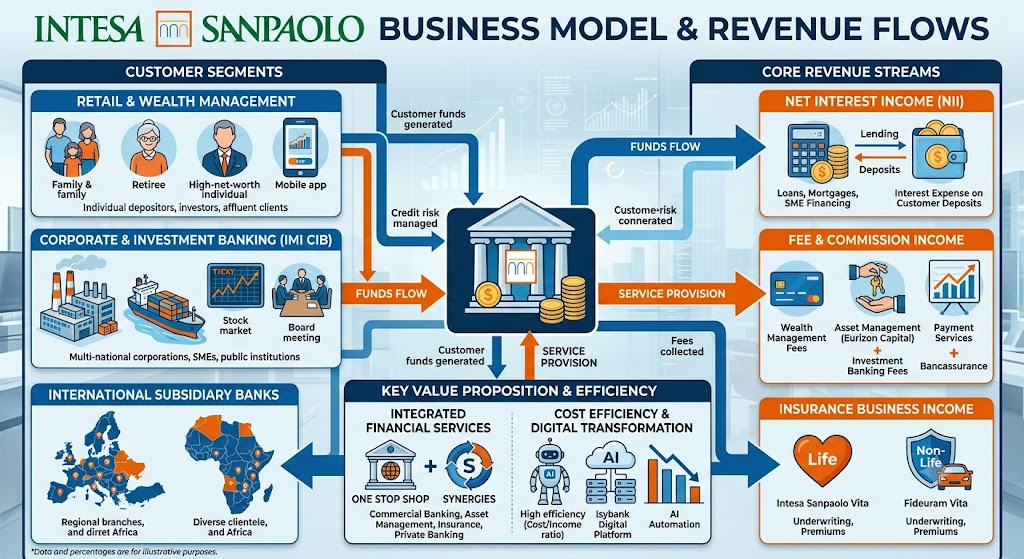
Intesa Sanpaolo generates revenue through three core pillars: Net Interest Income (NII), Net Fee and Commission Income, and Insurance Business Income.
Revenue Generation & Financial Metrics
- Net Interest Income (NII): Earned through retail mortgage lending, SME financing, and corporate credit via its IMI Corporate & Investment Banking (IMI CIB) division. In FY2025, NII generated €14.8 billion, representing the primary revenue engine despite lower interest rate environments.
- Wealth Management & Commissions: Intesa Sanpaolo oversees approximately €1.5 trillion in total customer financial assets. Wealth management, asset management (Eurizon Capital), and private banking (Fideuram) generated record net commissions of over €9 billion in 2025.
- Insurance Operations: Operating through Intesa Sanpaolo Vita and Fideuram Vita, insurance activities contribute life and non-life underwriting revenue, adding over €1.7 billion in gross income annually.
Operational Efficiency & Risk Strategy
Intesa Sanpaolo maintains a “Zero-NPL Bank” strategy. Through aggressive loan offloading and strict underwriting, its net NPL ratio stood at 0.8% with bad loans nearly zeroed. The bank operates at a cost-to-income ratio of 42.2% (and under 39% in interim quarters), making it one of the most efficient European banks.
Strategic Growth Focus
The bank’s strategy concentrates on expanding fee-generating wealth management assets to decouple revenue from interest rate volatility, while continuously lowering operational costs via digital automation.
Sources
- https://group.intesasanpaolo.com/en/investor-relations/press-releases/2026/02/20260202-ris-fy25-uk
- https://group.intesasanpaolo.com/en/investor-relations/press-releases/2026/07/20260729-ris-1h26-uk
- https://www.diplomacyandcommerce.hr/intesa-sanpaolo-posts-record-q1-profit-as-wealth-management-accelerates/
- https://it.wikipedia.org/wiki/Intesa_Sanpaolo
AI Growth Strategy, Budget, and Partnerships
Intesa Sanpaolo integrates artificial intelligence to lower cost-to-income ratios and modernize banking operations under its group-wide “AIxeleration” program.
Investment Budget & Scope
Since 2022, Intesa Sanpaolo has deployed over €5.7 billion in technology transformation, including €5.6 billion dedicated directly to IT modernization and cloud platform architecture. The bank employs an internal team of more than 300 AI specialists and IT engineers. As of 2025, the group has developed and deployed over 150 active AI use cases.
Strategic Technological Partnerships
- Google Cloud & TIM: Intesa Sanpaolo executed a complete migration of its core IT banking infrastructure to Google Cloud regions hosted in TIM data centers in Turin and Milan. This architecture supports real-time data streaming and advanced machine learning workloads.
- Thought Machine: Intesa Sanpaolo partnered with UK fintech Thought Machine to adopt its cloud-native core banking platform, Vault. This powers Isytech, the technology architecture behind Isybank, enabling rapid deployment of automated credit and service workflows.
Concrete Applications & Real-World Implementation
- Generative AI in Operations: Generative AI tools assist employees in document summarization, internal knowledge routing, automated code generation across software development lifecycles, and anti-money laundering (AML) pattern identification.
- Digital Bank (Isybank): Isybank acts as an AI-driven digital platform targeting 4 million retail customers, drastically lowering service costs per customer compared to physical branch networks.
- Credit Risk & Wealth Advisory: Predictive AI algorithms analyze real-time transaction data to forecast corporate default risks and provide automated portfolio rebalancing suggestions for wealth advisors.
Back to Intesa Sanpaolo