
The following is the Q1 2026 earnings summary for Interactive Brokers (IBKR):
Interactive Brokers achieved record quarterly revenue in Q1, driven by a growing active client base and strong growth in trading volume.
Client Assets and Capital
- Total client equity: Reached 789B USD, up 38% YoY and 1% sequentially.
- Client idle cash balances: Hit a record 169B USD, up 35% YoY.
Trading Volume and Commission Revenue
- Daily Average Revenue Trades (DARTs): 4.4M, up 24% YoY.
- Commission revenue: Surpassed 600M USD for the first time, an increase of 19% YoY.
- Product performance: Trading volumes across stocks, options, and futures all showed double-digit year-over-year growth, with futures contracts hitting a record quarterly high, driven by increased market volatility.
Market Observations
- Shift in investor behavior: Trading activity showed a move toward larger, higher-quality securities, with a reduction in the proportion of trading in low-priced (pink sheet) stocks.
Key updates from Interactive Brokers (IBKR) for Q1 2026 include:
Financial Highlights
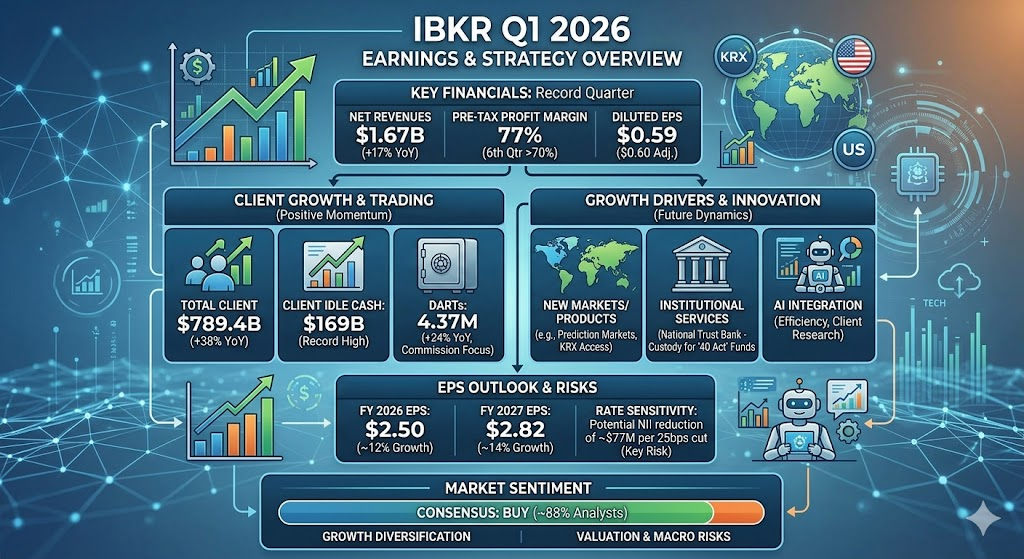
- Record Revenue: IBKR reported record net revenues of 1.67 billion USD (GAAP), representing a 17% increase year-over-year.
- Profitability: The company maintained a pre-tax profit margin of 77%, marking the sixth consecutive quarter above 70%, reflecting strong operational efficiency.
- Earnings: Reported diluted EPS was 0.59 USD (0.60 USD adjusted), compared to 0.48 USD (0.47 USD adjusted) in the same quarter last year.
- Dividend Increase: The Board of Directors raised the quarterly cash dividend from 0.08 USD to 0.0875 USD per share, payable on June 12, 2026.
Growth and Business Metrics
- Client Expansion: Total customer accounts grew by 31% to 4.75 million.
- Asset Growth: Customer equity reached 789.4 billion USD (up 38% YoY), and customer credit balances (uninvested cash) hit a record 169 billion USD (up 35% YoY).
- Trading Activity: Total Daily Average Revenue Trades (DARTs) increased by 24% to 4.37 million.
- Product Performance: Commissions rose 19% to 613 million USD, driven by double-digit volume growth across stocks, options, and futures. Futures trading, in particular, hit a quarterly record, fueled by heightened market volatility and hedging demand.
Strategic Developments
- AI Integration: The firm continues to expand its use of AI for internal automation (onboarding, compliance) and client-facing tools, aiming to improve research accuracy and responsiveness.
- Operational Efficiency: Execution, clearing, and distribution fees decreased by 12% to 106 million USD, aided by reduced regulatory fees and efficient capture of liquidity rebates.
- Currency Strategy: The company’s currency diversification strategy (holding equity in a basket of 10 major currencies, or “GLOBALs”) resulted in a 53 million USD decrease in comprehensive earnings due to a slight depreciation of the U.S. dollar value of the basket.
For the second quarter of 2026, Interactive Brokers (IBKR) is positioning itself for growth through geographic expansion, new product categories, and the continued scaling of its technological infrastructure. The following are the key growth drivers:
1. New Product and Market Access
- Prediction Markets: Following the recent integration of platforms like Kalshi, CME Group, and ForecastEx, IBKR is capturing volume from event-driven trading (e.g., U.S. elections, policy outcomes). This is expected to attract a new segment of speculative and hedging participants, providing a non-traditional revenue stream.
- Korean Market Expansion: As of May 2026, IBKR has become the first major U.S. broker to offer direct trading of stocks listed on the Korea Exchange (KRX). This expansion is specifically designed to attract institutional and high-net-worth investors interested in the Korean semiconductor and electronics sectors.
2. Infrastructure and Institutional Services
- National Trust Bank (NTB) Progress: IBKR is advancing its trust bank operations, which are expected to reach full scale by the end of 2026. This is a critical move to unlock custody services for “40 Act” funds, significantly boosting the firm’s competitive position in the institutional asset management space.
- AI-Driven Efficiency: The firm is deepening its integration of AI across compliance, onboarding, and client-facing research tools. These efficiencies reduce operational costs while improving user retention by offering more precise, automated portfolio insights.
3. Structural Shifts in Earnings
- Transition from NII to Commission-Based Growth: As interest rates continue to soften, IBKR is successfully transitioning its growth engine from Net Interest Income (NII) to trading commissions. Given the 24% YoY increase in DARTs in Q1, the firm is well-positioned to offset potential interest rate compression through sheer volume growth if market volatility remains elevated.
- Client Ecosystem: With account growth maintaining a robust 31% YoY rate, the sheer density of the client base provides substantial cross-selling opportunities, particularly as investors seek more sophisticated hedging tools in the current AI-infrastructure-heavy market environment.
4. Key Risks and Monitoring Points
- Interest Rate Sensitivity: The primary headwind remains the Federal Reserve’s interest rate trajectory. Market estimates suggest that for every 25-basis-point cut, the firm faces a potential annualized impact of approximately 77 million USD on its NII. The focus for Q2 will be on whether volume growth can effectively hedge this compression.
- Investment Quality Shift: The recent trend of investors moving capital away from speculative low-priced (pink sheet) stocks toward larger, higher-quality securities is a net positive for the firm’s platform reputation, though it requires constant monitoring to ensure commission revenue remains stable despite the changing asset mix.
In summary, IBKR’s growth in the coming quarter is expected to be defined by its “One-Stop Global Trading” value proposition and the rapid adoption of alternative trading tools, allowing it to sustain its high profit margins despite the expected headwinds from a lower-interest-rate environment.
The outlook for Interactive Brokers’ (IBKR) earnings per share (EPS) over the next year remains positive, characterized by steady growth despite potential headwinds from interest rate cycles.
EPS Projections
Market consensus estimates for IBKR’s EPS are as follows:
| Fiscal Period | Consensus EPS Estimate (USD) | Expected Growth |
| FY 2026 | 2.50 | ~12% |
| FY 2027 | 2.79 – 2.82 | ~13-14% |
Note: These estimates are based on analyst consensus and are subject to market conditions, particularly interest rate fluctuations and trading volumes.
Key Drivers for EPS Growth
- Structural Transition to Commission-Based Revenue: While Net Interest Income (NII) has historically been a major profit driver, the company is successfully pivoting toward commission revenue. Robust growth in Daily Average Revenue Trades (DARTs), driven by a 30%+ year-over-year increase in client accounts, suggests a more sustainable long-term revenue stream.
- New Product Innovation: The expansion into Prediction Markets (integrating Kalshi, CME Group, and ForecastEx) and direct access to Korean Equities (KRX) are opening new avenues for trading volume that are less sensitive to interest rate fluctuations.
- Operational Efficiency: IBKR maintains industry-leading pre-tax profit margins (consistently above 70%). As the firm further automates its onboarding and compliance processes using AI, it expects to improve its operating leverage, allowing revenue growth to outpace expense growth.
Risks and Headwinds
- Interest Rate Sensitivity: The most significant risk to EPS growth is the Federal Reserve’s interest rate trajectory. Analysts estimate that for every 25-basis-point (0.25%) cut in interest rates, the firm’s annual NII could decrease by approximately 77 million to 82 million USD.
- Valuation and Expectations: Trading at a premium multiple relative to its historical P/E, IBKR is highly valued for its execution quality. As a result, the market demands consistent performance; any “miss” in quarterly earnings or guidance often leads to short-term price volatility.
Market Sentiment and Price Targets
The consensus among Wall Street analysts remains “Buy.”
- Target Price: The average 12-month analyst price target stands at approximately 86.00 USD, suggesting a modest upside potential of roughly 5–6% from the current trading price of ~81.35 USD.
- Analyst Spread: There is a wide variance in outlooks, ranging from conservative estimates around 64 USD to bullish targets as high as 98 USD (e.g., Goldman Sachs).
Investment Thesis: The Bull vs. The Bear
The Bull Case (Potential Upside)
- Unmatched Growth: IBKR continues to deliver industry-leading account growth (exceeding 30% YoY for over a year). This “scale effect” is the primary engine of their value.
- Structural Diversification: The firm is effectively pivoting from being purely an interest-rate-sensitive stock to a commission-driven powerhouse. New revenue streams, such as the recently launched Prediction Markets and Korean Equity (KRX) access, help insulate revenue from fluctuations in U.S. interest rates.
- Operational Efficiency: With pre-tax profit margins consistently in the 70%+ range, the company’s AI-driven cost-efficiency model allows it to maintain high profitability even as it aggressively expands its global footprint.
The Bear Case (Potential Downside)
- Interest Rate Sensitivity: The most significant headwind is the potential for Federal Reserve interest rate cuts. Because a portion of IBKR’s revenue is tied to Net Interest Income (NII), every 25-basis-point rate reduction is estimated to impact annual earnings by roughly 77M to 82M USD.
- Valuation Maturity: Trading at a P/E multiple of approximately 36x, the stock is no longer “cheap.” Investors are paying a premium for its high-quality execution, which leaves little room for earnings “misses.”
- Technical Headwinds: Recent indicators, such as the MACD histogram turning negative in mid-May 2026, suggest a period of consolidation or short-term volatility as the market digests the stock’s massive ~87% rally over the past year.
Expert Summary
Interactive Brokers is currently in a “digestion phase” after a period of exceptional performance.
- For Long-Term Investors: The company’s “moat”—its global platform and superior technology—remains intact. Its expansion into institutional custody (via the National Trust Bank) could provide a fresh leg of growth toward the end of 2026 and into 2027.
- For Short-Term Traders: The stock is currently showing signs of consolidation. Technical indicators suggest potential downward pressure in the near term, making it a “watch and wait” scenario for some institutional traders until the price finds firmer support.
Disclaimer: This analysis is for informational purposes only and does not constitute financial or investment advice. Stock investments carry inherent risks, and you should conduct your own due diligence or consult with a qualified financial advisor before making any investment decisions.
Source:
- https://www.interactivebrokers.com/mkt/getFileNew.php?file=latestEarningsPR
- https://cmnews.com.tw/article/newsyoudeservetoknow-0f06b8d6-3ddd-11f1-8728-d0332a0fa1af
- https://finance.biggo.com.tw/news/US_IBKR_2026-04-21
Back to Interactive Brokers page