The history of ING Group can be divided into four distinct phases, evolving from a traditional domestic financial entity into a global digital banking leader:
1. Foundation and Merger Period (1845–1991)
- Historical Origins: Roots trace back to the insurance firm Nationale-Nederlanden (founded in 1845) and the postal savings bank Postbank (founded in 1881).
- The 1991 Merger: Dutch insurance giant Nationale-Nederlanden merged with NMB Postbank Group to officially form ING Group, creating a pioneer in integrated bancassurance services.
2. Global Expansion and M&A Phase (1991–2007)
- International Acquisitions: Acquired the UK’s historic Barings Bank in 1995, followed by US insurance companies including ReliaStar, Aetna, and Equitable of Iowa.
- Pioneering Digital Banking: Launched ING Direct in 1997, disrupting the global retail banking sector with a branchless, high-interest direct banking model.
3. Financial Crisis and Restructuring Phase (2008–2014)
- Government Support: Received a €10 billion capital injection from the Dutch government during the 2008 global financial crisis.
- Divestment of Insurance: To comply with EU state-aid requirements, ING underwent major restructuring by spinning off its global insurance and asset management divisions (such as listing NN Group and Voya Financial) to refocus exclusively on banking.
4. Digital Transformation and Sustainability Leadership (2015–Present)
- Digital-First Strategy: Transformed into a technology-driven digital bank, continuously refining cross-border mobile banking platforms.
- Advancing Green Finance: Embedded sustainability into its core lending decisions through initiatives like the Terra Approach, positioning the group as a leader in ESG and climate-transition financing.
Business Model and Development Strategy
ING Group is a global financial services institution focused on banking. Its business model and development strategy emphasize high-performance operational mechanisms and digital-driven growth.
1. Business Model
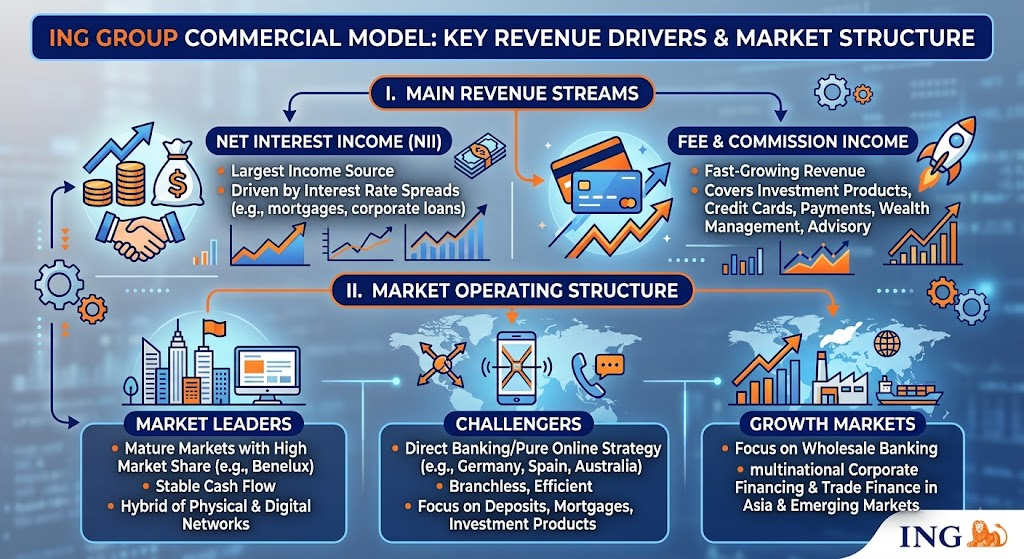
ING primarily generates revenue through two core segments: Retail Banking and Wholesale Banking.
1. Revenue Streams
- Net Interest Income (NII): The largest income driver, derived from the spread between deposits and loans (e.g., mortgages, corporate financing, working capital loans).
- Fee and Commission Income: A fast-growing second engine, covering investment products, credit card services, payment transactions, wealth management, as well as corporate capital market advisory and underwriting fees.
2. Market Classification
ING classifies its global markets into three operating categories:
- Market Leaders: Mature markets with high market share across physical and digital networks in the Benelux region (Netherlands, Belgium, Luxembourg), providing stable cash flows.
- Challengers: Markets such as Germany, Spain, Italy, Poland, and Australia, where ING operates using a “digital-first” or branchless direct banking strategy to gather deposits and expand mortgages and investment products efficiently.
- Growth Markets: Regions such as Asia and select emerging markets, focusing primarily on Wholesale Banking to assist multinational corporate financing and trade finance.
2. Development Strategy
ING executes a global strategy centered on accelerating growth, expanding impact, and creating value:
1. “Digital-First” and Mobile-Primary Experience
- Core Customer Growth: Focused on growing “Mobile Primary Customers” who interact primarily through the mobile app.
- Automation and Scalability: Leveraging standardized technology platforms across countries (such as shared data and IT infrastructure) to lower per-transaction operating costs and enhance operating margins.
2. Revenue Diversification Strategy
- To reduce over-reliance on interest rate fluctuations (net interest margins), ING actively increases the proportion of fee-based income.
- Expanding investment products, digital insurance cross-selling, daily payments, and enterprise Transaction Banking services.
3. Sustainability and Green Finance Leadership (ESG & Terra Approach)
- Terra Approach Framework: ING is a global pioneer in climate transition finance methodology, steering its loan portfolio to align with Paris Agreement target trajectories (covering high-emission sectors like steel, energy, automotive).
- Sustainable Financing Growth: Prioritizing lending to renewable energy, transition technologies, and ESG-aligned corporates while expanding its market share in green bonds and sustainability-linked loans (SLL).
Source:
https://www.ing.com/About-us/Strategy.htm
https://www.ing.com/About-us/Profile-and-fast-facts.htm
Back to ING