
Corporate History
Founding and Post-War Optical Expansion (1941–1960s)
Founded in 1941 in Hoya City (now Nishitokyo), Tokyo, by brothers Shoichi and Shigeru Yamanaka as Toyo Optical Glass Manufacturing, the firm initially produced specialty optical glass for binoculars and cameras. Following World War II, it leveraged precision molten-glass techniques to enter commercial consumer optics, launching crystal glassware in 1945 and its first ophthalmic eyeglass lenses in 1962.
Diversification into Electronics and Global Expansion (1970s–1990s)
Recognizing the commoditization risk of purely mechanical optical glass, Hoya diversified into electronics in the 1970s. The company began commercial production of IC photomask substrates in 1974 and entered contact lenses in 1972. During the late 1980s and 1990s, Hoya invented and scaled high-rigidity glass memory substrates for computer hard disk drives (HDDs) and synthetic quartz mask blanks for semiconductor lithography, expanding manufacturing footprints across Southeast Asia and Europe.
Transformation through Governance and Med-Tech M&A (2000s–2010s)
Under long-time CEO Hiroshi Suzuki, Hoya transformed into a corporate governance pioneer in Japan by adopting a “company with committees” system, heavily prioritizing ROE and return of surplus capital. In 2007–2008, Hoya executed a high-profile takeover of Pentax Corporation, spinning off Pentax’s commoditized digital camera assets to Ricoh while absorbing Pentax Medical to become a tier-one contender in flexible endoscopy. Simultaneously, Hoya pioneered EUV mask blanks, locking in key positioning with lithography giant ASML and leading foundries.
Advanced Lithography Leadership and Enterprise Modernization (2020s–Present)
Hoya consolidated its near-monopolistic status in high-NA and standard EUV mask blanks while scaling value-added medical segments, such as myopia control lenses (MiYOSMART). Recent years brought renewed operational scrutiny, notably following the April 2024 cyberattack, prompting massive enterprise-level investments into unified IT modernization, advanced operational resilience, and AI-enabled manufacturing.
Business Model and Strategic Development
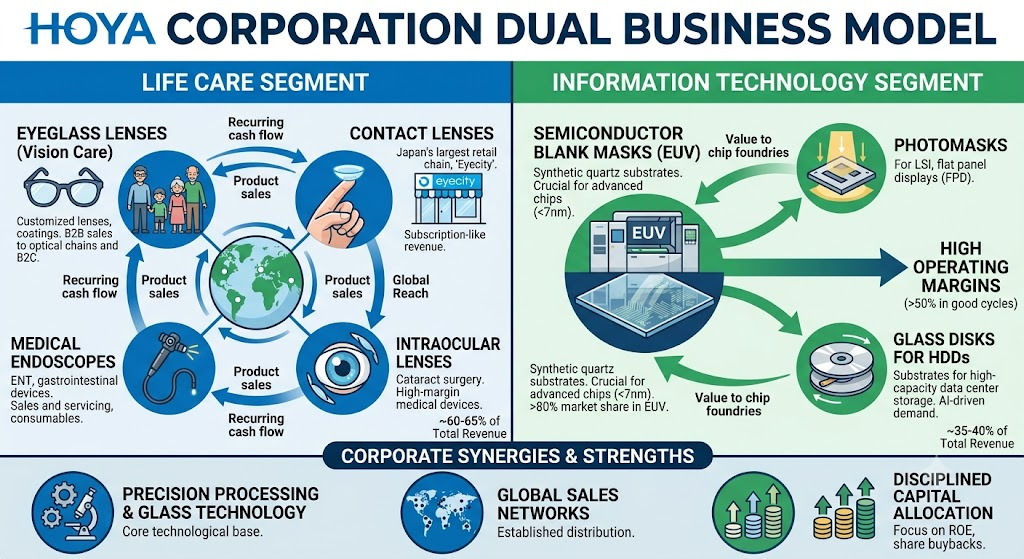
Hoya operates an asymmetric, high-barrier business model built on cash-generative stability and tech-driven operating leverage. The company operates primarily through two segments:
Life Care Segment (Defensive Recurring Cash Flow)
Accounting for approximately 60-65% of consolidated revenues, Life Care provides recession-resistant, repeat-purchase cash flow. In eyeglass lenses, Hoya generates high-margin revenue through proprietary coating formulations, progressive lens designs, and specialized pediatric myopia-control lenses (MiYOSMART) sold through global optometry and optical retail chains. In contact lenses, it captures retail margins directly via Japan’s largest retail chain, “Eyecity”. In its Medical sub-segment, Hoya monetizes Pentax flexible endoscopes through initial device sales, recurring specialized consumable disposables, and ongoing service maintenance contracts.
Information Technology Segment (High-Margin Technology Tollbooth)
Generating 35-40% of revenues but frequently delivering more than 50% of operating income, the IT segment enjoys operating margins exceeding 50%. In semiconductor materials, Hoya manufactures blank masks—the raw synthetic quartz substrates coated with thin films upon which integrated circuit patterns are etched. By securing a virtual monopoly (>80%) on EUV mask blanks required by foundries like TSMC, Samsung, and Intel, Hoya functions as a pricing-power tollbooth on advanced-node semiconductor manufacturing (sub-3nm and High-NA EUV). In memory storage, Hoya sells precision glass substrates used in nearline hyperscale data center HDDs, capitalizing on AI-driven capacity expansions.
Financial Scale and Capital Strategy
For FY2024 (ended March 31, 2025), Hoya reported consolidated revenue of ¥866.0 billion (+14% YoY) and an operating profit of ¥255.8 billion (+22% YoY), reflecting an overall consolidated operating margin of ~29.5%. In Q4 FY2024, the IT segment posted an operating profit margin of 52.7% on ¥80.4 billion in sales. Hoya adheres to a disciplined “Small Headquarters, Autonomous Business Unit” doctrine, reinvesting strictly into high-hurdle-rate R&D while returning excess free cash flow via share buybacks and dividends.
Sources for Business Model Information
- https://www.hoya.com/ir/2025/en/highlight/
- https://www.hoya.com/ir/2025/en/capability/
- https://www.hoya.com/ir/2024/en/highlight/index.html
- https://umbrex.com/resources/company-profiles/hoya-corp/
- https://quartr.com/events/hoya-corporation-7741-q4-2025_FGhTGv7s
AI Development Strategy, Budget, and Partnerships
Hoya approaches Artificial Intelligence via two complementary vectors: as a foundational material enabler for AI infrastructure, and as a downstream deployer within clinical diagnostic imaging and manufacturing operations.
Infrastructure Enabler (Hardware Foundation for AI Compute and Storage)
Hoya’s core commercial AI play is material: advanced AI accelerators (such as Nvidia GPUs and custom hyperscaler ASICs) cannot be produced without EUV lithography, for which Hoya supplies the vast majority of blank masks. Concurrently, generative AI data generation has created an acute demand for mass enterprise storage. Hoya supplies high-density glass substrates to HDD manufacturers (e.g., Seagate, Western Digital) for heat-assisted magnetic recording (HAMR) drives, which expand cloud data center capacity to 30TB+ per drive.
Clinical AI Integration in Healthcare (PENTAX Medical)
Within its Life Care segment, Hoya actively embeds AI into clinical medical diagnostics:
- AI Computer-Aided Detection (CADe): PENTAX Medical developed and commercialized the DISCOVERY AI system, an embedded endoscopy platform that analyzes video streams in real-time to highlight colorectal polyps and lesions during colonoscopies, improving adenoma detection rates (ADR).
- Key Strategic Partnerships: PENTAX Medical partnered with specialized AI software houses and medical research institutions, including an alliance with Wision A.I. to bring real-time lesion-detection algorithms into clinical suites across Europe, APAC, and the US, as well as collaboration with the French AI start-up MAGENTIQ-EYE.
Industrial AI in Smart Manufacturing
In its semiconductor and glass fabrication facilities, Hoya deploys computer vision and deep learning inspection algorithms to detect sub-nanometer surface defects, substrate planar roughness, and thin-film uniformity flaws, bypassing human visual limits to maximize wafer yields on angstrom-level EUV blank blanks.
R&D Budget and Strategic Allocations
Hoya allocates approximately 4% to 5% of annual revenue to consolidated R&D expenditures (amounting to ¥35 billion to ¥45 billion annually). While Hoya does not break out AI as an isolated line item, internal capital deployment targets AI in three strategic pools: next-generation High-NA EUV defect analysis tools, automated clinical image diagnosis algorithms inside PENTAX Medical, and enterprise-wide cybersecurity architecture overhauls following its 2024 operational outage.
back to Hoya