
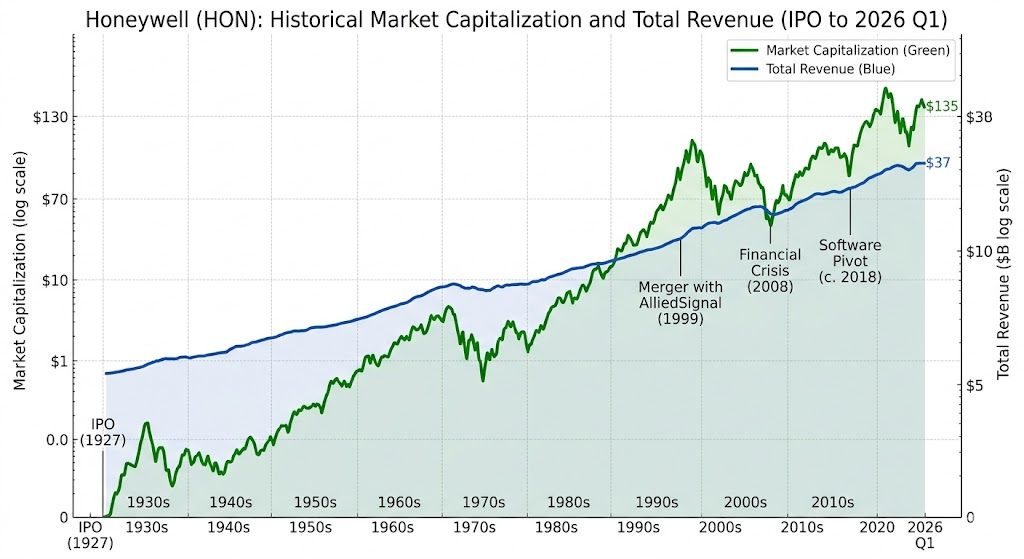
Honeywell’s history spans over a century, evolving from a single invention into the industrial giant it is today. Its development can be categorized into the following stages:
The Formative Years (1885–1927)
The company’s roots trace back to 1885, when Albert Butz invented the furnace regulator and established the Butz Thermo-Electric Regulator Company. In 1906, Mark Honeywell founded the Honeywell Heating Specialty Company, specializing in hot water heating systems. In 1927, these complementary businesses merged to form the Minneapolis-Honeywell Regulator Company, solidifying its market leadership in climate control technology.
Diversification and Aerospace Expansion (1928–1998)
During World War II, the company pivoted its automation and control expertise toward the defense sector, developing aircraft instrumentation and autopilot systems, which marked its entry into the aerospace industry. In the post-war era, the company aggressively expanded through acquisitions, entering fields such as electronic computing, industrial automation, and safety systems, transforming into a global industrial conglomerate.
Merger and Structural Transformation (1999–2017)
In 1999, Honeywell underwent a major merger with AlliedSignal. While the Honeywell name was retained, the organizational structure was fundamentally restructured. The business was reorganized into core divisions—Aerospace, Automation and Control Solutions, and Performance Materials and Technologies—which established the framework for its modern operations.
The Digital and Industrial Software Era (2018–Present)
In recent years, the company has pivoted toward a strategy of hardware-software integration, reorganizing its core operations into four business segments: Aerospace, Building Automation, Industrial Automation, and Energy and Sustainability Solutions. The company is now focused on the Industrial Internet of Things (IIoT), AI-driven predictive maintenance, and energy transition technologies, positioning itself as a data-driven high-tech solutions provider.
As a diversified industrial conglomerate, Honeywell’s competitive landscape varies across its four core business segments: Aerospace, Building Automation, Industrial Automation, and Energy & Sustainability Solutions.
Key Competitive Segments
- Aerospace TechnologiesThis sector faces competition from global leaders in aviation and defense:
- GE Aerospace: A major rival in aircraft engines and avionics.
- RTX Corp (formerly Raytheon Technologies): Highly overlapping interests in aerospace components and defense systems.
- Safran, Rolls-Royce, and Thales: Primary competitors in engine manufacturing, avionics, and specialized aerospace systems.
- Building AutomationFocused on smart buildings, energy management, and fire safety:
- Industrial and Process AutomationInvolving Industrial Internet of Things (IIoT) and data monitoring:
- Emerson Electric: Honeywell’s primary rival in process control and automation solutions.
- ABB: A global powerhouse in power and automation technology.
- Eaton: A key competitor in power management and data center infrastructure, often competing directly on hardware-software integration strategies.
Competitive Strategy and Differentiation
Honeywell’s primary competitive advantage lies in its software-first strategy, centered on its Forge platform. Unlike competitors that may focus purely on hardware, Honeywell strives to create “systems of systems” by utilizing an open architecture that connects diverse industrial assets, allowing them to provide higher-margin, data-driven service offerings.
Market Dynamics
As of May 2026, Honeywell is in the midst of a significant corporate transformation. The company is preparing to spin off its Advanced Materials business and has been streamlining its portfolio—including the potential divestiture of certain warehouse and workflow solutions—to simplify its corporate structure. These moves are intended to allow the company to focus more intensely on high-growth areas, fundamentally altering its competitive positioning against the rivals listed above.
Source:
https://www.youtube.com/watch?v=DrSNKvZtifw
Back to Honeywell page