
Market Position and Market Share
Honda Motor Co., Ltd. holds a distinct dual-leadership position in the global mobility sector, functioning as an automotive manufacturer and the world’s preeminent motorcycle producer.
- Global Automotive Market: In the passenger vehicle segment, Honda ranks as the 8th largest automaker worldwide by group volume, competing closely with Ford, Hyundai, and BYD. For calendar year 2024 and 2025, Honda recorded global automobile sales of approximately 3.67 million to 3.80 million units, representing a global light-vehicle market share of approximately 4.0% to 4.4%. In the United States—its single most profitable automobile market—Honda maintains a strong market share of roughly 8.5% to 9.2%, anchored by high-volume nameplates such as the CR-V, Civic, and Accord. However, its market position in Mainland China has faced downward pressure due to accelerated domestic New Energy Vehicle (NEV) adoption.
- Global Motorcycle Market: Honda is the world’s largest two-wheeler manufacturer by a wide margin, holding the #1 position globally for decades. For calendar year 2025, Honda’s global motorcycle sales reached approximately 20.1 million to 20.2 million units, capturing an estimated 30% to 33% share of the worldwide two-wheeler market. Key volume drivers include developing markets such as India, Indonesia, Vietnam, and Brazil, where Honda maintains market shares exceeding 40% to 70% in select local categories.
- Power Products and Aerospace:Honda remains a global producer of general-purpose combustion engines, marine outboards, and power generators, with annual sales exceeding 3.6 million units. Additionally, its aircraft division produces the HondaJet, which has frequently ranked as the most-delivered aircraft in the light business jet class.
Supply Chain Upstream and Downstream Analysis
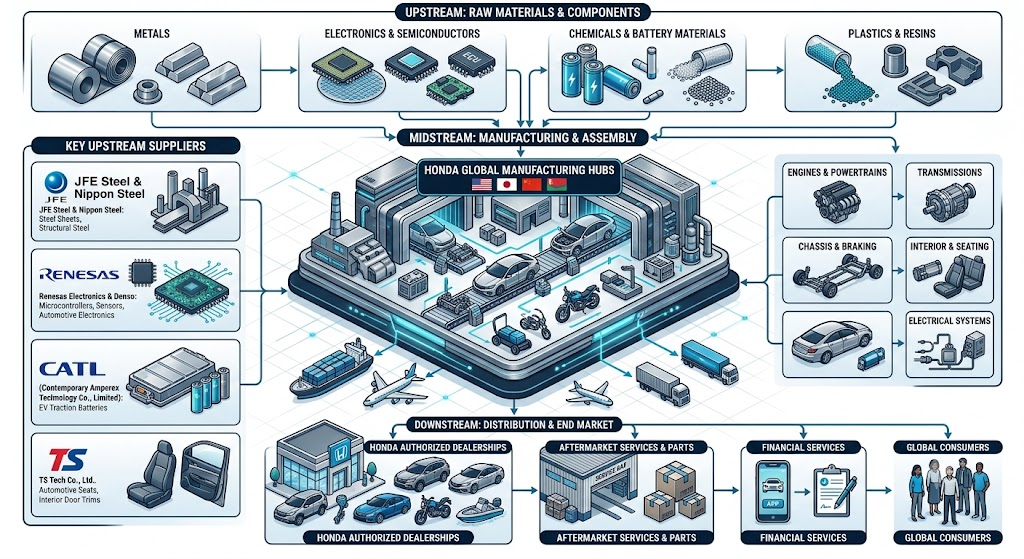
Honda operates a global supply chain characterized by tight-knit Tier-1 component alliances, expanding battery joint ventures, and localized assembly clusters designed to insulate regional operations from trade shocks.
Upstream (Raw Materials & Cell Production)
- Steel and Structural Metals: Honda relies on major global mills for automotive-grade sheet metal, high-strength tensile steel, and specialized aluminum alloys. Primary suppliers include Nippon Steel and JFE Steel in Japan and Asia, as well as Cleveland-Cliffs and Nucor for North American manufacturing hubs.
- Traction Batteries & Electrochemistry: To secure cell supply for its transition toward hybrid and battery electric vehicles (BEVs), Honda has diversified away from single-source dependencies:
- North America: L-H Battery Company, a multi-billion-dollar joint venture with LG Energy Solution located in Jeffersonville, Ohio, dedicated to pouch-type lithium-ion cells for Honda and Acura EVs.
- Global & Asia: Strategic collaboration with Contemporary Amperex Technology Co., Limited (CATL) for long-term LFP and NCM cell procurement in China and international models.
- Domestic Japanese R&D: HN Energy Co., Ltd., a joint venture with GS Yuasa focusing on high-energy-density lithium-ion batteries and next-generation solid-state cell architecture.
Midstream (Key Tier-1 Component Suppliers)
- Astemo, Ltd. (Consolidated Subsidiary):Formed via the merger of Hitachi Automotive Systems with Honda affiliate suppliers Keihin, Showa, and Nissin Kogyo.Honda raised its equity stake from 40% to 61% by acquiring shares from Hitachi, converting Astemo into a consolidated subsidiary.Astemo supplies integrated powertrain systems, electronic control units (ECUs), suspension systems, and electronic braking systems, serving as Honda’s central hardware-software backbone for Software-Defined Vehicles (SDVs).
- Interior & Seating: TS Tech Co., Ltd., in which Honda holds an approximate 22% to 23% equity interest, serves as the primary developer and manufacturer of automotive seats, interior door trims, and motorcycle seating assemblies.
- Drivetrain, Precision Mechanics & Steering: Musashi Seimitsu Industry Co., Ltd. provides precision forged transmission gears, camshafts, and differential assemblies.Steering systems and hub bearings are co-supplied by JTEKT and NSK.
- Semiconductors, Electronics & Software: Honda relies heavily on Renesas Electronics, Denso, and Bosch for microcontroller units (MCUs) and vehicle management systems. For next-generation digital cockpits and AI mobility, Honda operates Sony Honda Mobility Inc. (an equal joint venture with Sony) to deliver the AFEELA EV line.
Downstream (Manufacturing, Logistics & Retail Channels)
- Manufacturing Hubs: Honda executes a “produce where consumed” localization strategy. Major manufacturing nodes include North America (Marysville, East Liberty, and Anna Engine Plant in Ohio; Alliston, Ontario in Canada), Japan (Suzuka and Yorii plants), China (Dongfeng Honda and GAC Honda joint ventures), and Southeast Asia (Thailand, Indonesia, and Vietnam for two-wheelers and passenger vehicles).
- Distribution & Dealer Network:Automotive and motorcycle distribution operates via thousands of independent franchised dealer networks across North America, Europe, Latin America, and the Asia-Pacific region.
- Captive Financial Services: Downstream distribution is reinforced by American Honda Finance Corporation (AHFC) and regional financing subsidiaries, providing wholesale floorplan financing to dealerships and consumer retail financing/leasing products.
Competitor Analysis: Technical and Financial Comparison
Honda’s primary competitors across its core product lines include Toyota Motor Corporation, Hyundai Motor Group, Nissan Motor, and electric vehicle specialists such as BYD and Tesla.
Technical Architecture & Strategy Comparison
- Hybrid Systems (HEV):
- Honda (e:HEV): Employs a dual-motor, multi-mode powertrain where the electric traction motor drives the wheels under most urban driving conditions, with the internal combustion engine acting primarily as a generator; an engine-lock clutch directly couples the engine to the wheels at highway cruising speeds. This architecture delivers responsive electric-drive dynamics without requiring a multi-speed planetary gear set.
- Toyota (THS-II / Multi-Stage): Utilizes a power-split planetary gearbox integrating two motor-generators with an Atkinson-cycle engine. Toyota’s system delivers superior scalability across heavy commercial utility vehicles and mechanical all-wheel-drive platforms, granting Toyota a larger volume moat in global hybrid markets.
- Electrification & Software-Defined Vehicles (SDV):
- BEV Dedicated Platforms: Honda lagged behind dedicated EV native players (Tesla, BYD, and Hyundai’s E-GMP platform), previously relying on a transitional GM Ultium partnership for models like the Honda Prologue and Acura ZDX. Honda is responding with its proprietary “Honda 0 Series” platform, emphasizing lightweight chassis engineering and thin packaging.
- Strategic Consolidation: To counterbalance Chinese automakers’ software agility and vertical cost structures, Honda formed a strategic alliance with Nissan to evaluate joint development of core SDV platforms, shared electric drive units (e-Axles), and modular battery standards.
- Advanced Driver Assistance Systems (ADAS):
- Honda deploys Honda SENSING 360 and has commercialized limited-run Level 3 automated driving (Traffic Jam Pilot under Honda SENSING Elite in Japan). However, in mass-market applications, Tesla’s camera-only FSD network and BYD’s scaled localized ADAS systems in China hold higher real-world fleet data collection volumes.
Financial Performance Comparison
- Revenue & Consolidated Top-Line:For Fiscal Year 2025, Honda reported consolidated sales revenue of approximately JPY 21.7 trillion (estimated ~USD 140 billion), representing approximately 6.2% year-over-year revenue expansion. In comparison, Toyota generated over JPY 45 trillion in consolidated revenue, maintaining more than double Honda’s top-line scale, while Hyundai Motor Company generated approximately KRW 160+ trillion.
- Operating Margins & Structural Divergence:
- Honda’s consolidated operating margin for FY2025 stood at approximately 5.6%, which declined toward the 2.6% to 3.7% range in subsequent quarters due to EV transition costs, supplier support outlays, and heavy price discounting in China.
- Segment Divergence: Honda exhibits a unique financial hedge: its motorcycle segment generates an operating margin exceeding 18%, delivering reliable cash flow that subsidizes the automobile division, which saw negative operating margins (-1.6%) during intensive EV capital expenditure cycles.
- By contrast, Toyota achieves consolidated automotive operating margins of 10% to 11%, driven by massive scale and high pricing power on hybrids. Hyundai Motor maintains consolidated operating margins around 8% to 9%, bolstered by its premium Genesis brand and higher-margin SUV portfolio.
- Free Cash Flow & Capital Allocation: Honda maintains high liquidity with R&D-adjusted operating cash flows around JPY 2.8 trillion annually. However, capital allocation is strained by concurrent capital expenditure commitments: multi-billion-dollar battery plant investments, software and SDV transition funding, and equity increases in key suppliers such as Astemo (JPY 152.3 billion), alongside ongoing shareholder returns via share repurchases and regular dividends.
Information Sources
- https://global.honda/en/investors/news/news20260210/main/0/link/FYE202603_3Q_financial_presentation_script_e_1.pdf
- https://global.honda/en/investors/library/filings/auto_20251216520495/pdfFile.pdf
- https://global.honda/en/newsroom/news/2025/c251216eng.html
- https://www.prnewswire.com/news-releases/honda-motor-co-ltd-hmcnyse-announced-its-consolidated-financial-results-for-the-fiscal-year-ended-march-31-2025-302453731.html
- https://tradeonlytoday.com/tech/honda/honda-reports-fiscal-year-2025-results/
- https://roadgenius.com/cars/statistics/sales-by-manufacturer/
- https://www.consumeraffairs.com/automotive/top-automakers-in-the-world.html
- https://www.autopunditz.com/post/global-best-selling-two-wheeler-brands-2025-honda-hero-tvs-bajaj-royal-enfield
- https://www.kamaxgroup.com/news/top-10-best-selling-motorcycle-brands-in-2025
- https://www.tstech.co.jp/english/company/profile/
- https://www.musashi.co.jp/assets/pdf/2021_Musashi_Integrated_Report_ENG.pdf
- https://oemparts.jp/articles/japanese-auto-parts-brands.html
back to Honda