
Company History
Founding and Motorcycle Supremacy(1948–1962)
Established in Hamamatsu, Japan, by Soichiro Honda and Takeo Fujisawa in 1948, the company began by attaching surplus two-stroke generator engines to bicycles. In 1949, Honda produced its first complete motorcycle, the Dream D-Type. The introduction of the lightweight, affordable Super Cub in 1958 revolutionized personal mobility worldwide, propelling Honda to become the world’s largest motorcycle producer by 1959 and financing its global expansion.
Automotive Entry and International Breakthrough(1963–1989)
Honda entered the automobile market in 1963 with the T360 mini-truck and S500 sports car. The watershed moment arrived in 1972 with the launch of the Honda Civic, equipped with the Compound Vortex Controlled Combustion(CVCC) engine, which met stringent US clean air standards without a catalytic converter. In 1982, Honda made history by opening the Marysville Auto Plant in Ohio, becoming the first Japanese automaker to manufacture passenger cars in the United States. In 1986, it launched Acura, creating Japan’s first luxury automotive sub-brand.
Global Scale and Technological Diversification(1990–2010)
Throughout this period, Honda expanded its global footprint across North America, Europe, and emerging Asian markets. The company introduced variable valve timing(VTEC), developed early hybrid powertrains(Insight), and diversified into robotics(ASIMO) and aerospace(HondaJet). While establishing a reputation for engineering excellence, the company’s reliance on bespoke hardware engineering laid the groundwork for organizational inertia during the later software revolution.
Electrification Pressures and Strategic Realignment(2011–Present)
Facing the global shift toward zero-emission mobility and autonomous driving, Honda announced ambitious targets to achieve 100% electrified sales(EVs and FCEVs) by 2040. However, persistent EV demand fluctuations, intense competition in China, and massive software development costs prompted strategic course corrections: prioritizing high-efficiency hybrid electric vehicles(HEVs), forming strategic technical alliances, and co-developing software-defined vehicle architectures.
Business Model and Strategic Direction
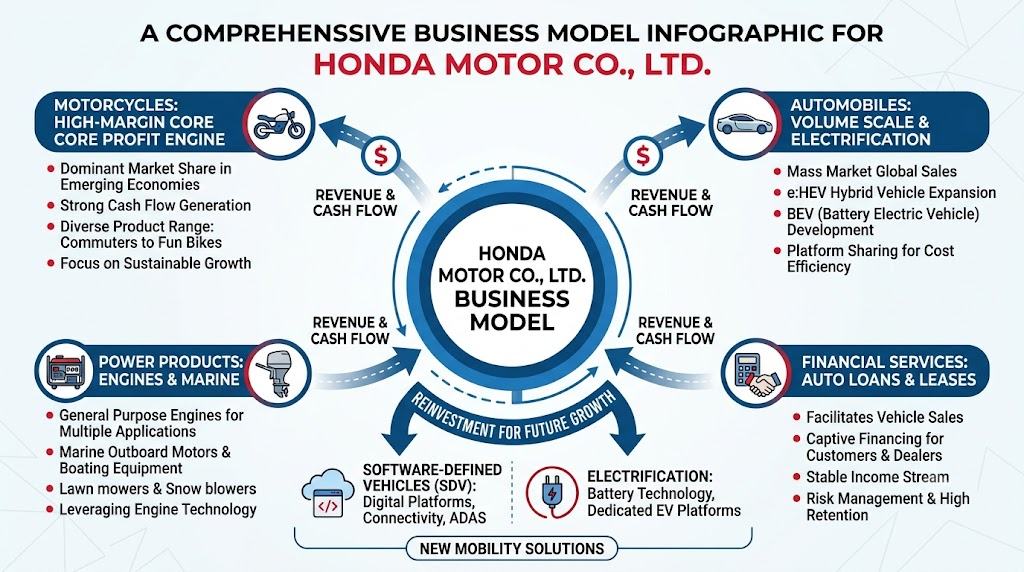
Honda operates an integrated mobility business model generating cash through four distinct operating segments:
1. Motorcycle Business(The Primary Profit Driver)
Unlike pure-play automakers, Honda’s primary profit engine is its motorcycle division. The company sells over 18 million to 20 million two-wheelers annually, dominating markets such as India, Indonesia, Vietnam, and Brazil. In fiscal year 2024, the motorcycle segment delivered approximately ¥546.5 billion in operating profit with double-digit operating margins, effectively subsidizing corporate research and capital expenditures for less profitable segments. Revenue is generated through retail sales of commuter scooters, premium touring bikes, spare parts, and localized manufacturing operations.
2. Automobile Business(Volume Scale and Hybrids)
Automobiles represent the largest share of consolidated revenue—over 60% of total group sales revenue, which reached ¥20.43 trillion in FY2024. Honda monetizes vehicle sales through global wholesale distribution to independent and affiliated dealership networks. Operating profitability in this segment has fluctuated significantly due to warranty claim adjustments, EV pricing pressure, and restructuring in mainland China. Honda’s core operational hedge is its e:HEV two-motor hybrid system, which yields stronger pricing power and margins compared to commoditized internal combustion vehicles or subsidized battery-electric models.
3. Financial Services(Captive Financing and Recurring Cash Flow)
Operating through subsidiaries such as American Honda Finance Corporation, this segment finances wholesale vehicle inventories for dealers and provides retail installment loans and leases to end-consumers. Financial services consistently contribute high-margin, counter-cyclical operating income, leveraging massive balance-sheet assets(over ¥14 trillion in financial assets and lease receivables) to generate interest spreads and fee revenue.
4. Power Products and Other Businesses
This segment encompasses general-purpose engines, lawnmowers, generators, portable outboard marine motors, and aircraft(HondaJet). While contributing a smaller percentage of overall revenue, it secures brand touchpoints in commercial, recreational, and industrial markets worldwide.
Strategic Direction
Honda’s commercial strategy hinges on a barbell approach: milking high-margin ICE and commuter motorcycle cash flows to fund transition investments, expanding hybrid(e:HEV) light trucks and sedans in North America as an interim bridge, and rationalizing underutilized manufacturing assets in joint-venture regions like China.
Sources for Business Model Information
- https://global.honda/en/investors/library/filings/filings2024051006/main/0/link/CY2024_20240510_TSEfling_1_e.pdf
- https://global.honda/en/investors/library/financialresult/main/07/teaserItems3/04/linkList/01/link/FYE202503_2Q_financial_reference_e_1.pdf
- https://global.honda/en/investors/library/documents.html
AI Strategy, Budget, and Key Partnerships
1. Capital Allocation and Software Budget
In mid-2024, Honda doubled its planned 10-year investment in electrification and software technologies through fiscal year 2030 to ¥10 trillion(approximately $65 billion). Within this capital envelope, approximately ¥2 trillion is explicitly earmarked for software research and development, encompassing in-vehicle operating systems, centralized compute architectures, and artificial intelligence integration for autonomous driving and intelligent cockpits.
2. Software-Defined Vehicles and In-Vehicle OS
Honda is re-architecting its vehicle electronics from distributed microcontrollers to centralized System-on-Chip(SoC) platforms running its proprietary “ASIMO OS”. This operating system connects vehicle motion control, intelligent automated driving(Honda SENSING 360 and next-generation L3/L4 algorithms), and connected services with Over-The-Air(OTA) update capabilities. For hardware compute, Honda is co-developing high-performance SoC solutions with semiconductor firms including Renesas Electronics.
3. Strategic Industrial Alliances
- Nissan and Mitsubishi Motors Alliance: In August 2026, Honda and Nissan formally cemented a joint-development agreement to standardize core electronic control units(ECUs), in-vehicle operating systems, and middleware platforms for their next-generation software-defined vehicles targeted for release from fiscal year 2029. This pooling of software assets aims to spread massive R&D overhead across more than 7 million combined vehicles annually to counter competition from US and Chinese rivals.
- Sony Honda Mobility(SHM / Afeela): Partnering with Sony Group Corporation in a 50:50 joint venture, Honda serves as the vehicle engineering and manufacturing backbone, while Sony oversees software, digital services, and AI entertainment ecosystems. The joint venture integrates Qualcomm Snapdragon Digital Chassis hardware to run foundation AI models for Level 2+/Level 3 automated driving and in-cabin generative AI interfaces.
- Autonomous Mobility with Cruise and GM: Honda established a mobility-as-a-service joint venture with GM and Cruise, targeting commercial autonomous ride-hailing services in central Tokyo using the purpose-built Cruise Origin autonomous vehicle platform, incorporating real-time computer vision and mapping algorithms.
back to Honda