
Company History
Founding and Heavy Machinery Origins(1910–1945)
- Namihei Odaira founded Hitachi in 1910 as an electrical repair shop attached to the Kuhara Mining plant in Hitachi, Ibaraki Prefecture.
- Developed Japan’s first domestically manufactured 5-horsepower electric induction motor in 1910, later spinning off as an independent enterprise in 1920.
- Expanded into industrial equipment, locomotives, and electrical generation to support Japan’s domestic industrialization.
Post-War Conglomerate Expansion(1946–1999)
- Listed on the Tokyo Stock Exchange in 1949 and diversified rapidly into consumer electronics, household appliances, mainframe computing, and semiconductors.
- Established international subsidiaries across North America, Europe, and Asia, becoming one of Japan’s preeminent multi-industry keiretsu giants.
- Suffered from creeping organizational inefficiencies and commoditization pressures in electronics toward the late 1990s.
The Conglomerate Discount and Restructuring(2000–2015)
- Struck severely by the 2008 global financial crisis, posting a historic consolidated net loss of ¥787.3 billion for the fiscal year ended March 2009.
- Launched a fundamental portfolio overhaul under new leadership, selling commoditized consumer businesses, hard disk drive manufacturing(sold to Western Digital), and display operations.
- Formulated the “Social Innovation Business” paradigm, pivoting resource allocation exclusively toward energy, transportation, and industrial IT infrastructure.
Digital and Infrastructure Pivot(2016–Present)
- Launched the Lumada data-driven IoT and software architecture in 2016 to cross-sell software into industrial assets.
- Executed massive acquisitions: acquired ABB Power Grids in 2020 for approximately $6.85 billion(now Hitachi Energy), GlobalLogic in 2021 for $9.6 billion, and Thales’ Ground Transportation Systems business in 2024 for €1.66 billion.
- Fully divested legacy non-core units including Hitachi Chemical, Hitachi Metals, and Hitachi Construction Machinery, operating primarily across three core pillars: Digital Systems & Services(DSS), Green Energy & Mobility(GEM), and Connective Industries(CI).
Business Model and Strategic Growth
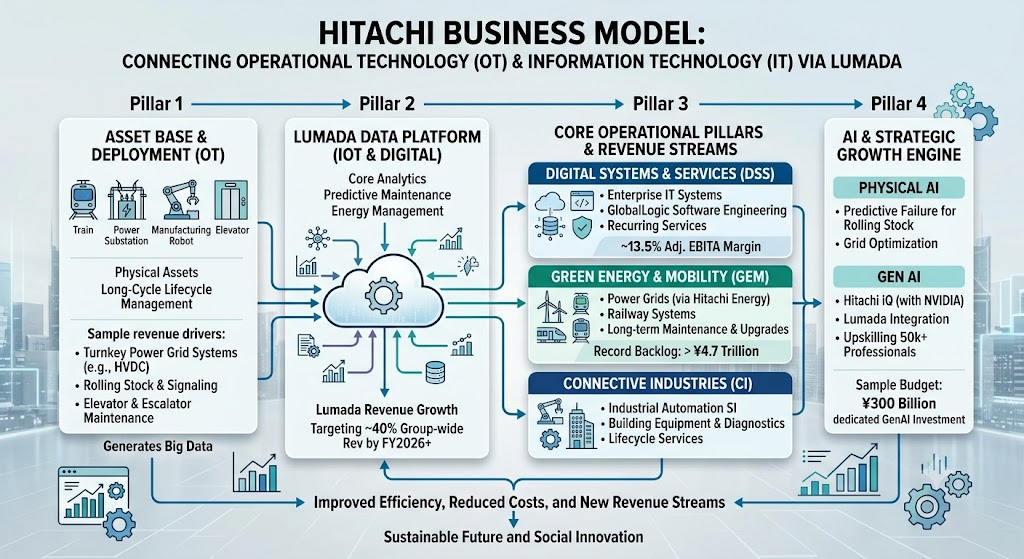
Hitachi makes money by operating a hybrid lifecycle model that connects high-barrier physical equipment(OT) with enterprise cloud software, systems integration, and predictive maintenance(IT). Rather than functioning merely as an equipment OEM, Hitachi uses physical infrastructure deployments to lock in decades of high-margin recurring services and digital asset-management revenue.
Core Operational Pillars and Revenue Engines
- Digital Systems & Services(DSS): Generates revenue via enterprise software integration, mission-critical government/financial cloud systems, and custom software engineering delivered via GlobalLogic. In FY2024, DSS delivered approximately ¥2.8 trillion in revenue with an adjusted EBITA margin exceeding 13.5%.
- Green Energy & Mobility(GEM): Commercializes heavy electrical transmission networks(HVDC systems, switchgears, transformers via Hitachi Energy) and turnkey railway networks(rolling stock, digital signaling via Hitachi Rail). Long-cycle supply contracts are bundled with 15–30-year lifecycle maintenance and digital monitoring agreements. GEM reached over ¥3.4 trillion in revenue in FY2024, supported by a record order backlog at Hitachi Energy exceeding ¥4.7 trillion.
- Connective Industries(CI): Monetizes specialized industrial automation, smart building systems(elevators and escalators), and semiconductor inspection equipment. Revenue flows from factory system integration(robotic SI) and building equipment service agreements.
The Lumada Engine and Monetization Mechanics
- Lumada functions as Hitachi’s common data and analytics software fabric. Sensors deployed across trains, power grids, and factory floors route performance metrics to Lumada, enabling condition-based maintenance, outage reduction, and energy efficiency analytics.
- In FY2024, total Lumada-driven revenue represented approximately 31% of Hitachi’s total revenue(advancing toward 40% group-wide and over 60% within the DSS segment). The shift from fixed-price hardware deliveries to recurring digital maintenance and SaaS contracts is the primary driver expanding group-wide adjusted EBITA margins above 11%.
Business Model Information Sources
- https://www.hitachi.com/IR-e/library/integrated/2024/ar2024e_08.pdf
- https://www.hitachi.com/content/dam/hitachi/global/en/ir/media/library/integrated/2025/ar2025e.pdf
- https://www.hitachi.com/content/dam/hitachi/global/en/press/files/2026/06/260610/20260610_04_digital_en.pdf
- https://umbrex.com/resources/company-profiles/hitachi-ltd/
AI Strategy, Capital Budget, and Strategic Alliances
Hitachi’s AI roadmap focuses on “Physical AI” and enterprise generative AI: bridging large foundational models with complex physical infrastructure assets(locomotives, electrical grids, building systems) rather than pursuing consumer LLMs.
Capital Expenditure and R&D Commitments
- Allocated a dedicated investment of ¥300 billion(approx. $2.1 billion) specifically earmarked for generative AI implementation, infrastructure, and human capital transformation.
- Committed to upskilling over 50,000 “GenAI Professionals” across its 270,000 global employee base to deploy AI solutions inside client architectures.
- Scaled the internal Hitachi Generative AI Center(established in 2023), completing over 100 industrial proof-of-concept projects and rolling out internal AI code generation tools that accelerate software delivery cycles by 70% to 90%.
Strategic Partnerships and Implementations
- NVIDIA Collaboration: Formed a strategic partnership combining NVIDIA accelerated computing, DGX systems, and NVIDIA AI Enterprise with Hitachi’s industrial equipment. Hitachi Vantara launched “Hitachi iQ”, an enterprise infrastructure appliance running NVIDIA H100 GPUs and high-throughput Hitachi storage. Additionally, Hitachi Rail deploys HMAX(Hitachi Motion Analytics eXperience) using NVIDIA Omniverse and physics-ML framework Modulus to simulate digital twin railway lines and predict mechanical failures before they cause line shutdowns.
- Microsoft Multi-Billion Dollar Alliance: Executed a multi-year partnership integrating Microsoft Azure OpenAI Service, Dynamics 365, and GitHub Copilot directly into Hitachi’s Lumada ecosystem. Specific applications include embedding generative AI into JP1 Cloud Services(Hitachi’s IT systems management software used by over 20,000 enterprise clients), reducing initial IT alert triage and operational response times by roughly 33%.
Back to Hitachi