Company History
Foundation and Early Expansion (1864–1933)
Gerard Adriaan Heineken purchased the Haystack brewery in Amsterdam in 1864, formally establishing the company. In 1873, the brewery adopted the name Heineken’s Bierbrouwerij Maatschappij. A key turning point occurred in 1886 when Dr. H. Elion, a pupil of Louis Pasteur, developed Heineken “A-yeast,” which remains the proprietary ingredient behind the signature taste of Heineken lager. Shortly after the end of Prohibition in 1933, Heineken became the first imported beer available in the United States, cementing its early international footprint.
Global Consolidation and Acquisition Era (1968–2009)
In 1968, Heineken merged with its main Dutch rival, Amstel, securing a dominant home market share. Throughout the late 20th century, the company aggressively expanded across Europe, Africa, and the Americas through equity investments and acquisitions. Notable structural deals included acquiring France’s Fischer Brewery, Italy’s Moretti, and building joint ventures in Asia via Asia Pacific Breweries (APB).
Strategic Scale and Portfolio Diversification (2010–Present)
Heineken accelerated its presence in emerging markets by acquiring the beer operations of Mexico’s FEMSA in 2010 and gaining full ownership of Asia Pacific Breweries in 2012. In 2017, it completed the buyout of Kirin’s operations in Brazil and acquired a majority stake in craft brewer Lagunitas. Under its “Evergreen” strategy launched in 2021, Heineken has pivoted toward premiumization, scaling non-alcoholic beverages, and aggressively streamlining global operating costs.
Business Model and Strategy
Heineken operates primarily as a global fast-moving consumer goods (FMCG) manufacturer, monetization occurring through the large-scale production, marketing, and distribution of alcoholic and non-alcoholic malt beverages.
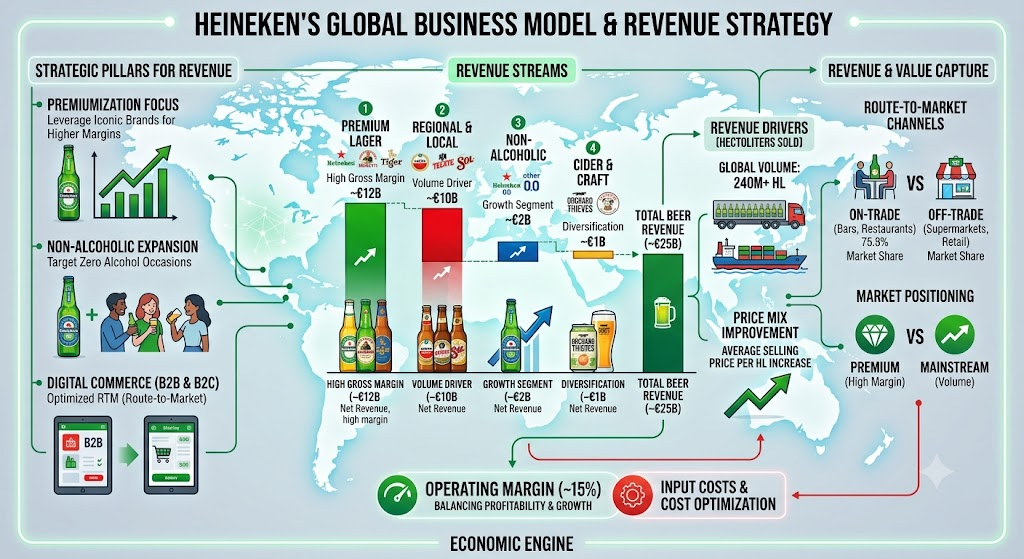
- Revenue Streams and Pricing Power: Heineken derives the vast majority of its revenues from wholesale beer sales to retailers, hospitality venues (on-trade bars and restaurants), and off-trade channels (supermarkets and liquor stores). The business focuses heavily on premiumization; the flagship Heineken brand generates higher gross margins than mainstream regional brands. In fiscal full-year reporting, Heineken N.V. consistently generates over €30 billion in net revenue (before exceptional items), driven by volume sales exceeding 240 million hectoliters globally.
- Volume-to-Value Pivot: The company leverages brand tiering to maximize profitability per hectoliter. The portfolio is structured into three tiers: Premium (Heineken, Birra Moretti, Sol), Mainstream Regional (Amstel, Tecate, Tiger), and Craft/Flavored (Lagunitas, Orchard Thieves Cider). Premium volumes carry price premiums of 10% to 30% over local mainstream brands, insulating overall revenue during periods of flat volume growth.
- Route-to-Market (RTM) Control: In fragmented or high-growth markets, Heineken controls its distribution assets to extract margin across the entire value chain. In Latin America and Africa, Heineken maintains direct-to-retail (D2R) e-commerce platforms (such as e-B2B platforms “eBO”) that allow bars and neighborhood stores to order directly from Heineken, capturing intermediate distributor margins and securing detailed point-of-sale data.
Information Sources
- https://www.theheinekencompany.com/investors/results-and-presentations
- https://www.researchgate.net/publication/387054450_Brewing_Success_A_Comprehensive_Strategic_Management_Study_of_Heineken’s_Global_Operations
AI Strategy, Budget, and Partnerships
Heineken treats Artificial Intelligence as a foundational element of its broader “Evergreen 2030” digital transformation strategy, focusing deployment on route-to-consumer optimization, supply chain efficiency, and targeted commercial spending.
- Commercial AI Deployment (AIDDA): Heineken developed and deployed AIDDA (AI-Driven Decision Assistant) across major operating markets including Mexico, Brazil, France, Italy, the UK, Austria, and Ireland. The system utilizes predictive analytics to serve over 3,700 sales reps supporting 490,000 commercial customers. Instead of taking order entries manually, sales reps receive real-time, algorithmic recommendations on optimal promotional execution and localized order replenishment.
- Commercial Spend Allocation (Allocation AI): To optimize marketing expenditures across diverse markets, Heineken operates “Allocation AI”. This platform models return on investment for Above-The-Line (ATL) and Below-The-Line (BTL) marketing investments, reallocating regional budgets based on predictive elasticities. Operating companies adhering to the platform have recorded measurable incremental gross profit increases across key markets such as Mexico, Brazil, and the Netherlands.
- Core Technology Infrastructure and Partnerships: Rather than building standalone AI models from scratch, Heineken embeds AI into its infrastructure via enterprise partnerships:
- Microsoft Azure OpenAI: Heineken utilizes Azure OpenAI and Azure AI services to run internal semantic search engines, connected executive decision tools built on Microsoft Power BI, and natural-language internal knowledge bases. It also powers predictive maintenance algorithms across breweries to prevent equipment downtime.
- IBM & SAP S/4HANA: In partnership with IBM Consulting, Heineken established its “Digital Backbone” on Microsoft Azure, harmonizing global data pipelines and deploying AIOps (AI-powered IT operations) to automate workflow processes across regional operating companies.
- WPP: Heineken works with WPP to integrate AI-driven personalized creative content and dynamic localized marketing campaigns at scale.
Back to Heineken