
Market Position and Market Share
Groupe Bruxelles Lambert(GBL)ranks as one of the largest listed investment holding companies in Europe, holding a core position on the Euronext Brussels benchmark index(BEL 20).
- Net Asset Value(NAV)and Market Capitalization: GBL manages a net asset value of approximately €13.1 billion to €13.3 billion, with a public market capitalization hovering around €9.5 billion to €10.0 billion. This positions GBL among the top five largest pure-play diversified holding companies in Western Europe by NAV, trailing peers such as Sweden’s Investor AB and the Netherlands-domiciled Exor N.V.
- Market Share & Sector Exposure: In the European listed holding company universe, GBL controls roughly 5% to 8% of total peer-group equity value. Rather than acting as an operating firm, its market dominance stems from concentrated anchor ownership in global oligopolies:
- SGS:14.2% equity stake(world leader in testing, inspection, and certification – TIC).
- Imerys:~54% equity stake(global leader in mineral-based specialties).
- Pernod Ricard:Significant minority position(~6.7%), maintaining exposure to the world’s second-largest wine and spirits group.
- Adidas: Strategic holding representing high-conviction exposure to global athletic footwear and apparel.
- Private Assets & Direct Majority Stakes:Over 38% of NAV is in controlled private assets, including Affidea(European diagnostic imaging leader), Sanoptis(ophthalmology networks), and Canyon Bicycles(global direct-to-consumer premium cycling leader).
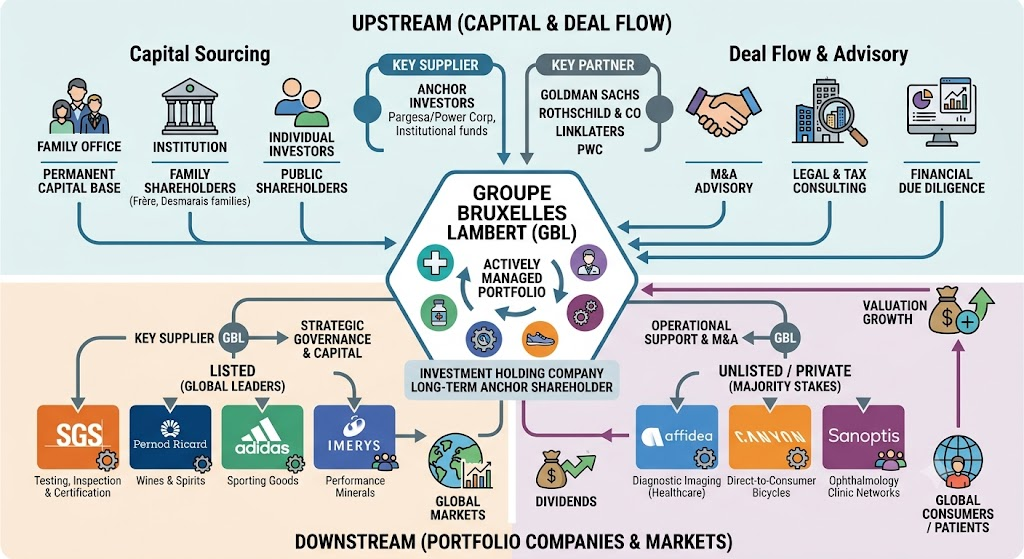
Upstream and Downstream Supply Chain Analysis
Because GBL is an investment holding company rather than an industrial operator, its supply chain functions as a financial and governance value chain:
- Upstream(Capital Sourcing, Underwriting, and Transaction Flow):
- Anchor Capital Providers: GBL operates with permanent, generational equity anchored by Pargesa(jointly controlled by the Belgian Frère family and Canada’s Desmarais family via Power Corporation of Canada). This family-office backing provides patient capital free of typical private equity fund redemption horizons.
- Debt Capital & Credit Underwriters: Key upstream liquidity suppliers include tier-one institutional lenders and bond investors. Syndicated debt facilities and bond issuances are handled by European investment banks such as BNP Paribas, ING, KBC, and Société Générale. GBL maintains an investment-grade credit rating with low loan-to-value(LTV)parameters.
- Deal Sourcing & Advisory Pipeline: Pipeline generation relies on M&A boutiques, bulge-bracket advisory desks(e.g., Rothschild & Co, Morgan Stanley, Goldman Sachs), legal advisors(e.g., Linklaters, Freshfields), and specialized transaction due-diligence providers(PwC, EY, Bain & Company).
- Downstream(Portfolio Asset Integration, Governance, and Value Realization):
- Operational Value Addition: Downstream execution involves board-level governance, capital expenditure approvals, digital transformation, and executive recruitment across portfolio companies(SGS, Imerys, Affidea, Canyon).
- Divestment & Capital Recycling Channels: Cash flow generation and realization channels include public equity markets(secondary block trades, share repurchases), strategic industrial acquirers, and secondary private equity buyers(e.g., selling non-core units or reallocating from public assets into majority private platforms).
- Shareholder Distribution: Proceeds flow downstream to public and family shareholders through progressive annual cash dividend payments and structured share buyback programs.
Competitor Analysis: Technical and Financial Comparison
GBL competes directly for public capital allocation against major European listed investment conglomerates, most notably Investor AB(Sweden), Exor N.V.(Netherlands/Italy), and Wendel(France).
| Metric / Dimension | Groupe Bruxelles Lambert(GBL) | Investor AB | Exor N.V. | Wendel |
| Portfolio Focus | Hybrid: Public blue-chips(SGS, Adidas)plus private healthcare/consumer platforms(Affidea, Canyon). | Nordic industrial powerhouses(Atlas Copco, ABB, AstraZeneca)plus Patricia Industries & EQT. | Global luxury, automotive, and tech(Ferrari, Stellantis, Philips, healthcare). | Mid-market buyouts, business services, and testing(Bureau Veritas, Crisis Prevention Institute). |
| Asset Scale(NAV) | ~€13.1B – €13.3B | >€70B – €80B | ~€35B – €40B | ~€7B – €9B |
| NAV Discount | Wide discount: ~30% to 38% | Narrow discount: ~3% to 12% | Wide discount: ~40% to 50% | Wide discount: ~35% to 45% |
| Investment Methodology | Long-term active ownership; shifting weight from minority public stakes to controlling private buyouts. | Industrial core model; perpetual active board participation via nomination committees. | Entrepreneurial operator-investor model led by the Agnelli family; highly focused big-ticket bets. | Classic private equity playbook via a listed permanent-capital holding structure. |
| Financial Strength & Leverage | Low gearing; conservative LTV ratio(<15%); stable dividend yield(~4% to 6%). | Minimal leverage; exceptional cash generation from listed dividends; elite credit profile(AA-). | High financial flexibility; substantial cash reserves; active share buyback mechanisms. | Investment-grade balance sheet; strict LTV ceiling targeted below 20%. |
- Strategic & Technical Comparison:
- Portfolio Tilt: Investor AB maintains superior shareholder value creation track records due to its industrial technology exposures(Atlas Copco, ABB, Epiroc)and structural co-investment partnership with private equity giant EQT. GBL historically relied on cyclical heavy industrials and energy(TotalEnergies, Lafarge), but has pivoted toward defensive testing/certification(SGS), diagnostic healthcare(Affidea, Sanoptis), and direct-to-consumer brands(Canyon).
- Control vs. Influence: Unlike Wendel, which focuses heavily on full buyouts of mid-caps, GBL employs a split model: holding substantial board-level influence in mega-cap listed names without operational takeover, while taking control or co-control positions in its unlisted portfolio.
- Financial & Capital Allocation Comparison:
- GBL trades at a persistent structural discount to its underlying NAV(frequently exceeding 30%), a market penalty shared with Exor and Wendel due to holding company complexity, tax drag, and family voting concentration. In contrast, Investor AB trades near parity or narrow discounts owing to its operational track record and Swedish governance transparency.
- To narrow this discount, GBL utilizes targeted share buybacks and maintains a high direct dividend payout yield funded by cash dividends collected from cash-generative holdings like SGS and Pernod Ricard.
Sources
- https://www.gbl.com/en
- https://www.gbl.com/en/portfolio/sgs
- https://www.powercorporation.com/en/companies/gbl/
- https://en.wikipedia.org/wiki/Groupe_Bruxelles_Lambert
- https://www.brusselstimes.com/2019393/gbl-investment-holding-company-divested-almost-e2-billion-in-2025
- https://www.livewiremarkets.com/wires/moving-beyond-founder-led
Back to GBL