
Company History
Foundation and Banking Consolidation (1902–1970s)
The group traces its roots back to 1902 with the establishment of the Lambert banking empire. Over several decades, the Lambert family consolidated financial holdings across Belgium, ultimately merging Banque Lambert with Banque de Bruxelles in 1975 to form Banque Bruxelles Lambert (BBL), establishing GBL as a prominent institutional powerhouse in Europe.
The Albert Frère Era and Industrial Conglomeration (1982–2011)
In 1982, Belgian financier Albert Frère took control of GBL alongside Canada’s Paul Desmarais (Power Corporation of Canada) via Pargesa Holding. Throughout the 1980s and 2000s, GBL functioned as a heavyweight strategic investor in European heavy industry, energy, and utilities, maintaining multi-billion-euro stakes in giants such as Total, Engie (GDF Suez), and Lafarge.
Strategic Rotation and De-carbonization (2012–2019)
Recognizing changing market dynamics and ESG headwinds, GBL began a decisive portfolio pivot in 2012. The company systematically dismantled its legacy energy and fossil-fuel positions (reducing energy from 41.5% in 2011 to under 5%), reallocating capital into resilient consumer, testing, and specialty materials leaders like adidas, SGS, and Imerys.
Private Assets Expansion and Pargesa Simplification (2020–Present)
In 2020–2021, GBL simplified its ownership architecture by absorbing Pargesa Holding. Under CEO Ian Gallienne and later executive management transitions, GBL accelerated acquisitions of controlling stakes in private market leaders—including direct-to-consumer bike manufacturer Canyon, healthcare networks Affidea and Sanoptis, and specialized platforms via Sienna Investment Managers and GBL Capital.
Business Model and Strategy
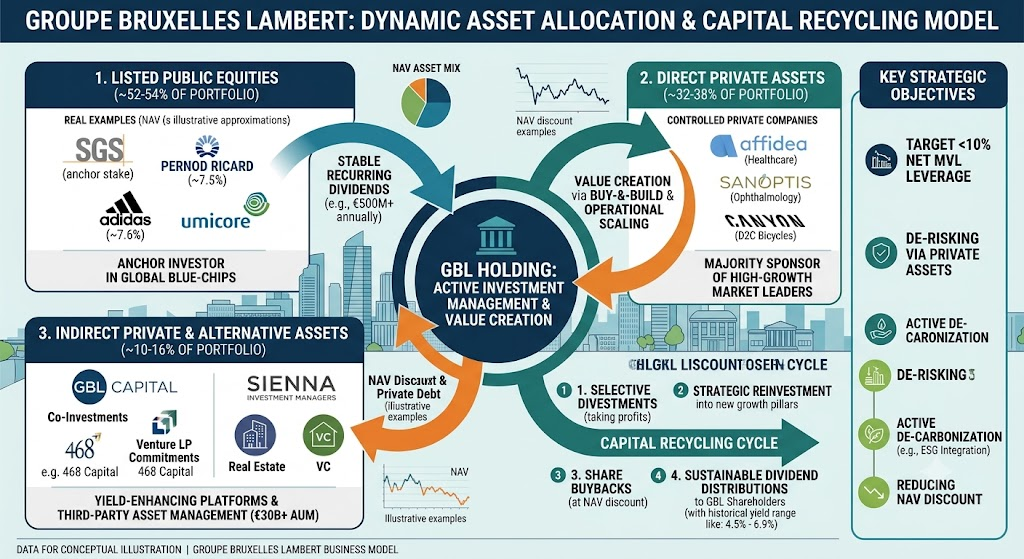
GBL does not run internal operational supply chains; it operates as an active equity holding company generating enterprise value, dividend cash flows, and realized capital gains through a three-pillar asset allocation architecture:
- Listed Assets (~52% to 54% of Portfolio): GBL holds major minority or anchor stakes (typically 7%–55%) in liquid, global blue-chips such as SGS, Pernod Ricard, adidas, Umicore, and Concentrix. These holdings upstream substantial, recurring dividend streams that form the backbone of GBL’s gross cash earnings.
- Direct Private Assets (~32% to 38% of Portfolio): GBL acts as a majority or controlling sponsor in non-listed, cash-generative leaders across healthcare, consumer, and light industrial niches (e.g., Affidea, Sanoptis, Canyon Bicycles). Value creation relies on operational scaling, buy-and-build consolidation, and multiple expansion rather than immediate dividends.
- Indirect Private & Alternative Assets (~10% to 16%): Through GBL Capital (co-investments and LP commitments) and Sienna Investment Managers (a third-party multi-asset manager overseeing approximately €30 billion in third-party and internal assets across private debt, real estate, and venture capital), GBL generates management fees, performance carry, and high-yield returns.
Capital Recycling and Value Realization
GBL monetizes its positions through periodic divestments, taking profits on mature holdings to reinvest into higher-growth sectors. The proceeds are redistributed through steady dividend payouts (yielding between 4.5% and 6.9%) and active share buybacks designed to take advantage of its net asset value discount. GBL maintains a disciplined balance sheet, targeting a net market value leverage (net MVL) below 10% through economic cycles.
Sources for Business Model
- https://www.gbl.com/system/files/public-files/Credit_Opinion-Groupe-Bruxelles-Lambert-16Jun2026-PBC_1486816.pdf
- https://live.euronext.com/en/product/equities/BE0003797140-XBRU/company-information
- https://www.powercorporation.com/en/companies/gbl/
- https://en.wikipedia.org/wiki/Groupe_Bruxelles_Lambert
AI Strategy, Investments, and Partnerships
GBL does not develop foundational AI models in-house; instead, its AI strategy operates through portfolio company integration, tech-enabled enterprise automation, and venture LP allocations:
- Enterprise AI Integration Across Key Holdings: GBL’s largest digital-exposure investment, Concentrix + Webhelp (in which GBL is a major anchor shareholder), is a primary vehicle for generative AI deployment. Concentrix integrates large language models, automated agent tooling, and predictive analytics across 70+ countries to modernize customer operations and process engineering.
- Clinical Diagnostics and Computer Vision (Affidea): In its majority-owned direct asset Affidea (Europe’s largest medical imaging and cancer diagnostics provider), GBL supports clinical AI adoption. Affidea deploys AI-based image reconstruction and radiologist computer-vision algorithms to reduce radiation dosage and accelerate automated scan interpretation.
- Venture Capital & Seed AI Deployments (GBL Capital): Through GBL Capital, the firm commits funds to specialized venture capital managers that back early-to-growth stage AI infrastructure and software startups. Notably, GBL committed €50 million to Berlin-based 468 Capital, which actively backs European AI founders, machine learning engineering, and autonomous software platforms.
- Operational Modernization & Budgets: While GBL does not disclose a centralized, consolidated “holding-level AI budget” in standalone figures, digital transformation and AI roadmaps are funded directly via portfolio company CapEx budgets and Sienna Investment Managers’ data intelligence infrastructure.
Back to GBL