
Company History
Foundations and National Consolidation (1846–1999)
Galp’s roots trace back to 1846 with Lisbon’s street lighting company (CRGE). State-led consolidation culminated in 1976 with the creation of Petrogal, uniting Portugal’s refining, transport, and fuel distribution assets. In 1999, the Portuguese government created Galp Energia SGPS to merge Petrogal and Gás de Portugal, consolidating domestic refining, retail distribution, and natural gas infrastructure under a single corporate holding.
Privatization and Deepwater Expansion (2000–2018)
Galp completed its initial public offering on Euronext Lisbon in 2006. Facing limited domestic growth, it directed capital upstream into deepwater exploration, forming an alliance with Petrobras to develop Brazil’s offshore pre-salt Santos Basin (notably the Tupi/Lula and Iracema fields). Upstream cash flows transformed Galp from a regional Iberian refiner into an international oil producer.
Portfolio Rationalization and De-risking (2019–2023)
Galp permanently shut down its Matosinhos refinery in 2021, concentrating refining activities entirely at its Sines complex to curb emissions and improve margins. It acquired operational and pipeline solar portfolios across Spain and Portugal. In upstream assets, Galp divested its stake in Mozambique’s Area 4 offshore gas block to optimize capital discipline and lower portfolio complexity.
Frontier Discoveries and Green Industrial Shift (2024–Present)
Galp announced oil and gas condensate discoveries at the Mopane complex in Namibia’s Orange Basin. To manage deepwater development capital expenditures, Galp brought in TotalEnergies as operator, swapping stakes to spread risk. Concurrently, Galp deployed capital toward renewable diesel (HVO), sustainable aviation fuel (SAF), and a 100MW electrolyzer project in Sines.
Business Model and Strategy
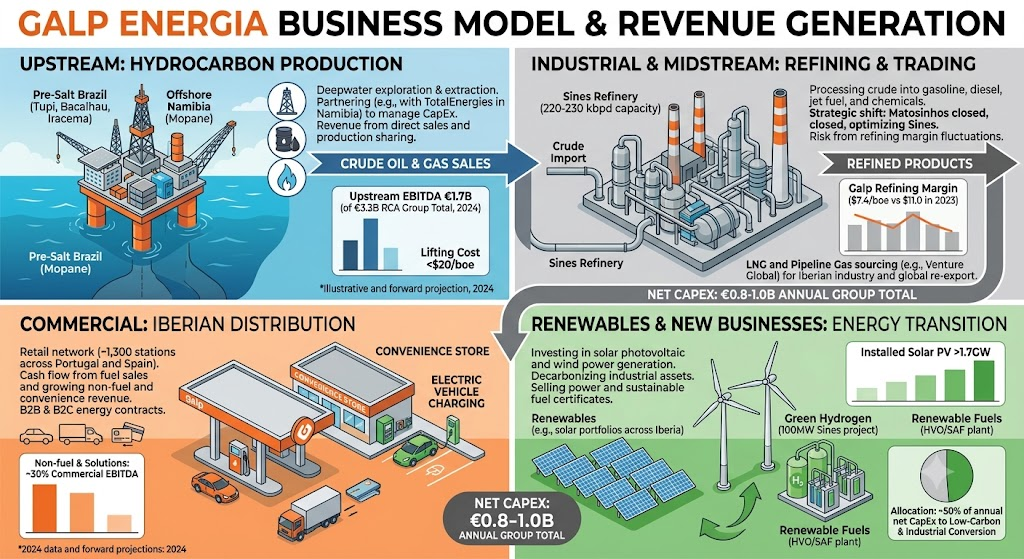
Galp monetizes energy across four segments: Upstream, Industrial & Midstream, Commercial, and Renewables & New Businesses.
Upstream Hydrocarbon Production
Galp generates revenue by producing and marketing crude oil and natural gas. Its offshore production base centers on Brazil’s pre-salt fields (including the Tupi and Bacalhau assets), operating at an extraction breakeven below $20 per barrel. In 2024, Upstream delivered approximately €1.7 billion of the group’s €3.3 billion replacement cost adjusted (RCA) EBITDA. In Namibia’s offshore PEL 83 (Mopane discovery), Galp’s strategy hinges on asset monetization and risk transfer: it farmed down operatorship to TotalEnergies, retaining a 40% non-operating stake while TotalEnergies covers 50% of exploration, appraisal, and development capital expenditures through first oil.
Industrial and Midstream Margin Capture
At the Sines complex (processing capacity of roughly 220–230 kbpd), Galp processes imported crude into gasoline, diesel, jet fuel, and petrochemical feedstocks. Earnings depend on crack spreads (the Galp refining margin was $7.4/boe in 2024, down from $11.0/boe in 2023). Midstream activities trade liquefied natural gas (LNG) and pipeline gas, sourcing supply from contracts (including US export terminals like Venture Global) to supply Iberian industries and re-export cargoes on arbitrage opportunities.
Commercial Downstream Distribution
Galp operates a retail network of approximately 1,300 service stations across Portugal and Spain, generating recurring cash flows from retail fuel margins, convenience store retail, and commercial fleet cards. Non-fuel convenience retail and energy solutions account for roughly 30% of commercial EBITDA. Galp sells electricity and decentralized natural gas contracts directly to B2B and B2C Iberian accounts.
Renewables and Low-Carbon Pivot
Galp owns over 1.7GW of installed solar photovoltaic capacity across Iberia, selling power into the wholesale market, via power purchase agreements (PPAs), and into grid ancillary services. Galp allocates roughly 50% of annual net capital expenditures (averaging €0.8–1.0 billion annually) toward low-carbon and industrial conversion projects. These include the construction of a 100MW green hydrogen electrolyzer and an HVO/SAF renewable fuels unit at Sines.
Sources
- https://www.galp.com/corp/Portals/0/Recursos/Inv_4Q24/Galp_4Q24.pdf
- https://theenergyyear.com/energy-company/galp/
- https://www.galp.com/corp/en/about-us/what-we-do/upstream/namibia
- https://brazilenergyinsight.com/2025/07/23/galp-reports-a-25-increase-in-second-quarter-profits/
- https://uk.investing.com/news/transcripts/earnings-call-transcript-galp-energia-q2-2025-reports-strong-ebitda-growth-93CH-4175749
AI Development Strategy and Implementation
Galp’s artificial intelligence and digital strategy focuses on industrial process optimization, upstream subsurface modeling, predictive asset integrity, and corporate automation.
Upstream Subsurface and Exploration AI
Galp partnered with IBM Brazil to apply cognitive computing and machine learning models to seismic data interpretation. Machine learning algorithms process 3D and 4D seismic wave data from pre-salt formations and Namibia’s deepwater blocks to predict porosity, carbonate reservoir structures, and hydrocarbon fluid migration. This reduces appraisal drilling risk in complex subsea environments.
Refining and Industrial Process Optimization
At the Sines industrial refinery, Galp deploys industrial analytics and machine learning under its Industry 4.0 program. The company uses algorithmic digital twins to optimize energy consumption across processing units. Galp sourced talent and models through industrial datathons with European academic institutions (including Instituto Superior Técnico and the University of Coimbra), offering €50,000 cash prizes for production optimization algorithms. Sensor-driven predictive maintenance monitors heat exchangers, compressors, and rotating equipment to forecast equipment degradation, reducing unplanned industrial downtime.
Enterprise and Risk Operations Automation
In its financial and administrative divisions, Galp deployed robotic process automation (UiPath) and machine learning tools across its CFO Office, targeting procurement, tax compliance, and predictive financial reporting. Galp engaged technical consultancy Devoteam to deploy a dedicated Power Management Cockpit (PMC) platform tracking 239 Key Risk Indicators (KRIs) across five internal operational data sources in real time.
Budget Allocation and Digital Spending
Galp does not separate AI as an isolated line item in public investor filings; instead, digital and operational software budgets sit within overall group capital expenditures (guided at roughly €0.8–1.0 billion net Capex per year), with digital transformation projects managed under the Chief Information and Digital Officer organization. Corporate innovation and startup pilots run through its corporate venture and open-innovation arms, using rapid 3-to-4 month prototyping cycles.
Back to Galp Energia