
Market Position and Market Share
Fujitsu Limited is Japan’s leading information technology vendor and one of the largest systems integration(SI) and IT services companies globally. In its domestic market, Fujitsu consistently ranks #1 in IT services market share, commanding approximately 14% to 16% of the Japanese IT services sector, ahead of major domestic rivals such as NTT DATA, NEC, and Hitachi. The company generates consolidated annual revenues of approximately ¥3.5 trillion to ¥3.6 trillion (over US$23 billion), with domestic operations contributing more than 60% of total revenue.
On the global stage, Fujitsu typically ranks within the top 10 to top 15 global IT services providers by revenue, holding a global market share estimated at around 1.5% to 2.0% in an otherwise highly fragmented worldwide market. Fujitsu has repositioned its core growth driver under the “Fujitsu Uvance” brand, focusing heavily on sustainability transformation, enterprise modernization, and generative AI engineering.
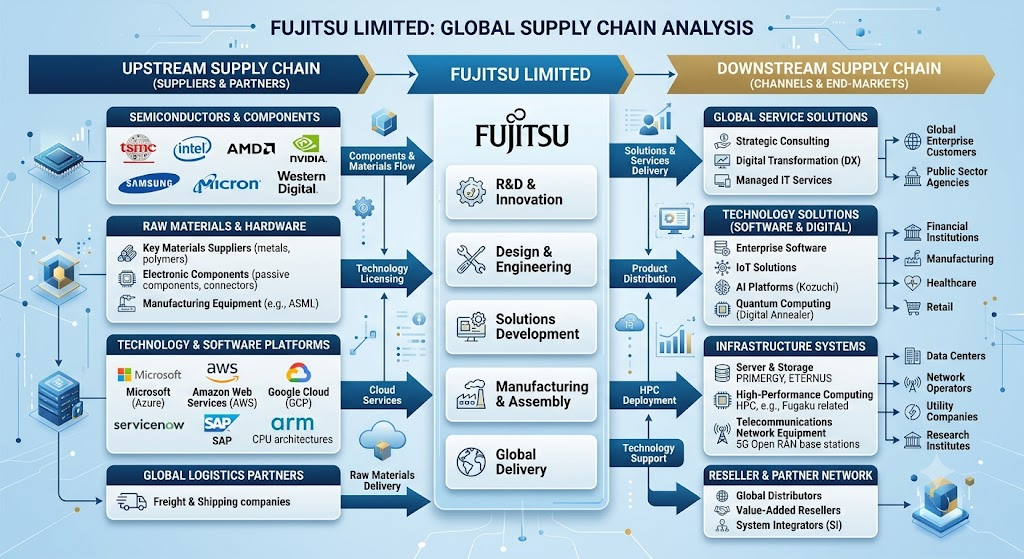
Upstream and Downstream Supply Chain Analysis and Key Suppliers
Upstream Supply Chain (Inputs & Components)
Fujitsu’s transformation into a software and digital services-led company has structurally altered its upstream procurement from pure hardware commodities to enterprise cloud capacity, specialized silicon, and software infrastructure:
- Semiconductors and Advanced Silicon:For its server, supercomputing, and telecom network lines (such as Fugaku architectures and 5G Open RAN base stations), Fujitsu sources semiconductor manufacturing from leading pure-play foundries—primarily Taiwan Semiconductor Manufacturing Company(TSMC)—utilizing advanced FinFET process nodes. Key processor and component suppliers include Intel, AMD, and NVIDIA for enterprise computing and AI accelerator pipelines, as well as Arm for processor architecture licensing.
- Hyperscale Cloud Infrastructure: Fujitsu acts as a strategic global system integrator. It procures hyperscale cloud infrastructure capacity and enterprise software platforms from Microsoft(Azure), Amazon Web Services(AWS), Google Cloud(GCP), ServiceNow, and SAP.
- Component & Storage Sourcing: Server memory, storage, and networking ASICs are procured from Micron Technology, Samsung Electronics, and Western Digital.
Downstream Supply Chain (Channels & End-Markets)
Fujitsu delivers its solutions to downstream clients through direct enterprise sales forces, global delivery centers(GDCs in India, the Philippines, and Poland), and regional reseller networks:
- Public Sector and Sovereign Infrastructure: Japanese central government ministries, local government bodies, healthcare systems, and sovereign utility grids. Fujitsu builds and maintains critical mission systems such as municipal administrative frameworks, tax administration systems, and social infrastructure.
- Financial Services & Banking: Japan’s megabanks (MUFG, SMBC, Mizuho), regional banking tiers, and insurance groups rely on Fujitsu for core mainframe systems, transaction switches, and digital banking platforms.
- Manufacturing, Automotive, and Retail: Global multinational enterprises across automotive (e.g., Toyota supply chain links), electronics, and international retail chains deploy Fujitsu’s enterprise resource planning(ERP), factory IoT, and cloud edge solutions.
Competitor Analysis
Primary Direct Competitors
- Domestic Giants: NTT DATA Group, NEC Corporation, and Hitachi.
- Global Systems Integrators & Tech Consultancies: Accenture, IBM, and Tata Consultancy Services(TCS).
Technical Comparison
- Fujitsu vs. NTT DATA / NEC:Fujitsu holds distinct hardware-to-software integration capabilities, retaining high-performance computing(HPC) engineering heritage (e.g., the Fugaku supercomputer developed with RIKEN and Arm-based CPUs) alongside its proprietary Kozuchi AI platform and quantum-inspired Digital Annealer. In contrast, NTT DATA is largely pure-play software/SI and telecommunications-network aligned via the wider NTT Group, giving NTT DATA greater sheer scale in global IT outsourcing. NEC excels in biometrics, telecommunications core routing, and submarine cables, while Fujitsu has prioritized enterprise digital transformation(DX) platforms through Uvance.
- Fujitsu vs. Accenture / Global Consultancies: Accenture and IBM possess broader global consulting reach and management-tier brand equity in North America and Europe. However, Fujitsu retains a dominant sovereign moat in Japan’s public sector and mission-critical financial mainframes where foreign vendors face significant regulatory and security-clearance hurdles.
Financial Comparison
- Revenue Scale: Fujitsu’s annual revenue stands at roughly ¥3.5 trillion to ¥3.6 trillion. This is comparable to NEC (approx. ¥3.3 trillion to ¥3.4 trillion) but trailing NTT DATA Group (which exceeds ¥4.3 trillion post-consolidation of NTT Ltd.). It is smaller than global players like Accenture (over US$64 billion).
- Operating Margins & Profitability: Historically compressed by legacy hardware manufacturing, Fujitsu’s consolidated operating margin has improved toward 7% to 10%. Its Service Solutions core segment achieves double-digit adjusted operating margins (approx. 11% to 12%), outpacing NEC’s traditional operational margins (around 7% to 8%) but trailing pure consulting/SaaS vendors like Accenture (15%+ adjusted operating margin).
- Capital Efficiency:Fujitsu maintains a disciplined balance sheet following divestments of non-core consumer PC and mobile hardware units, producing an ROE (Return on Equity) around 12% to 14%, outperforming several traditional Japanese conglomerate peers.
Sources
- https://global.fujitsu/en-global/pr/news/2025/11/19-01
- https://www.astuteanalytica.com/industry-report/japan-it-services-market
- https://www.investing.com/news/company-news/fujitsu-q1-fy2026-slides-profit-surges-56-on-services-strength-93CH-4825233
- https://global.fujitsu/en-global/about/ir
- https://www.gartner.com/reviews/product/fujitsu-digital-technology-and-business-consulting-services
back to Fujitsu