
Company History
Foundation and Telecommunications Heritage (1935–1950s)
Established in 1935 as Fuji Telecommunications Equipment Manufacturing(富士電気製造からの分社), the company began as a manufacturing spinoff producing telecommunications switching hardware, telephone equipment, and electrical systems in pre-war and post-war Japan.
Mainframe Leadership and Computing Expansion (1960s–1980s)
During Japan’s rapid economic ascent, Fujitsu developed Japan’s first commercial relay computer(FACOM 100) and later partnered with Amdahl Corporation to challenge IBM’s global dominance in mainframes. Throughout this era, it expanded aggressively into semiconductor design, memory chips, and enterprise servers.
Global Acquisitions and Market Saturation (1990s–2000s)
The firm acquired the UK-based computer manufacturer ICL and expanded into consumer electronics, flat-panel displays, and European telecommunications networks. However, rapid commoditization of hardware and fierce competition from Taiwanese and South Korean semiconductor manufacturers squeezed operating profitability.
Restructuring and Digital Transformation Pivot (2010s–Present)
Facing margin compression, Fujitsu divested its microchip manufacturing facilities, mobile device units, and PC operations to partners such as Lenovo. Under its current leadership, the group reorganized into a software-centric consulting and DX(digital transformation) powerhouse, consolidating its high-margin offerings into Fujitsu Uvance while actively expanding its high-performance computing capabilities.
Business Model and Strategic Growth
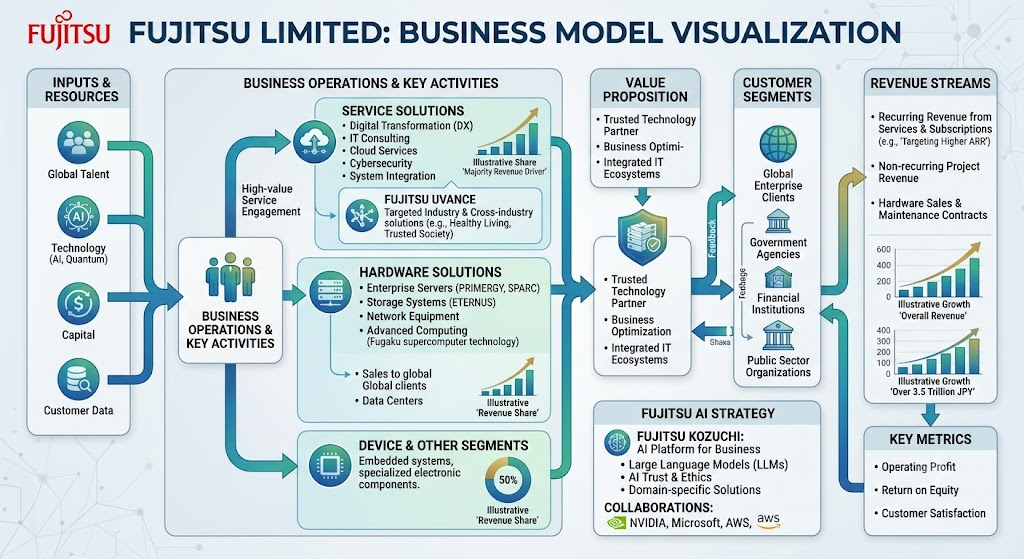
Fujitsu generates revenue primarily through multi-year enterprise IT service contracts, systems integration(SI), managed services, and proprietary enterprise platforms. The core monetization engine resides in three business pillars:
- Service Solutions: The primary profit and revenue driver, accounting for over ¥2.24 trillion of group revenue in FY2024. It delivers end-to-end IT architecture design, legacy system modernization, ERP migrations, and cybersecurity operations for enterprise clients and public sector bodies. Within this division, its growth brand Fujitsu Uvance monetizes standardized cloud solutions, vertical ESG workflows, and SaaS integrations, recording ¥482.8 billion in revenue in FY2024(up 31% year-on-year).
- Hardware Solutions: Focuses on mission-critical enterprise hardware, including mainframe infrastructure, PRIMERGY x86 servers, and open networking equipment(Open RAN). Monetization includes upfront hardware sales paired with multi-year hardware maintenance and technical support service-level agreements(SLAs).
- Ubiquitous Solutions & Device Segments: Covers specialized client peripherals, embedded systems, and lingering client device operations, generating transactional hardware sales that are progressively managed for cash generation rather than capital expansion.
Across all operations, Fujitsu posted consolidated revenue of ¥3,550.1 billion and a record adjusted operating profit of ¥307.2 billion in FY2024, yielding an adjusted operating margin of 8.7%. Its core strategic trajectory centers on migrating customers from bespoke, low-margin on-premise system development toward standardized, repeatable subscription platforms under Fujitsu Uvance, targeting higher margins and recurring ARR.
Sources
- https://global.fujitsu/-/media/Project/Fujitsu/Fujitsu-HQ/ir/documents/Financial_Results/2024/FY/2024FY-Financial-Summary-en.pdf
- https://global.fujitsu/-/media/Project/Fujitsu/Fujitsu-HQ/ir/documents/Financial_Results/2024/FY/2024FY-MTP-Progress-Update-note-en.pdf
- https://www.fujitsu.com/global/about/ir/
AI Strategy, Budget, and Strategic Alliances
Fujitsu positions artificial intelligence as an operational integration layer embedded across its enterprise platform rather than merely selling standalone consumer LLMs.
- Core Platform (Fujitsu Kozuchi): The company centralizes its enterprise AI capabilities within Fujitsu Kozuchi, an enterprise AI engine combining proprietary domain-specific generative models, automated coding verification, explainable AI, and high-speed graph neural network algorithms. Kozuchi is engineered to accelerate enterprise workflows such as automated legacy software migration, regulatory drug discovery screening, and real-time supply chain optimization.
- Capital Commitment and R&D Budget: Fujitsu allocates over ¥100 billion annually toward group-wide research, development, and strategic digital investments, prioritizing enterprise generative AI, sovereign AI frameworks, and quantum-inspired digital annealing technology. In parallel, Fujitsu deploys capital through its corporate venture capital arm(Fujitsu Ventures) with dedicated funds exceeding ¥10 billion targeting early-stage AI, cloud observability, and data infrastructure startups.
- Supercomputing and Hardware Co-Development: Leveraging its leadership in designing the Fugaku supercomputer alongside RIKEN, Fujitsu is developing its next-generation energy-efficient Arm-based processor, FUJITSU-MONAKA. MONAKA targets AI data center inference workloads, delivering significant performance-per-watt efficiency improvements over conventional architectures.
- Key Strategic Partnerships:
- NVIDIA: Collaborating on sovereign enterprise AI infrastructure and LLM acceleration, integrating NVIDIA GPU accelerators with Fujitsu’s server ecosystem and software toolkits.
- Cohere: Strategic partnership to co-develop secure, enterprise-grade Japanese large language models tailored for regulated industries, financial institutions, and government bodies requiring on-premise data confidentiality.
- Microsoft and AWS: Cloud platform alliances embedding Kozuchi microservices and Fujitsu Uvance industry offerings directly into Azure OpenAI and AWS Bedrock environments for global enterprise deployments.
back to Fujitsu