
Corporate History
- Founding and Industrial Foundations(1885–1945): Zenpachi Fujikura established the predecessor business in Tokyo in 1885, initially manufacturing silk-and cotton-insulated winding wires. Incorporating as Fujikura Electric Wire Corporation in 1910, the company built early industrial scale by supplying telecommunications and electrical transmission wiring during Japan’s nationwide modernization and wartime infrastructure buildouts.
- Post-War Expansion and Global Telecommunications Pivot(1946–1990): Following post-war reconstruction, Fujikura diversified into synthetic insulation, coaxial cables, and high-voltage transmission lines. In the 1970s and 1980s, the company pioneered optical communications technology, launching high-precision fusion splicers and fiber-optic cables that positioned Fujikura as an international supplier alongside Western peers during the initial fiber-to-the-home(FTTH) and telecom infrastructure boom.
- Electronics Diversification and Margin Compression(1991–2019): Fujikura expanded aggressively into consumer electronics components, primarily flexible printed circuits(FPCs) for smartphones and automotive wire harnesses. While revenue expanded, commoditization in consumer hardware and brutal price erosion from Chinese and Taiwanese contract manufacturers compressed operating margins, resulting in persistent financial drag and periodic restructuring impairments across its electronics division.
- Structural Transformation and the AI Infrastructure Boom(2020–Present): Beginning with its 100-Day Plan and subsequent Medium-Term Management Plans, Fujikura decisively restructured: it exited loss-making smartphone FPC operations, streamlined automotive harness production, and redirected capital toward high-margin optical components. Surging generative AI compute clusters catalyzed massive adoption of Fujikura’s high-density SWR/WTC cables and fusion splicers across North American hyperscalers, propelling consolidated operating profit to historic records.
Business Model and Growth Strategy
Fujikura generates revenue primarily by designing, patenting, and manufacturing high-density optical transmission equipment, specialized fiber-optic termination systems, automotive electronic components, and industrial energy solutions. Rather than functioning as a low-margin commodity cable manufacturer, the company monetizes high-barrier intellectual property, tight manufacturing tolerances, and system-level installation efficiency.
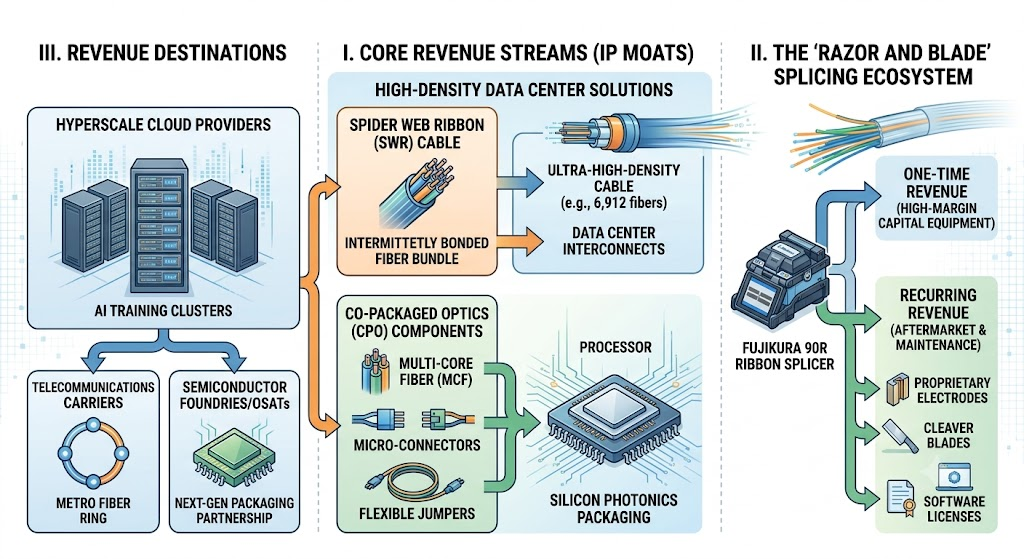
- High-Density Optical Infrastructure Monetization: The core earnings engine resides in the Information and Communications Systems division. Fujikura monetizes its proprietary Spider Web Ribbon(SWR) and Wrapping Tube Cable(WTC) architectures. SWR bonds fibers intermittently, allowing them to bunch together like ribbons during splicing while flexing like loose fibers inside small-diameter conduit. By packing up to 6,912 fibers into standard underground pathways—achieving nearly double the density of conventional loose-tube cables—Fujikura charges a substantial premium over commodity single-mode fiber. Cloud providers and telecommunication carriers pay this premium because ultra-dense fiber deployment slashes civil engineering costs, conduit drilling, and rights-of-way permitting expenses.
- The “Razor and Blade” Splice Ecosystem: Fujikura commands the global market in core-alignment optical fusion splicers(such as the 90R and 90S series). Splicing a 6,912-fiber cable with legacy individual arc splicers requires days of labor. Fujikura pairs its SWR cables with 12-fiber ribbon splicers that fuse a dozen fibers simultaneously with sub-micron accuracy. Fujikura monetizes both the initial high-margin equipment sales and the recurring, captive aftermarket demand for proprietary electrodes, cleaver blades, maintenance service contracts, and licensed automated stripping tools.
- Financial Performance and Margin Profile: For the fiscal year ending March 31, 2025, consolidated revenue expanded 22.5% year-on-year to ¥979.4 billion, continuing onward toward ¥1,182.4 billion in fiscal 2026. The Information and Communications segment serves as the profit driver, consistently delivering operating profit margins above 20%, heavily outperforming the company’s legacy Industrial Energy and Automotive Harness segments.
- Capital Discipline and Portfolio Pruning: Fujikura’s growth strategy centers on return on invested capital(ROIC). Management abandoned market-share chasing in cutthroat consumer smartphone components, focusing investment exclusively where technological barriers defend gross margins. Cash generated from its operational turnaround is redeployed toward capacity expansion in North America, automated factory retrofitting, and next-generation connectivity modules.
Sources for Business Model
- https://www.fujikura.co.jp/eng/ir/news/
- https://www.fujikura.co.jp/eng/ir/library/annual/
- https://finance.biggo.com/news/2Q3GQp4BNl__-4_GtKpy
- https://ng.investing.com/pro/TSE:5803/explorer/total_rev
AI Strategy, Capital Expenditure, and Partnerships
Fujikura positions its business as a primary physical enabler of artificial intelligence clusters, where bandwidth and physical footprint constitute critical operational bottlenecks. Modern AI models require thousands of interconnected GPUs running parallel workloads across server racks and multi-building data center campuses. Traditional copper interconnects hit physical limits regarding reach, heat dissipation, and latency beyond short intra-rack distances, requiring continuous optical migration.
- AI Interconnect Strategy and Co-Packaged Optics(CPO): Fujikura is targeting the transition from pluggable optical transceivers(800G and 1.6T) toward Co-Packaged Optics(CPO) and Near-Package Optics(NPO) architectures. Inside high-density AI clusters, high-frequency signals degrade rapidly when routed through standard printed circuit boards. Fujikura is developing ultra-fine multi-core fibers(MCF), micro-optical connectors, and flexible optical circuit jumpers that route light directly onto the silicon photonics substrate adjacent to the GPU/ASIC compute package, lowering interconnect power consumption by an estimated 25% to 30%.
- Medium-Term Capital Expenditure Allocation: Under its strategic roadmap toward the fiscal year ending March 2029, Fujikura outlined a capital expenditure program committing up to ¥300 billion(approximately $1.9 billion to $2.0 billion) dedicated primarily to optical expansion. Reflecting geographical demand from generative AI data center buildouts, Fujikura allocated up to ¥260 billion(approximately $1.6 billion) directly to North American manufacturing and logistics infrastructure, targeting a quadrupling of core optical fiber cable production capacity compared to fiscal 2022 baselines. The remaining ¥40 billion is targeted for domestic Japanese plants to modernize cleanrooms, automate micro-assembly lines, and secure critical raw material processing.
- Target Operating Milestones: Fujikura’s medium-term management blueprint targets consolidated annual net sales of ¥1.6 trillion and operating profit of ¥315 billion by fiscal 2029. The Information and Communications segment is projected to generate ¥1.05 trillion in revenue and ¥285 billion in operating profit by fiscal 2029, representing over 90% of total group operating earnings and cementing the firm’s pivot to an AI infrastructure pure-play.
- Strategic Partnerships and Customer Ecosystem: Fujikura operates directly with tier-one North American hyperscale cloud operators(including Microsoft Azure, Amazon Web Services, Google Cloud, and Meta Platforms) both directly and via systemic distribution integrators like AFL(America Fujikura Ltd.). In advanced optics and silicon photonics packaging, Fujikura collaborates closely with optical transceiver developers, leading semiconductor assembly and test(OSAT) foundries, and the Consortium for On-Board Optics(COBO) to standardize multi-fiber push-on(MPO/MTP) connector specifications, optical engine sockets, and high-density ribbon terminations required for next-generation 1.6T and 3.2T optical backplanes.
back to Fujikura