
FII Historical Development Stages
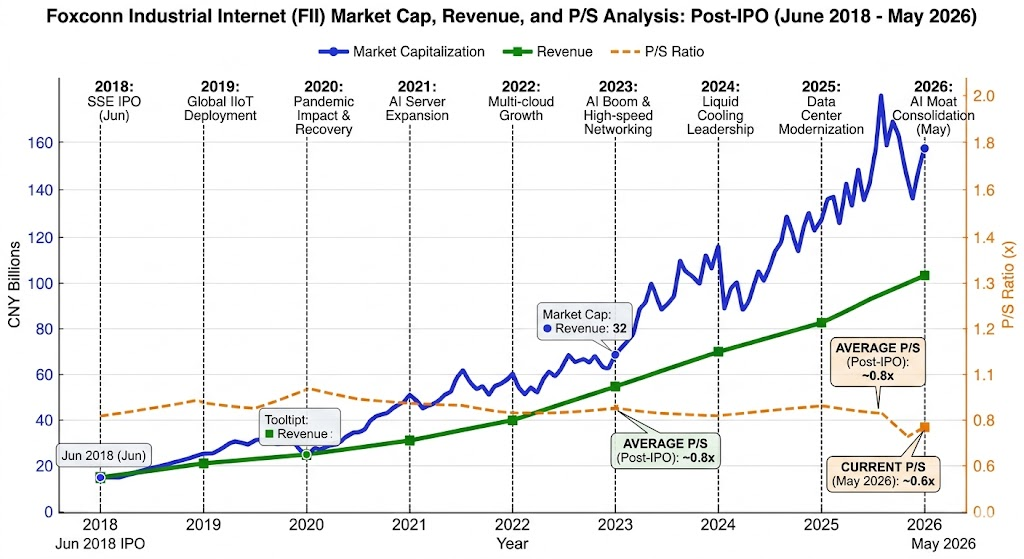
Foxconn Industrial Internet (FII) has evolved from a hardware assembler into an industrial technology company through strategic capital deployment and industrial upgrading.
Stage 1: Foundation and Expansion (2015-2017)
FII was formally established in 2015, integrating assets and technologies from the Hon Hai Group in telecommunications, cloud servers, and precision tools. This stage focused on optimizing global production lines, securing long-term partnerships with leading global tech giants, and establishing a robust foundation in manufacturing scale.
Stage 2: IPO and Smart Manufacturing Transformation (2018-2020)
The company listed on the Shanghai Stock Exchange in 2018, marking one of the largest industrial internet IPOs at the time. During this phase, FII actively integrated Industrial Internet of Things (IIoT) and big data analytics, launching “lighthouse factories” (highly automated factories) and driving digital transformation to upgrade its precision manufacturing capabilities into data-driven industrial services.
Stage 3: AI Empowerment and Industrial Upgrading (2021-Present)
The company solidified a dual-core strategy of cloud computing and the industrial internet. As global demand for AI infrastructure surged, FII became a key supplier in the AI server supply chain. Its technical capabilities expanded from hardware assembly to advanced liquid cooling, high-performance computing (HPC) cluster integration, and edge computing solutions, successfully transitioning into a full-scale industrial technology leader.
Foxconn Industrial Internet (FII) operates in a highly competitive global technology supply chain, clashing with major Electronic Manufacturing Services (EMS) and Original Design Manufacturer (ODM) giants. Its competitive strategy revolves around comprehensive AI supply chain coverage and large-scale manufacturing advantages.
Core Competitors
FII’s competitors can be categorized into three primary segments based on their business focus:
- Server and Cloud Infrastructure Competitors (Direct Threats)
- Quanta Computer: FII’s most formidable rival. Through its subsidiary QCT, Quanta has established direct engineering relationships with global Cloud Service Providers (CSPs), holding a high market share in Open Compute Project (OCP) architecture and hyperscale data centers.
- Wistron and Inventec: Both Taiwanese firms possess strong capabilities in AI server and GPU substrate assembly. Wistron, in particular, maintains a competitive edge in complex GPU substrate assembly and frequently competes with FII for high-end AI server project wins.
- Global EMS Competitors (Operational Model Challenges)
- Jabil and Flex: These US-headquartered firms specialize in high-margin, high-complexity sectors such as medical, aerospace, and energy. By utilizing “design-to-delivery” strategies and regionalized manufacturing, they avoid the price-sensitive competition FII faces in consumer electronics and commodity servers.
- China-Based Competitors (Market Share and Cost)
- Luxshare-ICT: A prominent representative of the “Red Supply Chain,” Luxshare has aggressively expanded into AIoT and precision components. Its vertical integration strategy puts downward pressure on FII’s manufacturing costs within China.
- BYD Electronics: Leveraging its parent group’s strong foundation in industrial automation, BYD has rapidly ascended in the server component and assembly space, posing a threat to FII’s market share in the domestic Chinese market.
FII: Competitive Strengths vs. Challenges
| Strengths | Challenges |
| Vertical Integration: One-stop service capability from GPU modules and substrates to full system integration. | Apple Dependency: Despite FII’s expansion into AI, the overall group remains sensitive to cyclical trends in consumer electronics. |
| AI Supply Chain Depth: Holds key positions in liquid cooling, high-speed 800G switches, and cabinet integration. | Geopolitical Risks: Must balance global manufacturing footprints with supply chain security, trade barriers, and carbon regulations (e.g., EU CBAM). |
| Economies of Scale: Massive production capacity and rapid ramp-up capabilities at critical global manufacturing hubs. | Margin Pressure: The EMS industry generally faces thin margins, requiring a transition to technology premiums (e.g., liquid cooling) to improve profitability. |
Summary
FII currently employs a dual-engine strategy focused on cloud computing and the industrial internet. Compared to its peers, FII’s primary strength lies in its ability to integrate the entire supply chain from modules to data center racks. To counter rivals like Quanta, FII fosters client stickiness through joint R&D on high-end liquid-cooled cabinets; against competitors like Jabil and Wistron, it leverages the efficiency of its “Lighthouse Factories” to maintain a cost advantage.
FII’s strategic priority in 2026 is to convert its AI server market share (targeting 40%) into long-term, stable data services and industrial software revenue, thereby creating a wider moat against pure-play manufacturers.
Source:
- https://www.fii-foxconn.com/
- https://www.sse.com.cn/
- https://www.quantatw.com/
- https://www.wistron.com/
- https://www.inventec.com/
- https://www.jabil.com/
- https://flex.com/
- https://www.luxshare-ict.com/
- https://www.bydelectronic.com/
Back to FII page