
Company History
Foundation and Digital Brokerage (1999–2007)
Fineco was established in 1999 as an independent online trading platform under the name Fineco Online, quickly emerging as Italy’s leading retail brokerage. In 2001, it expanded into transactional checking accounts and payment cards, transitioning from a niche trading portal into a full direct bank.
UniCredit Integration and Restructuring (2008–2013)
Following corporate restructuring, Fineco became a specialized asset gathering and online retail banking subsidiary of UniCredit Group. During this era, it refined its hybrid distribution model by integrating a physical network of personal financial advisors with its automated digital platform, driving steady asset consolidation despite the European debt crisis.
IPO and Full Independence (2014–2019)
In 2014, Fineco was listed on Borsa Italiana and subsequently included in the benchmark FTSE MIB index. UniCredit progressively reduced its stake, culminating in a complete divestment in 2019. Achieving complete operational independence enabled Fineco to build its own asset management factory, Fineco Asset Management (FAM), based in Dublin.
European Expansion and Automation (2020–Present)
Operating as a standalone pan-European contender, Fineco entered the UK market and accelerated proprietary asset solutions. Through multi-year strategic plans, the company integrated artificial intelligence across its advisory software and began preparations to launch broader pan-European brokerage services to capture cross-border retail savings.
Business Model and Strategy
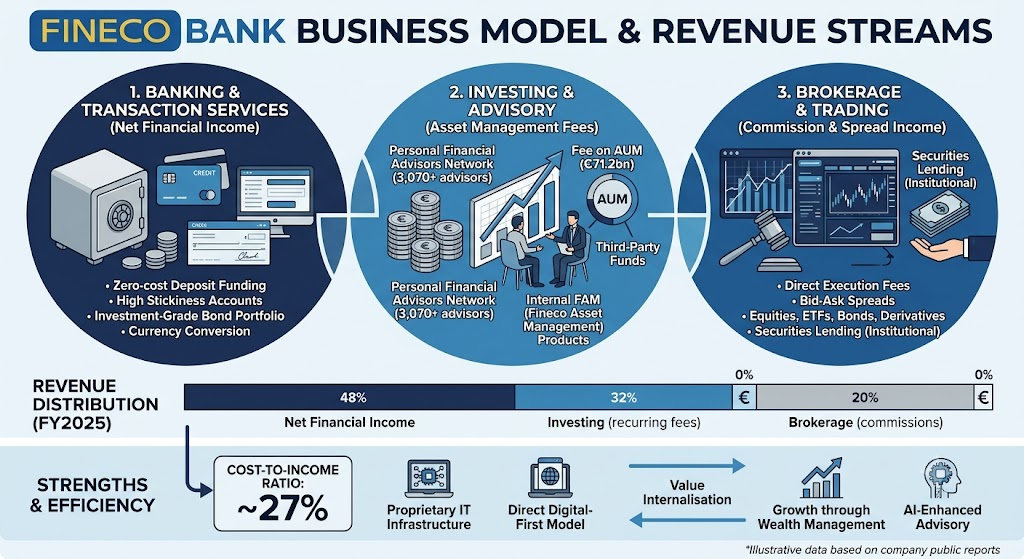
FinecoBank operates a diversified financial services business model generating revenues from three core pillars: banking, investing, and brokerage. Unlike traditional branch-heavy institutions, Fineco owns its entire proprietary software stack, deploying almost 20% of its workforce in tech-related functions to maintain an operating cost-to-income ratio between 25% and 27%.
- Net Financial Income (NFI): Generates interest spread from customer deposits (€30.8 billion stock as of late 2025) and its investment-grade bond portfolio, with an estimated cost of deposit funding close to zero due to high account stickiness.
- Investing and Advisory Fees: Fineco collects recurring management fees on Assets Under Management (AUM, €71.2 billion) through its internal FAM platform and third-party fund distribution, supported by over 3,070 tied personal financial advisors.
- Brokerage and Transaction Commissions: Direct per-trade execution fees, currency conversion markups, and bid-ask spreads generated across equities, ETFs, bonds, and derivatives, as well as institutional securities lending.
Fineco’s strategic growth focuses on value chain internalization (boosting high-margin proprietary FAM products), scaling private banking clients (assets exceeding €500,000 reaching €81.4 billion), and expanding institutional securities lending across customer ETF holdings.
Sources
- https://images.fineco.it/pub/pdf/chi-siamo/comunicati-ipo/2026-02-06-PR_FINECOBANK_RESULTS_FY25.pdf
- https://images.finecobank.com/docs/pdf/pub/corporate/investors/FY25-Results.pdf
- https://images.fineco.it/pub/pdf/chi-siamo/comunicati-ipo/2025-02-06-PR_FY24_Results.pdf
- https://about.finecobank.com/en/sustainability/
Artificial Intelligence Strategy and Execution
FinecoBank embeds artificial intelligence as an operational backbone designed to raise employee leverage rather than replace human advisory interactions. Under its 2026–2029 strategic roadmap, AI deployment is targeted to lift net inflows and annual customer acquisition into low-double-digit growth rates, expanding well above the historical 6% baseline.
- Core Operational Implementation: Fineco integrates machine learning algorithms within its proprietary advisory platform, X-Net. Key applications include automated portfolio diagnostics, dynamic multi-variable scenario modeling, and natural language generation for tailored investment client reports. These tools have increased commercial proposal generation by advisors by approximately 20%.
- Onboarding and Internal Knowledge Retrieval: Semantic enterprise search systems streamline compliance retrieval across corporate directives and accelerate digital customer verification workflows.
- Budget and Dedicated Expenditures: Fineco manages AI development primarily in-house, budgeting specific AI development and maintenance costs directly within operational line items (recording dedicated growth-related AI expenditure increments of €2.3 million year-over-year in FY2025).
- Technology Partnerships and Infrastructure: The bank utilizes Microsoft enterprise solutions and cloud infrastructures under strict EU AI Act and GDPR frameworks, pairing private foundational models with its proprietary customer financial datasets. Fineco maintains a formal Group AI Global Policy covering algorithmic explainability, automated risk governance, and security auditing.
Back to FinecoBank