
Corporate History
Foundational Roots (1949–1983)
The enterprise traces back to March 1949 in Ube, Yamaguchi Prefecture, where Hitoshi Yanai founded Men’s Shop Ogori Shoji. In 1963, the business incorporated as Ogori Shoji Co., Ltd., operating as a conventional regional menswear boutique catering to suburban shoppers.
The UNIQLO Pivot and Domestic Explosion (1984–1999)
In 1984, Tadashi Yanai succeeded his father and launched “Unique Clothing Warehouse” in Hiroshima, introducing self-service, affordable casual wear inspired by American campus cooperative stores. In September 1991, Ogori Shoji formally renamed itself Fast Retailing Co., Ltd. The company listed on the Hiroshima Stock Exchange in 1994 and graduated to the Tokyo Stock Exchange First Section in 1999. The nationwide phenomenon of its 1,900-yen fleece jackets in 1998 cemented UNIQLO as a dominant household brand in Japan.
Global Expansion and Multi-Brand Portfolio (2000–2015)
Fast Retailing aggressively expanded internationally, entering the UK in 2001 and China in 2002. After initial overexpansion and store closures in Europe, the group refined its global flagship strategy, opening landmark locations in New York’s SoHo (2006), London, and Paris. Concurrently, it diversified through M&A, acquiring Theory (Link Theory Holdings) and Comptoir des Cotonniers, while creating low-priced sister brand GU in 2006.
The Digital Consumer Retail Era (2016–Present)
In 2017, Fast Retailing initiated the “Ariake Project,” fundamentally rewiring the company from a conventional merchant into an information-driven “Digital Consumer Retail Company”. By leveraging integrated supply-chain data, RFID tracking, and warehouse automation, Fast Retailing accelerated overseas expansion across North America, Europe, and Southeast Asia, transforming Overseas UNIQLO into its single largest engine of revenue and operating profit.
Business Model and Monetization Strategy
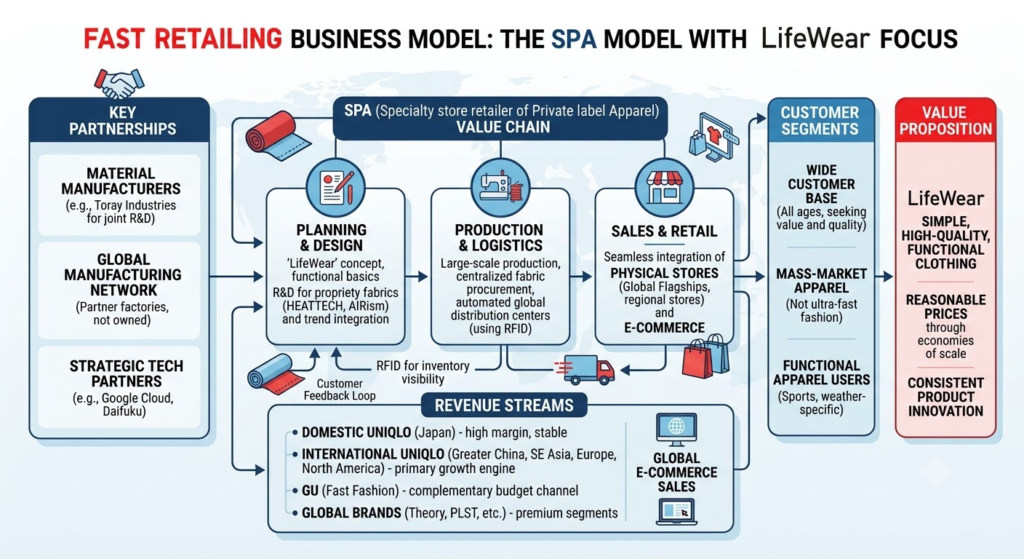
Fast Retailing operates a modified Specialty store retailer of Private label Apparel (SPA) business model centered on high-volume, standardized basic apparel. Rather than competing on rapid trend replication with thousands of SKUs like Inditex (Zara) or ultra-fast fashion platforms (Shein), Fast Retailing generates revenue through deep product rationalization, long production cycles, and economies of scale.
- Mass-Market Core SKUs and Economies of Scale: Fast Retailing focuses on roughly 1,000 to 1,500 core SKUs per season, compared to tens of thousands at peer retailers. By producing enormous volumes of single fabric platforms (e.g., HEATTECH, AIRism, Ultra Light Down) jointly developed with Toray Industries, the company drives unit manufacturing costs down significantly, enabling gross profit margins typically between 52% and 55%.
- Geographic Monetization Engine: Overseas UNIQLO is the primary revenue driver, contributing roughly 60% of total revenue and more than 60% of group business profit. While Greater China represents its largest single international profit center, the post-2022 expansion strategy has diversified cash flow by aggressively scaling in North America and Europe, where operating margins run above 15%. Domestic UNIQLO serves as a high-margin, mature cash-cow segment generating stable operating profits exceeding 150 billion yen annually.
- Tiered Portfolio Architecture: GU serves as a complementary budget channel capturing younger demographics and fast-moving trends at 30% to 40% lower price points than UNIQLO, while Theory and PLST capture contemporary business-casual and premium segments.
- Full-Price Sell-Through Efficiency: By focusing on timeless basics rather than transient runway styles, Fast Retailing limits end-of-season clearance write-downs. AI-driven replenishment and global inventory transfers keep markdown ratios materially lower than standard department store chains, preserving consolidated operating margins near 18%.
Information Sources (Business Model)
- https://www.fastretailing.com/eng/group/strategy/
- https://www.fastretailing.com/tc/ir/financial/
- https://www.fastretailing.com/eng/ir/library/pdf/ar2019_en.pdf
Artificial Intelligence Strategy, Budget, and Partnerships
Fast Retailing treats AI and automation as structural levers to eliminate overproduction, minimize stockouts, and synchronize front-line store staff with executive decision-makers under its “All-Employee Management” philosophy.
- Strategic Core and Infrastructure (Management Cockpit): Through its ongoing IT and digitalization investments—allocating tens of billions of yen annually into group digital infrastructure and automated warehousing—Fast Retailing built a centralized data platform called the “Management Cockpit”. Integrated with generative AI natural language queries, this system allows store managers and merchandise planners to query and analyze real-time operational indicators across company, store, and SKU levels simultaneously.
- Demand Forecasting and Markdown Optimization: The company deploys proprietary machine-learning algorithms to forecast regional demand by processing historical sales velocity, local weather forecasts, foot-traffic analytics, and real-time RFID inventory scans. This precision demand modeling reduced overstock markdowns substantially, capturing hundreds of millions of dollars in preserved retail value.
- Global Voice of Customer (VoC) Translation: Handling billions of interactions across dozens of languages, Fast Retailing implements enterprise generative AI pipelines to automatically ingest, translate, categorize, and synthesize customer reviews and store feedback globally. Product development teams in Tokyo utilize these automated sentiment clusters to refine clothing fits and material choices in real time.
- Strategic Partnerships:
- Google Cloud: Primary technological partner for big data analytics, machine-learning toolchains, and internal enterprise collaboration platforms to connect global operations.
- Accenture: Strategic digital transformation partner assisting in the architecture of cloud-based customer relationship management, digital commerce platforms, and predictive supply-chain operations.
- Daifuku Co., Ltd.: Logistics automation partner responsible for modernizing Fast Retailing’s global distribution centers (such as the Ariake warehouse), where robotic sorting systems and AI vision technologies automated up to 90% of warehouse handling operations.
back to Fast Retailing