
Company History
The Industrial Foundation (1899–1956)
The group’s lineage began in 1899 when Giovanni Agnelli co-founded Fabbrica Italiana Automobili Torino (FIAT) in Turin. Over the first half of the twentieth century, FIAT evolved into Italy’s preeminent industrial conglomerate, expanding beyond passenger vehicles into aviation, heavy machinery, and defense manufacturing. In 1927, Giovanni Agnelli established IFI (Istituto Finanziario Industriale) as an investment holding company to manage the family’s expanding industrial and financial holdings.
Post-War Expansion and Diversification (1957–2003)
Under the leadership of Gianni Agnelli, the family diversified into banking, insurance, retail, and publishing, notably acquiring control of Juventus FC in the 1920s and expanding stakes in prominent European businesses. In 1957, IFI acquired control of IFIL (later renamed IFIL Finanziaria), creating a dual-tier holding structure. Throughout the late twentieth century, IFIL served as an active investment arm while FIAT remained the core manufacturing pillar, surviving multiple European macroeconomic shocks and automotive crises.
Consolidation and Turnaround under Marchionne and Elkann (2004–2015)
Gianni Agnelli’s grandson, John Elkann, assumed leadership during a severe corporate crisis in the early 2000s. Elkann appointed Sergio Marchionne as FIAT CEO in 2004. In 2008–2009, IFI and IFIL merged to streamline the governance structure, giving birth to the modern Exor entity. Marchionne orchestrated the historic acquisition and operational turnaround of Chrysler, creating Fiat Chrysler Automobiles (FCA) in 2014, and executed the strategic spin-offs of CNH Industrial and Ferrari.
Global Reallocation, Re-domiciliation, and Diversification (2016–Present)
In 2016, Exor moved its legal domicile to the Netherlands to access flexible corporate governance frameworks and dual-class voting structures. It acquired reinsurer PartnerRe for $6.9 billion in 2016, subsequently selling it to Covéa in 2022 for €8.6 billion in cash, which unlocked immense liquidity. Exor engineered the 50-50 merger between FCA and PSA Group in 2021 to create Stellantis, while recycling capital into healthcare (becoming the largest shareholder in Philips with an investment exceeding €2.8 billion), luxury (Christian Louboutin), and external asset management via Lingotto.
Business Model and Development Strategy
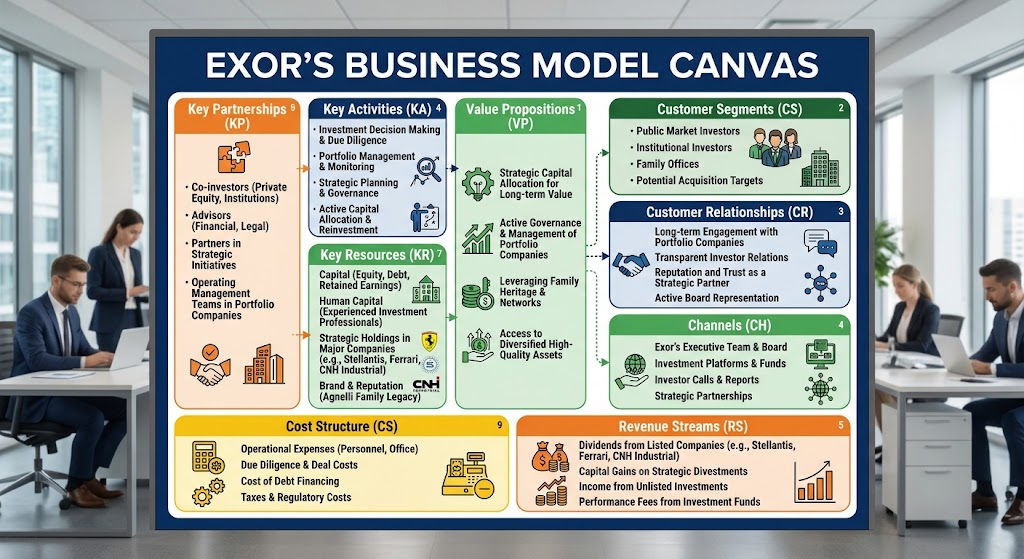
Exor operates as an active investment holding company, generating enterprise returns through four distinct economic mechanisms rather than operational sales: capital gains on disposals, dividend extractions from portfolio holdings, capital compounding via third-party asset management, and opportunistic share buybacks capitalizing on holding company discounts.
Capital Deployment and Portfolio Structure
Exor manages a Gross Asset Value (GAV) exceeding €33 billion, divided among large core companies (approximately 77% of GAV), investment platforms (Lingotto representing roughly 12%), private/unlisted assets (about 9%), and liquid cash reserves. Its largest single asset is Ferrari, valued at over €12 billion, followed by stakes in Stellantis (15.5% economic rights, 23.9% voting rights), Philips (roughly 17.5% economic interest), CNH Industrial (around 27%), and unlisted luxury brand Christian Louboutin (24%).
Cash Generation and Financial Metrics
The company earns hundreds of millions of euros annually in ordinary dividends from its listed holdings, primarily driven by Ferrari, Stellantis, and CNH Industrial. In liquidity events, Exor harvests large capital gains; for example, its divestment of PartnerRe yielded €8.6 billion in cash proceeds, and recent exits such as GEDI, Lifenet, and NUO produced approximately €2.7 billion at an aggregate 1.4x invested capital multiple. Exor maintains a conservative balance sheet, operating with a loan-to-value (LTV) ratio of 6.9%—well inside its 20% internal ceiling—and roughly €1.4 billion to €1.6 billion in pure cash reserves, leaving more than €3.7 billion available for strategic deployment.
Development Strategy
Exor’s capital allocation strategy focuses on three pillars:
- Sector Rebalancing toward Secular Growth: Reducing long-term structural exposure to legacy automotive manufacturing by rotating divestment proceeds into non-cyclical sectors, specifically healthcare (Philips and bioMérieux) and high-margin luxury goods.
- Active Ownership and Governance: Holding anchor minority or majority stakes that grant significant board seats and voting power, enabling Exor to direct capital allocation, mergers, and CEO appointments across its operating entities.
- NAV Accretion via Arbitrage: Repurchasing its own deeply discounted public shares (including completed buyback tranches of €1 billion) alongside investing through Lingotto, an independent asset manager wholly owned by Exor that has expanded to over $10 billion in assets under management with a 26% internal rate of return (IRR) since inception.
Sources
- https://www.exor.com/pages/investors-media/letter-shareholders
- https://www.exor.com/sites/default/files/2023/document-documents/EXOR_Annual%20Report%202022.pdf
- https://www.investing.com/news/company-news/exor-2025-presentation-nav-slides-8-as-auto-holdings-weigh-93CH-4578135
- https://www.investing.com/news/transcripts/earnings-call-transcript-exors-h2-2025-performance-sees-nav-decline-93CH-4578102
- https://live.euronext.com/de/product/equities/NL0012059018-XAMS/company-information
Artificial Intelligence Strategy and Initiatives
Exor pursues a two-pronged artificial intelligence strategy: acting as a direct early-stage equity backer of frontier AI infrastructure and foundation models, while mandating that its large operating portfolio companies deploy specialized AI to protect operational margins.
Early-Stage Venture Investments and Frontier AI Backing
Exor participates in frontier AI venture investing via Exor Ventures (historically known as Exor Seeds) and its specialized venture spinout Ora Global, directed by Noam Ohana. Exor has committed several hundred million euros across venture vintages, backing more than 100 deep tech and software companies:
- Foundation Models: Exor was an early institutional investor in French AI champion Mistral AI, backing its rapid scale-up from seed stage into a multi-billion-dollar enterprise foundation model developer.
- Embodied AI and Autonomous Systems: Exor backed Wayve, the UK-based developer of end-to-end embodied AI foundation models for autonomous driving, as well as Physical Intelligence (generalist robotic foundation models).
- Industrial Robotics and Computer Vision: Exor Ventures led a €15 million Series A financing round for Paris-based Inbolt, which builds AI-powered real-time 3D vision guidance systems allowing industrial robotic arms to operate dynamically on assembly lines.
- AI Compute and Hardware Infrastructure: The portfolio holds strategic stakes in Crusoe Energy Systems (AI data centers powered by stranded energy), DustPhotonics (optical interconnects for accelerated computing clusters), and Nebuly (user analytics for LLMs).
Portfolio Company Integration and Corporate Partnerships
Exor facilitates tech cross-pollination between its venture bets and core industrial holdings:
- Healthcare AI (Philips): Philips has made generative AI and predictive clinical algorithms central to its enterprise imaging and informatics division, partnering with Amazon Web Services (AWS) and Microsoft to scale AI-driven diagnostics across hospital workflows.
- Automotive and Manufacturing (Stellantis and Ferrari): Stellantis executes multi-billion-euro software and digital Cockpit R&D roadmaps in partnership with Amazon and Foxconn (Mobile Drive joint venture), integrating cloud AI analytics into vehicle telemetry and deploying vision AI across European manufacturing plants. Ferrari applies proprietary AI simulation algorithms to vehicle dynamics, aerodynamic wind-tunnel testing, and real-time Scuderia Formula 1 telemetry optimization.
- Ecosystem Building (Vento): In Italy, Exor established Vento, a venture-building initiative that provides pre-seed equity tickets of up to €150,000 alongside technical resources to Italian founders building AI-native tools and automated software platforms.
Back to Exor