EVE Energy holds a position in the first tier of the global lithium battery industry, with its core businesses maintaining leading positions in multiple market segments:
- Energy Storage Systems (ESS): Ranks firmly as the second-largest global supplier of energy storage battery cells, holding a market share of over 10%, and demonstrates strong competitiveness in utility-scale power stations and high-capacity cell series.
- Primary Lithium Batteries: Has maintained the world’s top ranking in global sales revenue and export volume for consecutive years, serving as a key global supplier for smart metering and IoT applications.
- Cylindrical Batteries: Ranks among the global leaders in shipment volume for consumer and small power cylindrical batteries.
- Power Batteries (EV): Its global power battery installed capacity ranking has steadily climbed into the global top six, successfully entering the supply chains of top-tier international automakers such as BMW and Hyundai-Kia.
- Corporate Ranking: Placed 278th on the Fortune China 500 list, highlighting its scale, strength, and comprehensive influence in the global new energy and lithium battery industry.
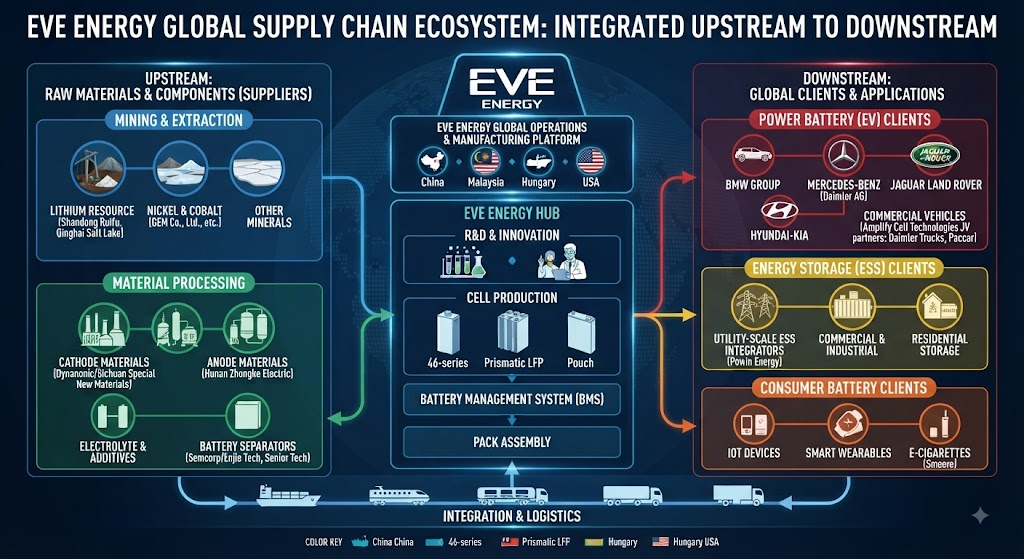
EVE Energy’s supply chain and key supplier layout encompass upstream raw materials, core components, and downstream international automakers and energy storage clients, strengthening its global competitiveness through vertical integration and strategic alliances:
1. Upstream Raw Materials and Core Component Suppliers
- Lithium Resources and Material Layout:
- Invested in Shandong Ruifu Lithium (holding a 20% stake) to ensure a stable supply of lithium carbonate and lithium hydroxide.
- Invested in Sichuan Special New Materials, a subsidiary of Dynanonic (holding a 40% stake), to secure cathode material resources.
- Signed a long-term strategic cooperation agreement with GEM Co., Ltd., securing an annual supply of over 10,000 tons of recycled nickel products (including nickel sulfate and ternary precursors) to establish a green supply chain across the power battery lifecycle.
- Partnered with enterprises such as Qinghai Salt Lake Industry to participate in lithium resource development and utilization in regions like Tibet.
- Battery Separators and Key Auxiliaries:
- Signed major supply agreements with leading enterprises such as Semcorp (Enjie Tech) and Senior Technology (e.g., Semcorp supplying multi-billion square meters of battery separators over the long term) to meet production demands at domestic and overseas plants.
- Anodes and Other Materials: Integrated and allied with upstream anode material and core auxiliary suppliers such as Hunan Zhongke Electric.
2. Downstream Key Clients and Global Partners (Downstream Supply Chain)
- Top-Tier International Automakers (Power Batteries):
- Successfully entered the supply chains of international luxury and mainstream automakers such as BMW, Jaguar Land Rover (JLR), Hyundai-Kia, and Daimler AG.
- Overseas Joint Ventures and Capacity Layout:
- US Market: Formed a joint venture named Amplify Cell Technologies (ACT) with Daimler Trucks, Paccar, and Accelera, constructing an LFP battery plant in Mississippi, USA, focused on supplying the North American commercial vehicle market.
- South Korea’s SK Group: Deepened technical and market synergy in power batteries through joint ventures (such as cooperation related to SK On) with SK Innovation.
- Energy Storage Systems and Energy Clients:
- Established long-term strategic supply relationships with world-renowned energy storage system integrators (such as Powin Energy) to supply high-capacity energy storage cells.
Sources:
https://en.wikipedia.org/wiki/EVE_Energy
https://www.marklines.com/en/top500/cf/eve-energy_hl2021
As a significant player in the global lithium battery sector, EVE Energy operates in a highly competitive market environment. Based on the market landscape in 2026, the following is an analysis of its competitive status:
Market Positioning and Competitive Dynamics
EVE Energy currently ranks among the top global players in the power and energy storage battery markets, adopting a “dual-track” strategy. Its core competitive strategy lies in navigating the industry’s “price wars” through technological iteration, supply chain management, and agile capacity expansion.
Classification of Main Competitors
- Market Leaders (Scale and Technological Moats):
- CATL (Contemporary Amperex Technology Co. Limited): The global market leader, possessing a powerful vertically integrated supply chain, strong R&D capabilities, and massive scale economies. With its product matrix—ranging from LFP to all-solid-state batteries—it remains EVE Energy’s most formidable competitor in terms of cost control and product range.
- BYD: Leveraging a vertical integration advantage (battery + vehicle manufacturing), it holds immense brand recognition in the power battery sector, particularly with its highly differentiated LFP “Blade Battery” technology.
- Growth-Oriented and Specialized Competitors (Energy Storage and Power):
- CALB, Gotion High-Tech: These companies compete with EVE Energy for supply shares among Tier-1 and Tier-2 automakers in the domestic market. Possessing significant scale-up capabilities, their competition focuses primarily on delivery speed and price-to-performance ratios.
- REPT BATTERO, Hithium: In the energy storage battery sector, these companies frequently capture market share through aggressive pricing strategies and rapid technological iterations, acting as direct competitors to EVE in this specific segment.
- International Giants:
- LG Energy Solution, SK On, Samsung SDI: Although their overall global market share is being squeezed by Chinese manufacturers, they maintain deep client bases in Western markets (e.g., BMW, Ford, VW) and demonstrate resilience in technical specifications and global footprints.
Core Competitive Advantages and Challenges
- Advantages:
- Technological Matrix: The company maintains a strong footprint in large cylindrical batteries (46 series), prismatic LFP cells, and pouch cells, with a proven ability to translate technology into mass production.
- Diversified Client Base: Successful entry into the supply chains of top-tier international automakers (e.g., BMW, Hyundai-Kia) reduces reliance on any single client.
- Financial Resilience: Through supply chain hedging and capacity optimization, EVE has effectively mitigated the impact of raw material price volatility, with profitability showing growth trends in 2026.
- Challenges:
- Margin Compression: Strategic price adjustments made to capture market share have left profit margins susceptible to intense industry-wide price wars.
- Capital Pressure: Large-scale global expansion (e.g., Malaysia, Hungary) tests cash flow and debt-to-asset ratios.
- Industry “Involution”: The extreme demand for cost reduction in the market forces the company to continuously optimize manufacturing processes to maintain gross margin recovery.
Conclusion
EVE Energy is currently at a critical turning point as it transitions from “scale-first” to “quality- and efficiency-driven” growth. Facing the dominant pressure from CATL and the aggressive pricing tactics of numerous secondary battery manufacturers, EVE Energy’s long-term competitiveness will depend on its “mass production and delivery capability for large cylindrical batteries” and its “penetration rate in global markets.”
Back to EVE Energy