
Since its establishment in 2001, EVE Energy has evolved over more than two decades from a single-product manufacturer into a leading global lithium battery platform enterprise. Its development history can be broadly categorized into four stages:
Stage 1: Inception and Focus on Primary Lithium Batteries (2001–2009)
- Foundations: Founded in 2001, the company initially focused on the R&D and manufacturing of primary lithium batteries.
- Technical Accumulation: Beginning in 2003, EVE deepened its footprint in the primary lithium battery sector. By establishing production bases and leveraging robust R&D, it secured a leadership position in markets such as smart metering and the IoT.
- Public Listing: In 2009, the company was among the first batch of enterprises to list on the Shenzhen ChiNext market (Stock Code: 300014), providing the capital support necessary for future expansion.
Stage 2: Expansion of Consumer Lithium-ion Batteries and Strategic Positioning (2010–2014)
- Diversification: In 2010, the company began expanding into the consumer lithium-ion battery market and established a postdoctoral research workstation to enhance its scientific and technical capabilities.
- Industry Integration: In 2012, it completed its lithium-ion battery production base and merged with Huizhou Desay Battery.
- Capital Operations: In 2014, the acquisition of a 50.1% stake in SMOORE allowed the company to enter the battery market for electronic atomizers, initiating a path of supply chain integration.
Stage 3: Explosive Growth in Power and Energy Storage Batteries (2015–2020)
- Focus on Power: In 2015, the company founded its New Energy Research Institute and began the production of power batteries. By 2016, it launched high-performance power battery projects and expanded production capacity on a large scale in regions such as Jingmen.
- Entry into International Supply Chains: Leveraging advanced technology, EVE secured designated supplier status with international automakers including Jaguar Land Rover, Daimler AG, Hyundai-Kia, and BMW, establishing itself as a top-tier global battery supplier.
- Innovation: The company launched “button-type” batteries for TWS earbuds and achieved significant breakthroughs in pouch-cell ternary batteries and lithium iron phosphate (LFP) batteries.
Stage 4: Global Strategy and Full-Scenario Solutions (2021–Present)
- Global Capacity Expansion: The company has been aggressively advancing the construction of production bases domestically and abroad, including facilities in Malaysia and Hungary, to drive its “Global Manufacturing, Global Service” strategy.
- Dual Drivers of Technology and Market: EVE focuses on the mass production and application of cutting-edge technologies such as large cylindrical batteries (46 series), solid-state batteries, and sodium-ion batteries, while maintaining a global leadership position in the energy storage battery sector.
- Comprehensive Solutions: The company has transitioned from a single-product battery supplier to a provider of full-scenario lithium battery solutions, supporting smart energy transitions and the realization of global low-carbon goals.
Sources
https://www.evebattery.com/about
https://en.wikipedia.org/wiki/EVE_Energy
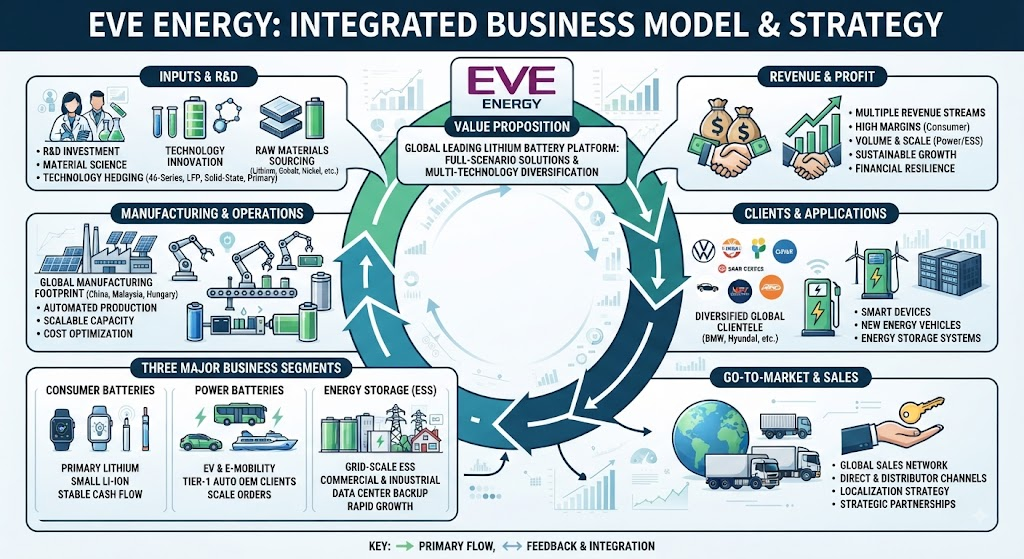
EVE Energy’s business model and strategy center around a “full-scenario lithium battery platform” and “multi-technology route hedging,” capturing revenue and profit through precise market positioning and a flexible global footprint.
1. Core Business Model
EVE Energy does not rely on a single product or a single track, instead achieving commercial monetization through a product portfolio spanning multiple sectors:
- Three Major Business Segments:
- Consumer Batteries: Includes primary lithium batteries and small lithium-ion batteries (such as button cells) applied in IoT, smart wearables, and electronic atomizers, providing stable cash flow and high gross margins.
- Power Batteries: Supplies new energy passenger vehicles and electric ships, securing large-scale orders by entering the supply chains of top-tier international automakers (such as BMW and Hyundai-Kia).
- Energy Storage Batteries: Provides large cells and system integration solutions for large-scale power stations, commercial and industrial sectors, and residential storage, scaling rapidly by benefiting from the global energy transition and data center demand.
- Diverse Technology Routes (All-around Technology Supermarket): Simultaneously deploys large cylindrical (46 series), prismatic, pouch, lithium iron phosphate (LFP), and solid-state batteries, thereby diversifying the risks of a single technology failure or market shift.
2. Core Development Strategies
- “Dual-Track” and Global Layout Strategy: Focuses on the dual tracks of power and energy storage while actively advancing the “global manufacturing, global service” strategy by establishing overseas bases in Malaysia, Hungary, and other regions to serve international clients locally and circumvent trade barriers.
- CLS Cooperation Model (Cooperation, Localization, Service): Exports manufacturing capabilities and solutions through capital and technical cooperation with outstanding overseas enterprises, lowering overseas expansion risks.
- Refined Quality-Efficiency and Shipment-Oriented Approach: Facing intense industry price wars and “involution” environments, the company’s strategy has shifted from purely pursuing scale to focusing on shipment growth and manufacturing process optimization, ensuring financial robustness and competitive resilience during profit compression periods.
Source:
- https://www.evebattery.com/about
- https://en.wikipedia.org/wiki/EVE_Energy
- https://battery-tech.net/battery-markets-news/eve-energy-forecasts-h1-profit-surge-of-95-to-110/
- https://www.huxiu.com/article/4851990.html
- https://www.tycorun.com/blogs/news/top-10-power-battery-cell-manufacturers
- https://source.benchmarkminerals.com/article/who-were-the-top-cell-suppliers-in-the-bess-market-in-h1-2025
Back to EVE Energy