
Corporate History
Formation and Consolidation (2000–2006)
- Formed in September 2000 via the merger of the Amsterdam, Brussels, and Paris stock exchanges to create a unified European trading venue following the adoption of the euro.
- Expanded in 2002 by acquiring the London International Financial Futures and Options Exchange (LIFFE) and integrating the Lisbon Stock Exchange (Bolsa de Valores de Lisboa e Porto).
The Transatlantic Era (2007–2013)
- Merged with the New York Stock Exchange in 2007 to form NYSE Euronext, the world’s first transatlantic exchange group.
- Acquired by Intercontinental Exchange (ICE) in late 2013; ICE retained the LIFFE derivatives franchise and spun off Euronext’s continental European operations.
Independence and Pan-European Expansion (2014–Present)
- Completed an initial public offering (IPO) as an independent entity in June 2014.
- Rebuilt scale through programmatic acquisitions: the Irish Stock Exchange (Euronext Dublin) in 2018, Oslo Børs VPS and power exchange Nord Pool in 2019–2020, and Borsa Italiana Group in 2021 for €4.4 billion.
- Migrated acquired exchanges onto its proprietary Optiq trading platform, relocated its core data center to Bergamo (Italy), and internalized clearing through Euronext Clearing.
Business Model and Strategic Plan
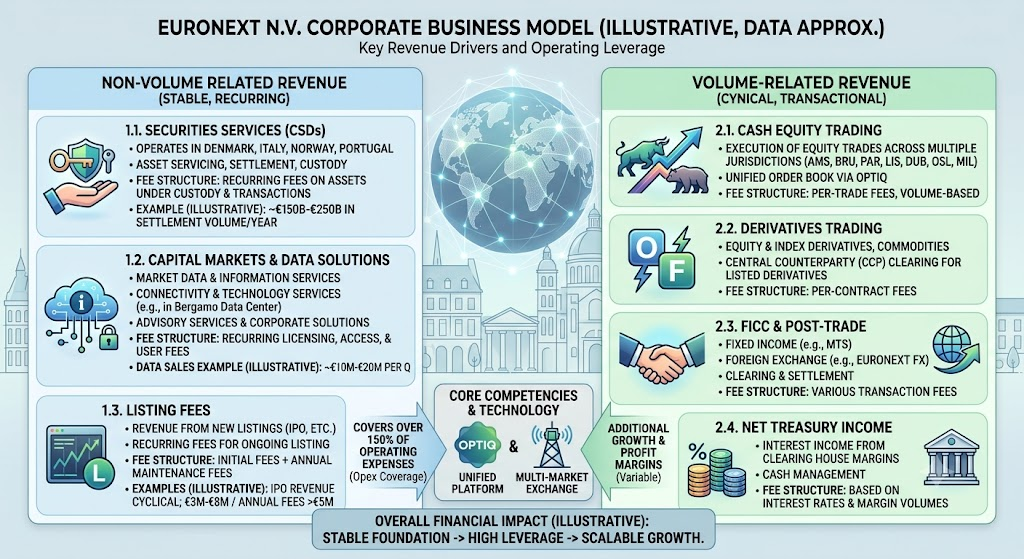
Euronext operates as a diversified financial market infrastructure provider, monetizing liquidity flow, asset servicing, and market intelligence across the capital markets lifecycle. Its revenue is split into two primary segments:
- Non-Volume Related Revenue (approximately 58% to 60% of total revenue): Provides stable, recurring top-line cash flow that covers over 150% of underlying operational expenses.
- Securities Services (CSDs): Euronext Securities operates settlement and custody across Denmark, Italy, Norway, and Portugal, charging recurring fees based on assets under custody and settlement transactions.
- Capital Markets & Data Solutions: Generates recurring licensing fees from market data distribution, real-time proprietary feeds, colocation/connectivity in the Bergamo data center, and SaaS corporate governance software.
- Listing Fees: Collects initial admission fees from primary corporate, ETF, and bond issuers, alongside recurring annual maintenance fees.
- Net Treasury Income: Accrues interest income from collateral and cash balances maintained within Euronext Clearing.
- Volume-Related Revenue (approximately 40% to 42% of total revenue): Driven by activity levels across asset classes.
- Cash Equity and Derivative Trading: Levies transaction-based fees on equity, ETF, warrants, and derivative trades executed across its venues.
- FICC Markets & Clearing: Charges clearing and execution fees across fixed income (MTS), foreign exchange (Euronext FX), and energy/commodities (Nord Pool power spot and agricultural futures).
Under the “Innovate for Growth 2027” strategic plan, Euronext targets a compound annual revenue growth rate (CAGR) and adjusted EBITDA CAGR above 5% (2023–2027E). Its capital deployment strategy combines a strict 50% net income dividend payout ratio, selective share buybacks (€300 million program executed in 2024–2025), targeted CAPEX of 4% to 6% of revenue, and balance sheet leverage maintained at 1.0x to 2.0x net debt-to-adjusted EBITDA to support disciplined M&A.
Sources for Business Model Information
- https://www.euronext.com/en/about/media/euronext-press-releases/euronext-announces-its-new-strategic-plan-innovate-for-growth
- https://www.euronext.com/en/media/12608/download
- https://www.euronext.com/en/innovate-for-growth-2027
- https://www.euronext.com/en/investor-relations/financial-information/news/euronext-announces-its-new-strategic-plan-innovate
AI Strategy, Budget, and Partnerships
Euronext positions Artificial Intelligence as a horizontal operational enabler within its “Innovate for Growth 2027” strategy rather than a consumer-facing product line.
- Strategic Execution and Use Cases: The exchange applies AI across three internal domains:
- Market Analytics and Surveillance: Implemented conversational AI agents to parse high-volume trading datasets, accelerating market share analysis, outlier detection, and anomalous flow tracking.
- Software Engineering Lifecycle: Incorporates code-generation models to accelerate development, modernize testing, and minimize technical debt on core architectures like Optiq.
- Operations & Automation: Automates document processing in listing applications, post-trade reconciliations, and compliance monitoring under stringent European financial market directives.
- Partnerships and Technical Infrastructure: Euronext partnered with enterprise data intelligence provider Dataiku, implementing its LLM Mesh framework. This allows Euronext analysts, engineers, and data scientists to build governed AI workflows that query internal databases while maintaining enterprise audit trails and preventing tool fragmentation. Internal analytics deployments using Dataiku AI agents demonstrated up to a 20% reduction in analyst time spent on recurring market share and performance queries.
- Budget and Capital Allocation: AI investments are funded through the group’s ongoing capital expenditure program, which allocates 4% to 6% of annual revenues (translating to roughly €70 million to €100+ million annually across IT, platform engineering, and data systems). Euronext prioritizes targeted, software-defined enterprise pilots that achieve direct operational cost synergies and improve employee productivity across its seven national jurisdictions.
Back to Euronext