
Company History
Foundation and Patented Beginnings (1987-1996)
Eurofins was founded in Nantes, France, by Gilles Martin to commercialize Site-Specific Natural Isotope Fractionation Nuclear Magnetic Resonance (SNIF-NMR), a patented chemical analysis method used to detect whether wine and sugar had been adulterated. During this initial phase, the business remained a specialized boutique testing laboratory focused predominantly on beverage authenticity.
IPO and Initial European Geographic Expansion (1997-2004)
The company completed its initial public offering on the Paris stock exchange in 1997. Eurofins utilized the IPO proceeds to initiate an aggressive buy-and-build strategy across Western Europe, diversifying its capabilities beyond wine analysis into broad food safety, agrochemical testing, and environmental compliance laboratories across Germany, the UK, and Scandinavia.
Global Scale and Multi-Sector Diversification (2005-2019)
Eurofins expanded internationally into North America, South America, and the Asia-Pacific region. It completed major acquisitions to establish dedicated divisions in biopharma product testing, discovery pharmacology, and clinical diagnostics. During this period, the group constructed major centralized testing hubs (Hub-and-Spoke model) to drive economies of scale for routine high-volume diagnostics.
Pandemic Surge, Reinvestment, and Maturity (2020-Present)
During the COVID-19 pandemic, Eurofins delivered unprecedented volumes of PCR testing and reagents, generating windfall cash flows that were channeled into debt reduction, laboratory automation, and modernizing proprietary IT architecture. Post-pandemic, the firm pivoted back to core testing, rationalizing legacy cost structures, resolving short-seller scrutiny over related-party assets, and expanding digital and AI-assisted bio-testing platforms.
Business Model and Strategy
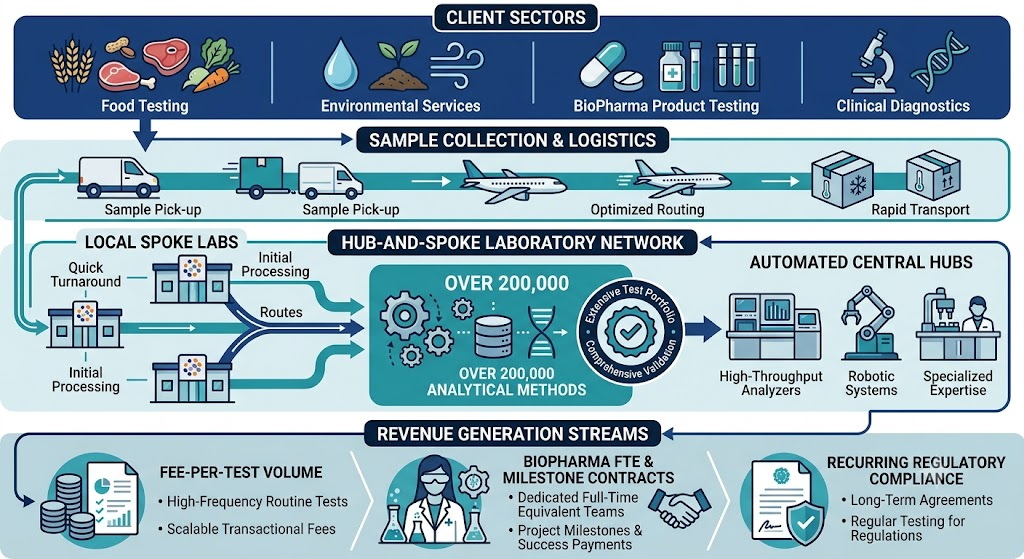
Eurofins makes money by selling specialized laboratory testing, characterization, regulatory compliance validation, and contract research services to corporate, agricultural, healthcare, and government clients. Its monetization engine does not depend on single-product manufacturing; instead, it relies on recurring analytical volume and fee-per-sample pricing models.
Revenue Streams and Value Generation
- Volume-Based Fee-per-Test: Eurofins charges clients per sample processed across food safety (e.g., pathogen detection, pesticide residue testing), environmental monitoring (water, air, and soil contaminants), and clinical diagnostics.
- Specialized High-Margin BioPharma Contract Services: The BioPharma Product Testing and Discovery Services divisions charge biopharmaceutical clients on a milestone, full-time equivalent (FTE), or high-throughput screening project basis for drug discovery, clinical-trial batch release, and stability testing.
- Recurring Regulatory and Compliance Programs: Multinational consumer and industrial enterprises contract Eurofins on multi-year analytical service agreements to maintain international food standards, environmental permits, and pharmacopeia compliance.
Cost Dynamics and Operating Leverage
- Hub-and-Spoke Operational Infrastructure: Routine, commoditized samples are collected by local satellite labs (spokes) and transferred overnight to large, heavily automated campus laboratories (hubs). This drives asset utilization, minimizes labor per sample, and lowers unit processing costs.
- Financial Performance Indicators: The business converts high analytical volumes into stable operating leverage. For H1 2026, Eurofins reported total revenues of €3,701m (organic growth of 2.7%), with an Adjusted EBITDA margin reaching 23.7%, tracking toward its mid-term target objective of 24% Adjusted EBITDA margin.
- Decentralized Entrepreneurial Governance: Individual laboratory directors are incentivized based on return on capital employed (ROCE) and EBITDA of their specific business units, aligning executive management compensation with localized margin expansion and customer retention.
Business Model Sources
- https://www.eurofins.com/en/investors/
- https://www.businesswire.com/news/home/20260722051143/en/Eurofins-Makes-Significant-Progress-in-H1-2026-Towards-Its-Mid-Term-2027-Objectives-With-130bps-of-Adjusted-EBITDA-Margin-Expansion-Strong-Cash-Conversion-and-29-EPS-Growth
- https://www.eurofins.com/en/media-centre/press-releases/eurofins-achieves-organic-growth-of-26-in-q1-2026-including-impact-of-exceptionally-severe-weather-2026-and-mid-term-objectives-reiterated/
- https://quartr.com/companies/eurofins-scientific-se_6249
AI Strategy, Investments, and Partnerships
Eurofins treats artificial intelligence not as a standalone software product, but as an operational optimization layer and a data-enhancement capability embedded directly inside its analytical laboratories.
Strategic Focus Areas
- Automated Data Interpretation and Chromatographic Review: Eurofins processes millions of chromatography, mass spectrometry, and genetic sequencing readouts annually. The group deploys proprietary machine learning models to automatically validate baseline chromatography peaks, identify anomalies, and filter out false positives, eliminating hours of manual review by analytical chemists.
- Predictive Testing and Molecular Property Prediction: Through its Discovery Services segment, Eurofins utilizes machine learning algorithms to predict early-stage ADME-Tox (absorption, distribution, metabolism, excretion, and toxicity) profiles of candidate drug molecules directly from chemical structures prior to physical synthesis.
- Smart Laboratory Logistics and Robotics Integration: AI-driven dispatch and scheduling engines dynamically allocate sample processing queues across automated liquid handlers and testing machines in centralized hub campuses, flattening turnaround time bottlenecks.
Budget and Resource Allocations
Eurofins incorporates AI investments into its broader digital transformation and internal software development budget, which typically commands over €150m-€200m annually in IT capital expenditure and operational software modernization. Rather than licensing monolithic commercial enterprise software, Eurofins allocates a substantial portion of this capital to its in-house software engineering centers (such as its major IT engineering hubs in India and Europe) to maintain proprietary Laboratory Information Management Systems (LIMS) with embedded AI toolsets.
Partnerships and Technology Collaborations
- Cloud and Infrastructure Partnerships: Eurofins partners with major cloud providers (principally Microsoft Azure and Amazon Web Services) to construct enterprise data lakes that aggregate decades of historical testing datasets for model training while ensuring compliance with HIPAA, GDPR, and GxP data integrity standards.
- Life Science and Academic Collaborations: The company engages in joint research projects with academic institutions and specialized biotech AI startups, integrating partner computer-aided drug design (CADD) platforms with Eurofins’ real-world bioassay validation pipelines.
Back to Eurofins