
Equinor’s(formerly Statoil) corporate history is divided into four key stages:
1972-1980s: State Founding and North Sea Oil & Gas Foundation
Founded in 1972 by an act of the Norwegian Parliament as state-owned Statoil to manage newly discovered North Sea oil and gas reserves. Spearheaded the development of giant fields like Statfjord, establishing the foundation for Norway’s modern national energy industry.
2001-2006: Partial Privatization and Global Expansion
Initiated partial privatization in 2001, listing on the Oslo and New York Stock Exchanges(with the Norwegian government retaining majority ownership). Accelerated international exploration and expansion into North America, West Africa, and Brazil.
2007-2017: Merger, Integration, and Energy Giant Growth
Merged with Norsk Hydro’s oil and gas division in 2007, consolidating its dominant position on the Norwegian Continental Shelf and growing into a major global natural gas supplier.
2018-Present: Rebranding and Low-Carbon Transition
Rebranded as Equinor in 2018(combining “Equity” and “Norway”) to mark its transformation from a traditional oil and gas producer into a broad energy company. Actively expanding into offshore wind(such as Hywind floating wind projects), solar energy, and carbon capture and storage(CCS), committing to net-zero carbon emissions by 2050.
Equinor’s business model and development strategy revolve around a dual-track approach of “robust oil & gas cash flows” and “low-carbon energy transition”:
Business Model(Revenue & Monetization Strategy)
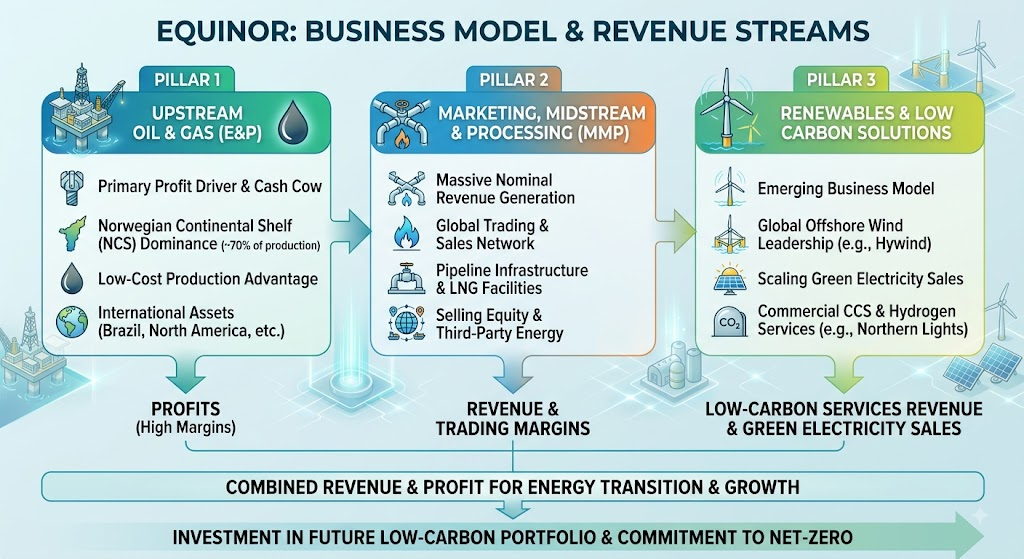
Equinor’s profit structure is primarily composed of three main business segments:
- Upstream Oil & Gas Exploration & Production(E&P Norway / E&P International): The primary profit driver and cash cow. Equinor controls approximately 70% of oil and gas production on the Norwegian Continental Shelf(NCS), benefiting from high economies of scale and low production costs; internationally, it holds high-margin offshore and onshore assets in North America, Brazil, and other regions.
- Marketing, Midstream & Processing(MMP): Generates massive nominal revenue. Through its multinational pipelines, liquefied natural gas(LNG) facilities, and global physical trading network, it sells equity and third-party crude oil, natural gas, and refined products to European and international buyers while earning trading and arbitrage margins.
- Renewables & Low Carbon Solutions: Emerging business model. Generates revenue by operating offshore wind and solar power plants to sell green electricity, as well as providing commercial carbon capture and storage(CCS, such as the Northern Lights project) services charging carbon storage fees.
Core Development Strategy
- Value-Driven Oil & Gas Optimization: Focuses on high profitability and low carbon intensity(Low CO2 Intensity) to continuously develop low-cost, high-return fields while supporting European energy security.
- Scaling Renewables: Leverages its established offshore engineering capabilities to lead the global offshore wind market(including floating wind) to increase green power output and investment returns.
- Pioneering Low-Carbon Technology Value Chains: Commercializes carbon capture and storage(CCS) and hydrogen technologies to help European heavy industries decarbonize, creating long-term revenue streams from low-carbon services.
Source:
- https://www.equinor.com/about-us/our-business-model
- https://www.equinor.com/about-us/strategy
- https://www.youtube.com/watch?v=XreL0ULhj9Y
Back to Equinor